Your cart
(0)
Made to order · dispatched by 24 December

By commission

TeeshaaAll Lighting
which stages of a light are really hand work, which are rightly machine-made, and the questions to ask any maker.
Handcrafted lighting means a light whose character-defining stages, such as stone selection and shaping, are done by skilled hands, while machines handle the parts they cut more precisely. Craft lighting, alabaster lighting included, is usually a mix of both, and the way to tell is to ask a maker which stage is which.
Craft lighting means that a person's skill and judgement shape how the finished light looks, not just that a person touched it. A worker who feeds a machine and a worker who selects a stone block and shapes it by eye are doing different jobs, though both could be called "handmade".
The terms are used loosely. "Hand-finished" can mean a mass-produced body with a final polish, and "handcrafted" on a label does not show what was done by hand. So look at stages, not slogans.
Original lighting is a separate question: an original design can be machine-made, and a handmade copy is still a copy. For one Teeshaa light from start to finish, read designed in Bangalore: how an alabaster light is made.
In a stone light, choosing the block, shaping it and finishing the surface decide how it looks, so ask first who does those stages. Cutting metal and wood parts by CNC and making LED electronics in factories are rightly machine work.
Teeshaa's About page lists the stages a piece passes through: design, stone selection, shaping, finishing, engineering, wiring, assembly and inspection. The Design Labs page, which covers Teeshaa's development and manufacturing division, adds the hand and machine detail used in the table below, and ends with final inspection and packing against the approved specification. For a specific piece from the collection, ask the studio for the split.
| stage | hand or machine | what to look for |
|---|---|---|
| stone selection | Hand. Design Labs selects each block by hand | The stone reviewed unlit and lit, not only unlit |
| shaping | Hand. Design Labs has blocks cut and worked by hand by trained artisans | Even walls and clean, continuous curves |
| finishing | Ask the maker. Teeshaa lists finishing as a stage, without a general hand or machine split | A consistent surface with no rough patches at edges |
| metal and wood components | Machine, then fabrication. Design Labs uses CNC cutting and custom metal fabrication in-house | Crisp edges and tidy joints where metal meets stone |
| LED modules and drivers | Machine. Factory-made electronics | Driver position (canopy or remote) and dimming stated on the product page |
| wiring, assembly and testing | Ask who does it. In-house at Design Labs | Tidy wiring, a piece that lights up and hangs true |
You often cannot prove hand work from a finished piece, because natural stone varies even when it is machine-cut. Look for variation that suits the material and care at the joints, then ask the maker.
The Teeshaa material page shows what the stone itself can do.
Natural clouding, veining and mineral inclusions in the stone are variation. A manufacturing defect is a fault in how the piece was made or assembled. Teeshaa's returns policy treats them differently: natural variation is not a defect.
Returns are accepted only if a piece arrives damaged or has a manufacturing defect, reported within 48 hours of delivery with clear photographs or videos. Custom-made, made-to-order and specially commissioned pieces are not eligible for returns, exchanges or refunds. Read the full terms in the refund policy before you order.
The warranty draws the same line. Every Teeshaa light carries a one-year warranty against manufacturing defects, covering the whole light. It does not cover physical damage, water or humidity damage, or damage caused by an installation done by anyone other than Teeshaa's team. You may use your own electrician, but then the installation cannot be guaranteed.
Care for Teeshaa's alabaster is gentle: use a soft, dry or lightly damp cloth, avoid harsh chemicals and abrasive cleaners, and follow the care guide supplied with the piece. See the care page.
Ask who made it, where, which stages are by hand, and what happens if something is wrong. A maker who can answer those plainly is easier to trust than one who relies on the word "handcrafted".
If you are briefing a maker, how to brief a lighting maker goes further, and lighting sample approval explains how samples are judged.
Crafted lamps trade sameness for individuality and usually take longer to arrive. Mass-produced lighting offers identical units and quicker supply. What you want from the piece decides it.
| factor | handcrafted | hand-finished claim | mass-produced |
|---|---|---|---|
| variation | Differs piece to piece, especially in natural stone | Depends on the body; ask which step was by hand | Units are designed to be identical |
| repairability | Ask the maker what can be repaired and by whom | Ask the seller | Often by replacing a part or unit; ask the seller |
| lead time | Often longer; Teeshaa made-to-order is typically 3 to 4 weeks | Varies | Often short, from stock |
| returns | Made-to-order pieces are often not returnable; at Teeshaa they are not | Read the seller's policy | Often returnable; read the seller's policy |
For how stone-led lighting reads as art, see sculptural lighting: when light is art.
Teeshaa's lights are made in Spanish alabaster, with one exception: the Pebble Lamp pairs alabaster with black Gorara stone. Pieces are designed in Bangalore and made in Teeshaa's own facilities in India. The Linea Pendant and the Essenzo Porcini Table Lamp are among those you can order online, while the Halo Crown Chandelier mixes a ready-to-order 60 cm Small with larger rings on enquiry.
If you want a lamp or chandelier in another material, Teeshaa Design Labs develops lighting in wood, metal, stone, crystal and glass to a brief, including one-off pieces. Share a drawing or a reference through the Design Labs page and the team confirms what is possible.
The About page lists the stages, the alabaster lighting hub collects the range, and the contact page books workshop visits.
In everyday use, the three words overlap, and none of them works as a specification. Handmade stresses that hands did the work, handcrafted adds skill and judgement, and artisanal suggests small-scale making. Ask which stages are done by hand and which by machine, because the label will not tell you.
Not as a blanket rule. Durability depends on the material, the construction, the wiring and how the piece is installed and cared for, whether it is made by hand or machine. Check the warranty wording, its exclusions, and how joints and wiring are handled. Teeshaa's one-year warranty covers manufacturing defects only.
Natural stone varies from block to block in clouding, veining and mineral inclusions, and hand finishing adds small differences of its own. With Teeshaa's Spanish alabaster, no two pieces are the same, and the returns policy does not treat natural variation as a defect. Sections of multi-part pieces are matched for colour, clouding and transmission.
Members of the Teeshaa trade programme can request alabaster and finish samples against an active project. If you are buying for your own home, ask the studio what is possible for your piece. Seeing the stone matters because it looks different unlit and lit.
Yes, by appointment. Teeshaa's design studio and workshop are in Bangalore. It is not a retail showroom, and there is no showroom in any other city. Book through the contact page, on +91 98454 77300 or at info@teeshaa.in.
Last updated 6 November 2026.
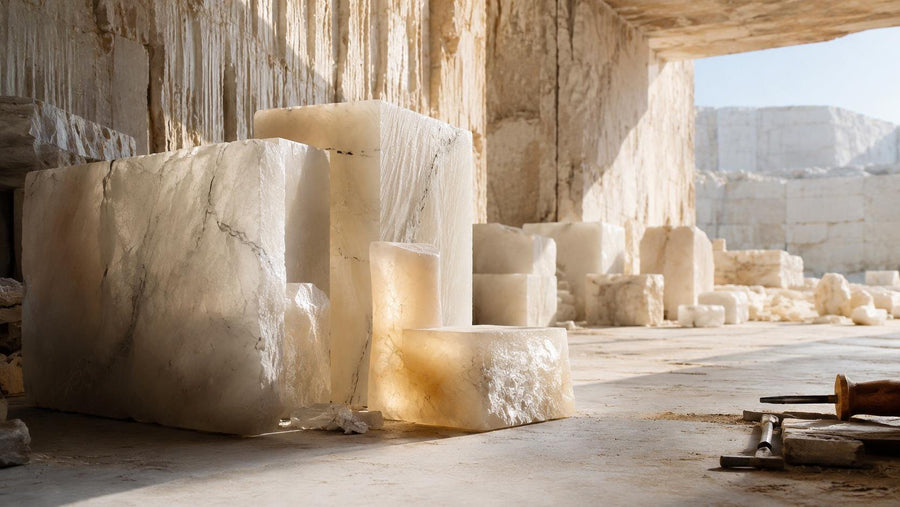 Designed in Bangalore: How an Alabaster Light Is MadeFrom Aragon quarry block to lit piece: selection, matching, carving, thickness, LED and assembly, plus a checklist fo...Read the guide
 What Is Alabaster, and Why Does It Glow?Alabaster is a translucent gypsum stone. Why it glows from within, why no two blocks match, how thickness changes the...Read the guide
Ask the team which stages of a piece are done by hand, or book a visit to the Bangalore studio and workshop.