Your cart
(0)
Made to order · dispatched by 18 November

By commission

From Aragon quarry block to lit piece: selection, matching, carving, thickness, LED and assembly, plus a checklist for briefing a made-to-order piece.
How are alabaster lamps made? A block of Spanish alabaster is quarried in Aragon, reviewed unlit and then lit, cut and shaped until the stone is thin enough to glow and sound enough to hang, then paired with metalwork, an LED source and a suspension cut to the room. Teeshaa designs every piece in Bangalore and controls the stonework, metalwork, engineering and assembly in its own facilities in India. This is how alabaster lamps are made, without the mystique.
From Aragon, in north-eastern Spain, where the Ebro valley is known for translucent gypsum alabaster. Quarry towns around Zaragoza, among them La Puebla de Hijar and Gelsa, have cut this stone for centuries. It is fine-grained, soft at about 2 on the Mohs scale, and it passes light through its full thickness.
Two different stones share the name. Gypsum alabaster, the one Teeshaa uses, is the softer and more evenly translucent. Calcite alabaster, often called Egyptian alabaster, is harder, banded and closer to onyx. Both are sold as alabaster, so when you compare lamps, ask which. The material page covers the geology.
Softness is a trade-off, not a flaw. It lets the stone be carved into thin domes and slender columns, and it means the stone dislikes water and harsh chemicals, which is why the honest answer to "can it go outside" is no.
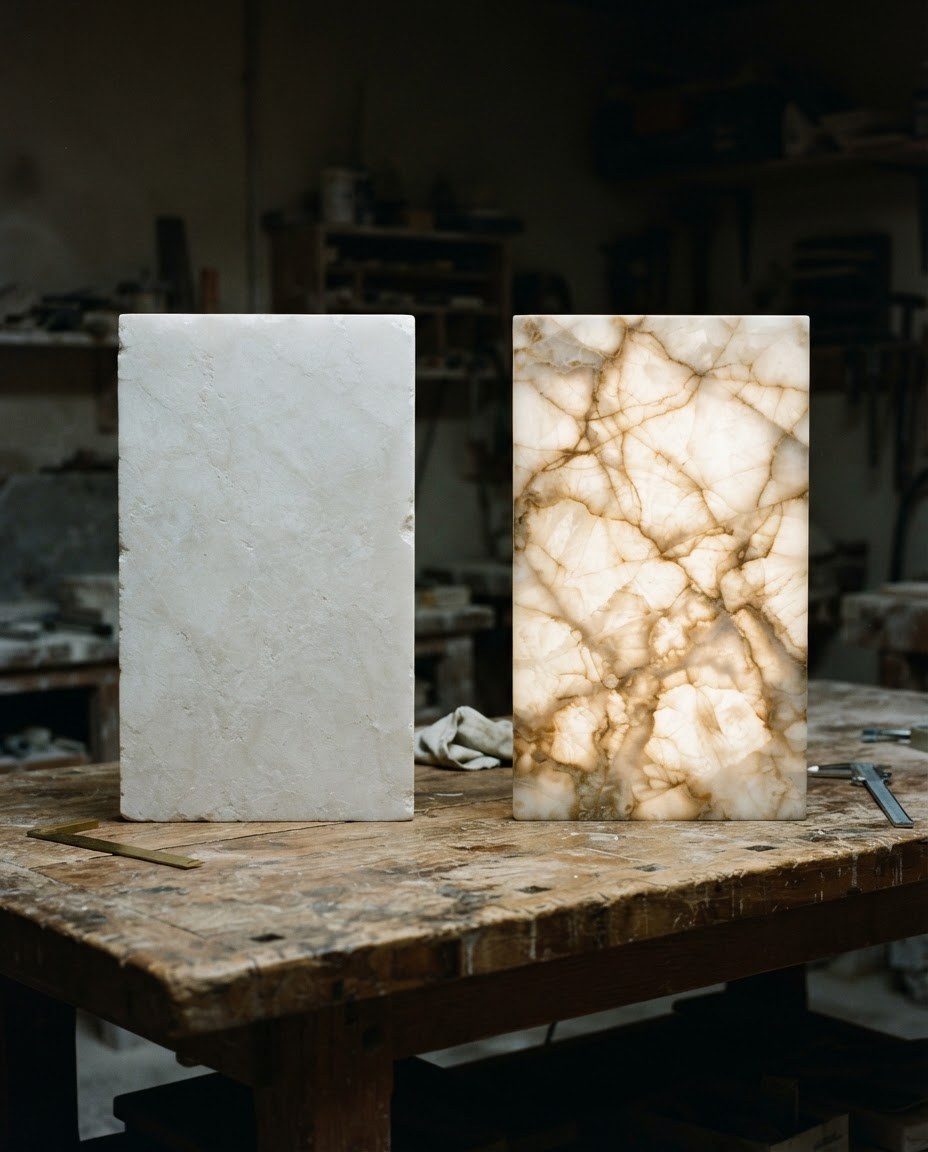
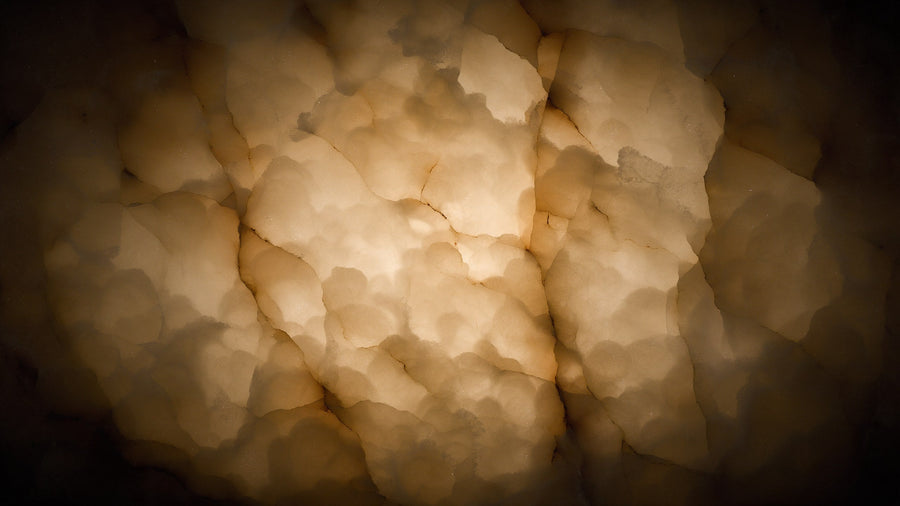
By looking at it twice. First unlit, on the bench, for colour, veining and faults; then lit from behind, for clouding, mineral density and how much light actually passes. A block that looks handsome unlit can be dull when lit, and a plain one can carry the best light. Only the lit view decides.
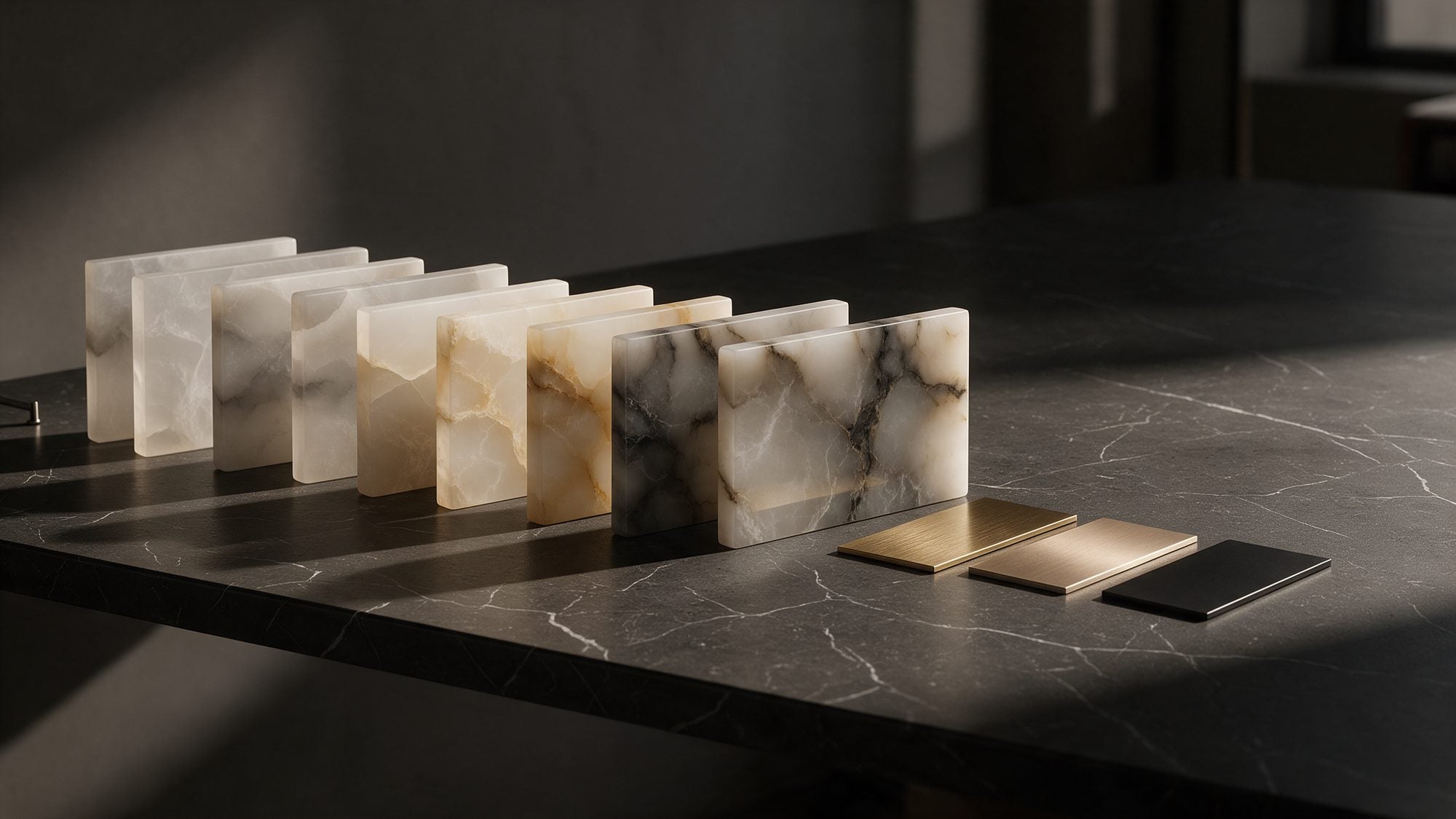
Matching is the slow part. A single pendant can be whatever its block wants to be. A cluster of five domes or a 120 cm ring has to read as one family when lit, so the parts are chosen together for colour, clouding and transmission. Take the Essenzo Pendant Cluster P5, 112 cm (44 in) across: light five domes at once and the eye will find the one that is warmer or cloudier than its neighbours unless they were matched.
This is also why no two Teeshaa pieces are identical, and why a photograph is a guide rather than a promise.
Alabaster is cut from the block, roughed to form and then brought down to its final wall. Every series asks something different of that process. The Linea columns are each carved from a single block, 30 cm tall and 6 cm wide in the small size, so the grain runs unbroken down the piece. The Lunar spheres are hand-carved, 20 or 25 cm across, with a wall that curves in two directions at once.
Thickness is the lever that sets the light. Thinner walls pass more light and show veins as drawn lines; thicker walls hold more cloud and shadow and read warmer and dimmer. The same block, carved to two thicknesses, gives two different lamps. Rings such as the Halo Crown, with a 4 cm tube, are shaped so the ring reads as one continuous band of light.
Metal is the secondary material and does the structural work. Canopies, frames and the stainless rods or wires that carry the piece are handled in-house alongside the stone, and the drop is cut to size. Finishes vary by piece. Most offer Champagne Gold, Brass Gold, Black and White; the Halo ring pieces offer Matte White, Brushed Brass, Antique Brass, Champagne Gold and Matte Black; the Essenzo Dome Wall Sconce is Satin Brass.
Most pieces use an integrated LED, a strip or a PCB, at 2700K, with 2000K, 2300K or 3000K offered on several. A few use E27 lamps: the Essenzo clusters and the Essenzo Dome Wall Sconce, while the Halo Crown is offered with either an LED strip or E27. Dimming is available on request and the driver sits remotely or in the canopy.
Each piece is assembled in Teeshaa's own facilities; by the time it is packed, its stone has been reviewed both unlit and lit. The suspension is cut to size for the room: a stainless rod on most pieces, stainless wire with transparent cable on the Halo rings, with total heights up to 183 cm (72 in) on those rings, so we ask for the finished ceiling height at ordering.
Lead time is typically 3 to 4 weeks for made-to-order sizes and formats, and pieces ship across India and worldwide. The manufacturing parent behind Teeshaa brings five decades of making; the about page tells that story, and the same facilities make lighting for other brands through Teeshaa Design Labs. Workshop visits in Bangalore can be booked by appointment.
If you want to see the process in one object, start with the Alabaster Linea Pendant: a single block, carved to a 30 cm column 6 cm wide, lit from within at 2700K, hung on a rod cut to size with a total drop up to 178 cm (70 in). Nothing hides the stone.
The Lunar Pendant shows the carving. A hand-carved sphere of 20 or 25 cm, in Champagne Gold, Brass Gold, Black or White metal, has to glow evenly over a surface that curves away from the light in every direction. The Halo Crown Chandelier shows the matching: a continuous ring of 60, 80, 100 or 120 cm with a 4 cm tube, where any inconsistency in the stone would show as a bright or dull patch.
The Pebble Lamp shows alabaster against an opaque stone: a hand-sculpted body in black or white stone body with alabaster carrying the light, in three sizes. Translucency, not surface, is the point.
Real alabaster is a natural gypsum stone, quarried in blocks and carved. Many alabaster lamps sold online are cast resin or glass with a printed pattern; they lack depth when lit. A natural piece differs slightly from every other and shows clouding through its thickness.
Designed in Bangalore and made in Teeshaa's own facilities in India, where stonework, metalwork, engineering and assembly are controlled in-house. The alabaster itself comes from Aragon in Spain. Pieces ship across India and worldwide. Workshop visits in Bangalore are by appointment.
Typically 3 to 4 weeks for made-to-order sizes and formats, as stated on product pages. Ready-to-order pieces are listed with their standard sizes and finishes. Large bespoke commissions follow their own programme, agreed at drawing stage.
See the range on the luxury lighting in Bangalore page, or ask about a piece drawn for your room through Bespoke.
 Buying Guides6 min read
What Is Alabaster, and Why Does It Glow?Alabaster is a translucent gypsum stone. Why it glows from within, why no two blocks match, how thickness changes the...Read the guide
 Buying Guides6 min read
Alabaster vs Marble vs Onyx: Which Stone Is Best for Lighting?Which stone is best for lighting? Alabaster glows evenly, onyx shows bold bands, marble belongs in bases. Translucenc...Read the guide
 Material Stories6 min read
Can You Use Alabaster Lighting in a Bathroom?Alabaster belongs at the vanity and dressing area, not above the bath or in the shower. Zones explained, mirror heigh...Read the guide
Teeshaa
Sculptural lighting in Spanish alabaster, designed in Bangalore and made in India. Tell us about the room and we will suggest the piece, the size and the finish.