Your cart
(0)
Made to order · dispatched by 18 November

By commission

Villa lighting room by room: double-height volumes, stairwells, dining, bedrooms, corridors and verandas, with heights, drops and a pre-first-fix checklist.
A villa lighting plan is best written room by room, on the architect's drawings, before the electrician's first fix. Decide the ambient piece for each space and where it hangs, fix the finished ceiling heights and drops, then choose fixtures to fit. Done in that order, a large house gets light that feels inevitable. Done in reverse, it gets a chandelier that fights a fan.
Start with the sections, not the plan. A villa's rooms differ in height far more than an apartment's, from 2.7 m family rooms to 6 m living volumes. Get finished ceiling heights, cove depths and beam positions from the architect before you pick a single piece, and mark every ceiling fan.
Then write one line per room: the ambient fixture, where it centres, its lowest point from the floor, its colour temperature and whether it dims. Teeshaa cuts suspension rods and wires to size, so the drop you write down is the drop you get, but only if it is written down. Decide dimming scenes at the same time; adding them later costs a ceiling.
With a vertical composition sized to the volume rather than a chandelier sized to the floor. A piece 1.5 to 2 m tall, hung so its lowest point is at least 2.1 m from the floor and its upper part is visible from the first-floor landing, fills a 5.5 to 7 m volume without blocking the view across it.
A worked example. Take a 5 m by 6 m living room with a 6 m ceiling. Length plus width is 11 m, about 36 ft, which gives a comfortable footprint of roughly 90 cm (36 in). Nested alabaster rings in a 4 ft format, or a 100 cm ring, suit that footprint; the vertical reach is set by the drop, up to 183 cm (72 in) on the Halo Crown and Halo Ring Style 1; taller drops are a bespoke matter, so the bottom still clears a standing adult.
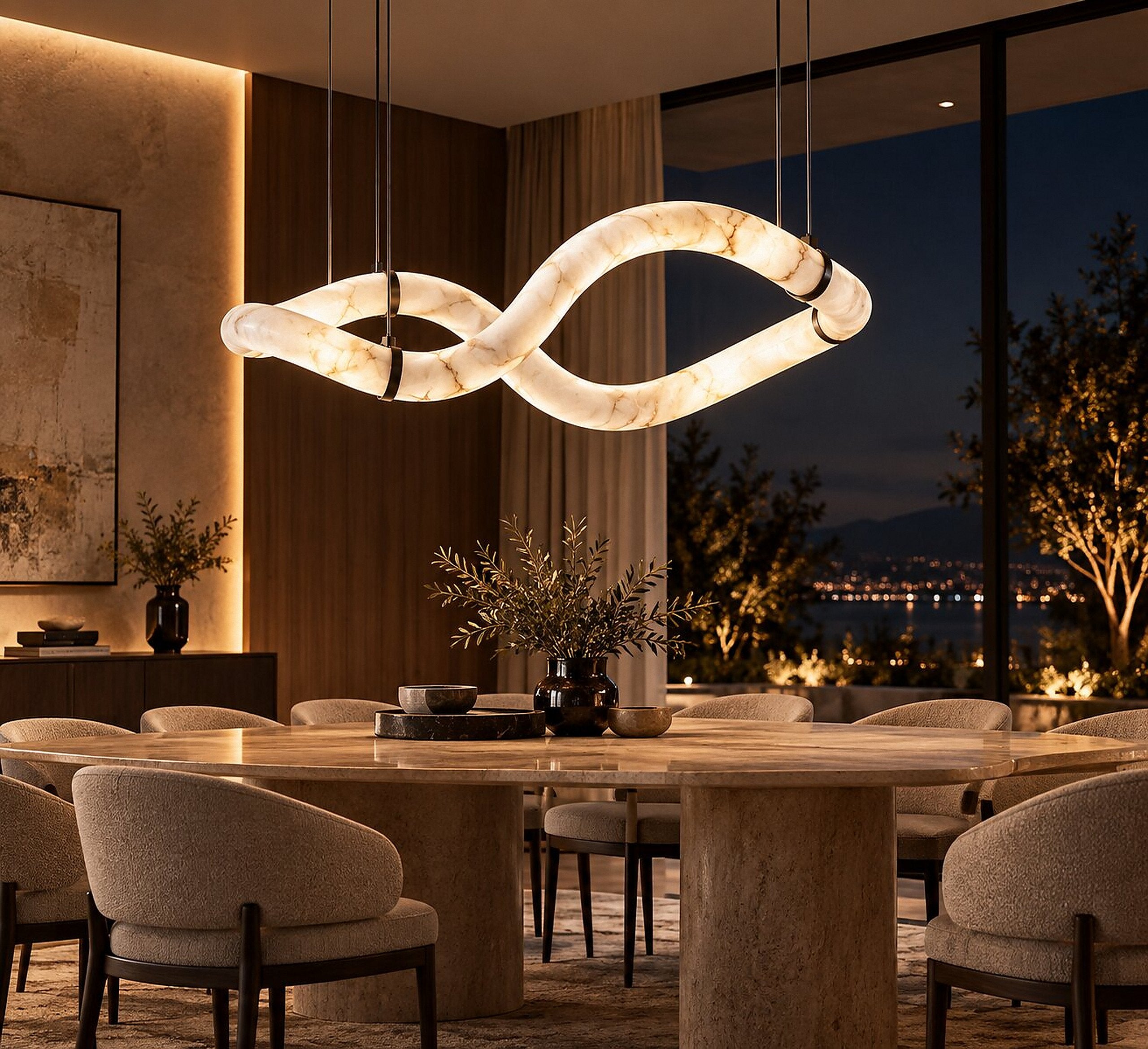
In a stairwell the eye reads the piece from below, from the landing and from the stair itself, so choose a form with no wrong side: spheres at varied heights or a tall ring composition, not a flat disc. Keep the lowest element 2.1 m above the highest tread beneath it and allow a way to clean it. See the guide to staircase and double-height chandeliers.
The dining pendant is the one piece in the house with firm rules. Its bottom sits 75 to 90 cm (30 to 35 in) above the tabletop. Its width is one half to two thirds of the table's width and never wider than the table minus 30 cm. For a 2.4 m by 1.1 m table, a linear piece around 1.6 m long is right; a 60 cm ring is lost in the length, and a 100 cm radial chandelier only works over a wider table. The dining room lighting page has the pieces.
Family rooms in villas tend to have the television, the fan and a 2.7 to 3.0 m ceiling. Give up on a centred chandelier here. Put the ambient light into a cove, add a pair of alabaster wall lights at 150 to 170 cm on the wall opposite the screen, and let a table lamp do the evening.
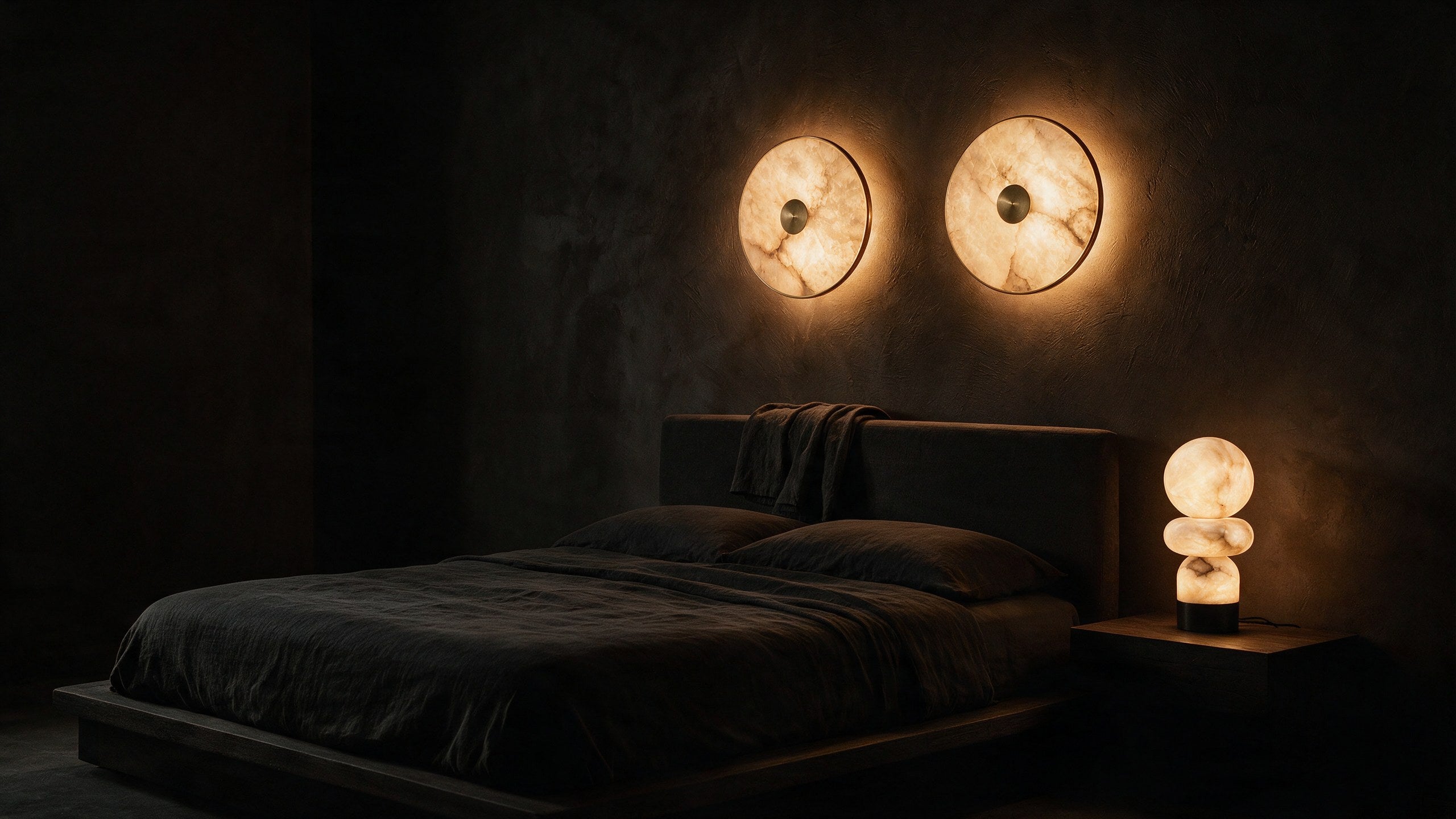
Bedrooms want the warmest light in the house, 2000K to 2300K, and the ability to go very low. Bedside wall lights centre 100 to 120 cm from the floor, about 60 to 75 cm above the mattress top; a pendant used as a bedside light frees the table entirely. Switch each side independently. The options are compared in bedroom lighting.
Villa corridors are long and often without daylight. Alabaster wall lights at 150 to 170 cm, spaced roughly every 2.5 to 3 m, give the passage a soft wash rather than a row of pools from downlights. In dressing rooms, flank the mirror at eye level, 150 to 165 cm, at 2700K or 3000K so clothes read true.
Only under full cover and out of any spray. Alabaster is a soft gypsum stone that dislikes water, so a deep, roofed veranda with no rain path and no pool splash can take a wall light or a pendant; an open terrace, a pool pavilion that gets wet, or anywhere the monsoon reaches cannot.
Light the outside with the garden instead: step lights and uplit trees, all rated for wet locations, and let the lit stone inside the glazing do the welcoming. Indoors, the stone needs only a soft dry cloth; see the care guide.
Choosing a villa's eight or twelve decorative fixtures from one material and one metal finish makes a large house feel like one idea, while varying the form so no room repeats another. Teeshaa works in Spanish alabaster with finishes that vary by piece, most commonly Champagne Gold, Brass Gold, Black and White.
For the double-height living room, the Halo Infinia Chandelier is nested alabaster rings in a 4 ft format, made to order, with presence from below and from the gallery. For the stair, the Vanta Halo Chandelier Vertical is an 80 cm vertical composition, made to order, in Matte White, Brushed Brass, Antique Brass, Champagne Gold or Matte Black.
Over the dining table, the Aura Chandelier is about 100 cm wide and 91 cm high (39.5 by 36 in), radial alabaster shades on a circular frame, offered at 2000K, 2300K or 3000K so it can match the bedrooms' warmth or the living room's. In corridors and dressing rooms, the Alabaster Linea Wall Mount is a slender vertical column that repeats well along a wall.
Add the room's length and width in feet; the sum in inches is a comfortable width. A 5 m by 6 m room gives about 90 cm (36 in). Then choose a piece with height, 1.5 to 2 m, so it reads in the volume, keeping 2.1 m clear beneath it.
2700K for living and dining as the baseline, 2000K to 2300K in bedrooms and bars, 3000K in dressing rooms and kitchens. Keep the whole house within that band and dim everything; mixing warm and cool white in one sightline makes a house feel disjointed.
Not in the open. Alabaster is a soft gypsum stone and is sensitive to water. A fully covered veranda with no rain path or spray can take a piece; a terrace, pool deck or balcony cannot. Use wet-rated garden fittings outdoors and keep the stone inside.
The lighting for villas and farmhouses page gathers the pieces above with sizes and finishes. For a house that wants a piece drawn to its own volume, start a conversation through Bespoke.
 Buying Guides6 min read
Chandelier Size Guide for Indian Living RoomsThe length-plus-width rule for Indian room sizes, how low a chandelier can hang under 2.7 m, sharing a ceiling with a...Read the guide
 Buying Guides6 min read
Bedside Lighting: Wall Lights or Table Lamps?Wall lights, table lamps or a pendant at the bedside: how to choose, with mounting heights, colour temperature, switc...Read the guide
 Buying Guides6 min read
Linear or Round Pendant: Which Suits Your Table?Match the light to the table: linear for long rectangles, round for round and square tables. Length, diameter and hei...Read the guide
Teeshaa
Sculptural lighting in Spanish alabaster, designed in Bangalore and made in India. Tell us about the room and we will suggest the piece, the size and the finish.