Your cart
(0)
Made to order · dispatched by 18 November

By commission

Match the light to the table: linear for long rectangles, round for round and square tables. Length, diameter and height rules with a size table.
Linear pendant vs round pendant comes down to the shape of the table. A linear pendant suits a rectangular table longer than about 1.8 m (6 ft), run to roughly two thirds of the table's length. A round pendant or chandelier suits round and square tables, sized to half to two thirds of the table's width. For a short rectangle either works, and over a bar or island the linear piece usually wins.
About two thirds of the table length. A 180 cm (6 ft) table takes a piece of roughly 110 to 120 cm; a 240 cm (8 ft) table, 150 to 160 cm; a 300 cm (10 ft) table, 190 to 210 cm. Never let the fixture come within 15 cm of either end of the table, or the people at the ends sit with light in their eyes.
Hang the bottom edge 75 to 90 cm (30 to 35 in) above the tabletop. Lower looks more intimate but blocks faces across the table; higher lights the floor instead of the food. In an Indian apartment with a 2.7 to 3.0 m ceiling and a 20 to 30 cm false ceiling cove, that often means a total drop of 0.8 to 1.3 m from the finished ceiling, which is why Teeshaa suspensions are cut to size rather than supplied at fixed lengths.
Width matters less than people think. A linear piece 10 to 20 cm wide sits comfortably over a 90 to 110 cm table; what you are placing is a line of light down the middle, not a canopy.
Whenever the table is round or square, and often when a rectangular table is shorter than 1.8 m. Size the piece to half to two thirds of the table width: a 120 cm round table takes a 60 to 80 cm piece; a 90 cm wide rectangle takes 45 to 60 cm. A round piece over a long table leaves the ends dark and the middle bright.
Round forms also suit rooms where the table is not the only thing in view. A ring or disc reads the same from every seat and from the sofa across an open-plan living and dining room, whereas a linear piece has a right way round. If your dining table sits in the middle of a square room, round is usually the calmer answer.

| Table | Best format | Fixture size (guide) |
|---|---|---|
| Round, 120 cm (4 ft) | One round piece | 60 to 80 cm diameter |
| Square, 140 cm (4.6 ft) | One round piece or cluster | 70 to 90 cm |
| Rectangle, 160 x 90 cm | Round or short linear | Round 45 to 60 cm; linear 100 to 110 cm |
| Rectangle, 180 x 90 cm (6 ft) | Linear, or a row of two | Linear 110 to 120 cm; pendants 60 to 75 cm apart |
| Rectangle, 240 x 100 cm (8 ft) | Linear, or a row of three | Linear 150 to 160 cm; pendants 60 to 75 cm apart |
| Rectangle, 300 x 110 cm (10 ft) | Linear, or a row of three to four | Linear 190 to 210 cm |
| Island or bar, 200 to 300 cm | Linear, or a row of pendants | Two thirds of the length; 75 to 90 cm above the counter |
Choose linear if the table is rectangular and longer than 1.8 m, if the room is long and narrow, or if the piece hangs over an island or bar. Choose round if the table is round or square, if it sits in the centre of a square room, or if you want the piece to read the same from the living area. Choose a row of single pendants if you want the light to follow the table but prefer separate forms, or if a long linear body would fight a ceiling fan on the same ceiling.
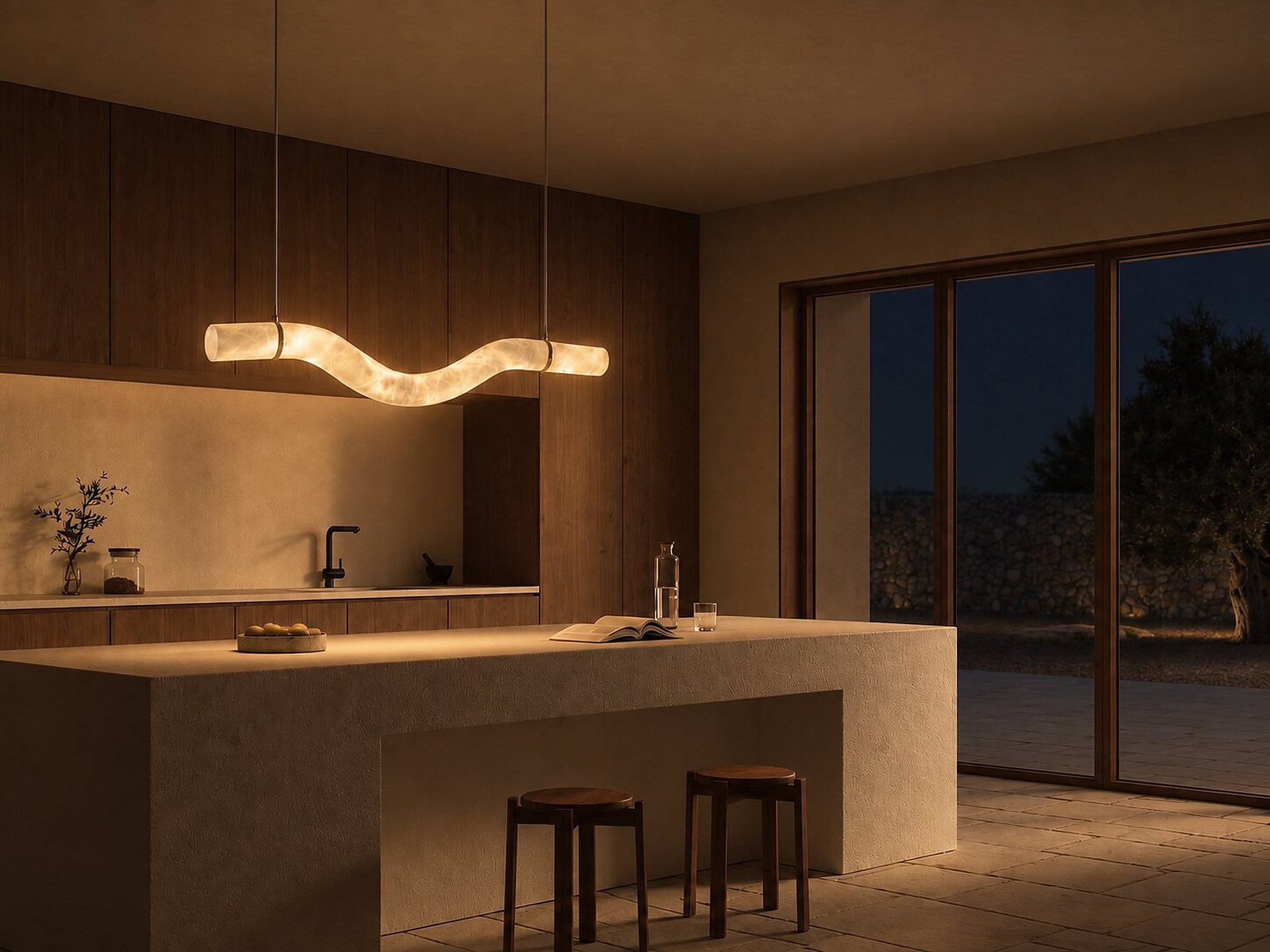
A counter is a line, so light it with a line. Over a kitchen island, keep the bottom of the piece 75 to 90 cm above the counter, 60 to 75 cm between pendant centres if you use singles, and 15 cm in from the island ends. A linear piece does the same job in one body and reads cleaner against open shelving behind it.
At a home bar or a long console, a horizontal composition at the same height gives a band of warm light at face level when people stand. In alabaster the diffusion is complete: there is no lamp image in the bottles or the glass. For counts and spacing over islands, see how many pendants over a kitchen island.
For a rectangular table of 1.8 to 2.4 m, the Essenzo Linear Suspension P4 places four domed alabaster diffusers in a line, each a separate piece of stone, so the light is spread along the table rather than pooled in the middle. It is ready to order online.
The Alabaster Linea H turns the Linea column horizontal: slender columns of lit stone running with the table or counter, each cut from a single block. It suits a long island or a bar as well as a dining table, and is also ready to order.
For a table in a larger room, the Vanta Halo Chandelier Horizontal runs the Halo ring form along 80 cm in the Small format and is made to order in Matte White, Brushed Brass, Antique Brass, Champagne Gold or Matte Black. If the table is round or square, the Essenzo Pendant Cluster P5, 112 cm (44 in) across with five domes on E27 lamps at 2700K, gives a soft round composition that reads the same from every seat.
An 8-seater is usually 240 cm (8 ft) long, so a linear piece of about 150 to 160 cm, hung 75 to 90 cm above the top. A row of three pendants spaced 60 to 75 cm apart does the same job in separate forms.
Yes, if the table is under about 1.8 m long. Size it to half to two thirds of the table width. Over longer tables a single round piece leaves the ends dark; use two round pendants or a linear piece.
75 to 90 cm (30 to 35 in) from the tabletop to the bottom of the fixture, regardless of ceiling height. In a room with a false ceiling that usually means a drop of 0.8 to 1.3 m, which is cut to size on Teeshaa pieces.
See the linear and horizontal pieces together on the linear pendant lights page, with round alternatives under dining room lighting. For how the stone itself shapes the light, read the Material page.
 Buying Guides6 min read
Chandelier Size Guide for Indian Living RoomsThe length-plus-width rule for Indian room sizes, how low a chandelier can hang under 2.7 m, sharing a ceiling with a...Read the guide
 Buying Guides6 min read
Bedside Lighting: Wall Lights or Table Lamps?Wall lights, table lamps or a pendant at the bedside: how to choose, with mounting heights, colour temperature, switc...Read the guide
 Buying Guides6 min read
Lighting a Double-Height Space: Stairwells, Voids and Tall Living RoomsDouble-height lighting is proportion, not brightness: a vertical composition read from two levels, 2.1 m clear over t...Read the guide
Teeshaa
Sculptural lighting in Spanish alabaster, designed in Bangalore and made in India. Tell us about the room and we will suggest the piece, the size and the finish.