Your cart
(0)
Made to order · dispatched by 18 November

By commission

Double-height lighting is proportion, not brightness: a vertical composition read from two levels, 2.1 m clear over treads, and access planned before you buy.
Double height ceiling lighting is a question of proportion, not brightness. In a stairwell, a void or a tall living room, the piece that works is a vertical composition long enough to be read from the landing as well as from below, hung so its lowest point clears 2.1 m (7 ft) above any tread or floor you walk on, with access for cleaning decided before you buy.
Light the volume with one vertical composition that spans the band between 2.1 m above the lower floor and eye level on the upper floor, then add low task light on the treads and landings separately. Trying to light a 6 m void from a single point at the ceiling leaves the stair dark and the ceiling bright.
Think of the space as two rooms stacked. People on the ground floor look up and see undersides. People on the landing look across and see the piece side-on, against a wall or a window. A composition with elements at several heights gives both views something to hold.
Indian villas and duplex apartments commonly run 5.5 to 7 m in a double-height living room or stairwell; the rules below scale down to a 4.2 m room with a mezzanine too.
Keep the lowest point of the fixture at least 2.1 m (7 ft) above the stair tread or floor directly below it, measured from the nosing of the highest tread the piece passes over. Over a landing or an open hall floor the same 2.1 m applies. Over a fixed table or a seating group that nobody walks through, you can go lower.
The trap in a stairwell is that the floor beneath the piece is not flat. A composition centred over the well may clear the ground floor comfortably at its lowest point while its outer elements hang over the third or fourth tread. Measure to the tread, not the floor.
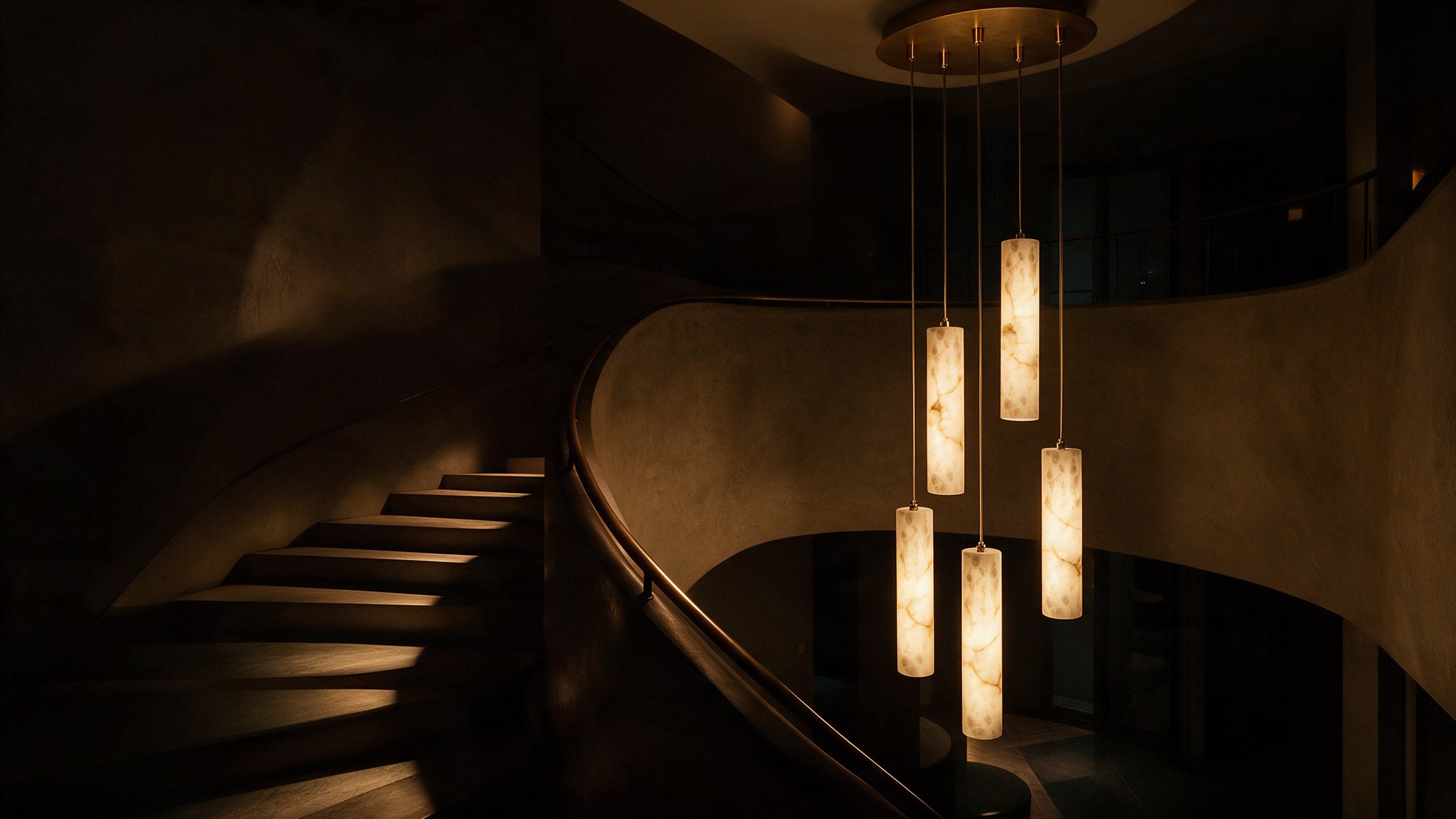
Most designers size the body of a chandelier to the height of the room before the floor area. The table gives a starting range; Teeshaa suspensions are cut to size, so the drop follows your measurements.
| Floor-to-ceiling height | Fixture body height (guide) | Lowest point over a stair or walkway |
|---|---|---|
| 4.5 m (15 ft) | 95 to 115 cm (37 to 45 in) | 2.1 m above the tread beneath |
| 5.5 m (18 ft) | 115 to 140 cm (45 to 55 in) | 2.1 m above the tread beneath |
| 6.0 m (20 ft) | 125 to 150 cm (49 to 59 in) | 2.1 m above the tread beneath |
| 7.0 m (23 ft) | 145 to 175 cm (57 to 69 in) | 2.1 m above the tread beneath |
A worked example. A stairwell is 5.8 m from the ground floor to the ceiling, with the first-floor landing at 3.0 m. The lowest element must sit at or above 2.1 m. Someone standing on the landing has their eyes about 4.5 m above the ground floor. The useful band for the piece is therefore 2.1 to roughly 4.8 m, a visual height of about 2.7 m. The answer is a staggered group, say five spheres or columns spread across 1.8 to 2.2 m of height, with 1.0 to 1.3 m of cable above the top element. A denser single body of 1.3 m would sit well from the landing but look remote from below.
From the landing. This is the view people hold longest, and it is side-on. Elements at eye level, about 1.5 m above the landing floor, do most of the work. Clouding and veining in the stone are visible at this distance.
From below. Looking up, you see the undersides and the canopy. A lamp inside a clear or open shade glares at this angle. Stone that is lit from within glows evenly with no visible source, so the view from the bottom of the stair is calm rather than bright. Keep the cables simple: stainless rod, or stainless wire with transparent cable on the Halo rings.
Plan access before you choose the piece and the drop. Dust settles on the upward faces of rings and spheres, and alabaster is wiped with a soft dry or lightly damp cloth, never a spray cleaner, so someone has to reach it. In most homes that means once or twice a year with a tower or a long ladder on the floor below.
Two choices make this easier: hang the piece so its upper elements are within reach of the landing balustrade, and ask for a remote driver positioned where an electrician can reach it without the tower. The care guide covers the cloth and what to avoid.

For a narrow well where the piece is seen mostly side-on, the Vanta Halo Chandelier Vertical sets the Halo ring language on its vertical axis: 80 cm long in the Small format, in Matte White, Brushed Brass, Antique Brass, Champagne Gold or Matte Black, with the drop set to the room. It is made to order, so send the ceiling height with the enquiry.
For a wider void with views from several floors, the Lunar Series Pendant Lamp P10 groups a larger number of hand-carved spheres, each a different piece of stone; it is made to order, so the arrangement is discussed against the volume. The smaller Lunar P5 does the same with five spheres.
If you want straight lines against a stair, the Alabaster Linea Pendant P5 groups slender columns, each cut from a single block, on stainless rods cut to your lengths; it is ready to order online. For a tall entrance hall that doubles as a stairwell, the nested rings of the Halo Infinia Chandelier in its 4 ft format give a round form that still has depth from above and below.
A vertical composition for the volume, then separate downlights or wall lights for reading and seating. One central point at the ceiling cannot do both jobs. In a 5.5 to 7 m room, a body of 1.2 to 1.8 m with the lowest element well above head height is the usual range.
Long enough that its visual centre sits near eye level on the upper landing, about 1.5 m above that floor, while its lowest point stays 2.1 m above the tread beneath. In a 5.8 m well that is usually 1.8 to 2.4 m of spread with cable above.
Teeshaa suspensions are stainless rod or wire cut to the room, so plan access by position rather than by lowering the piece: within reach of a landing, with the driver placed where it can be reached. A soft cloth once or twice a year is all the stone needs.
See the pieces and drop options together on the staircase and double-height chandeliers page, and for a void that needs a composition built to its dimensions, start with Bespoke. Related guides: foyer and entrance chandeliers and living room chandeliers.
 Buying Guides6 min read
Chandelier Size Guide for Indian Living RoomsThe length-plus-width rule for Indian room sizes, how low a chandelier can hang under 2.7 m, sharing a ceiling with a...Read the guide
 Buying Guides6 min read
Bedside Lighting: Wall Lights or Table Lamps?Wall lights, table lamps or a pendant at the bedside: how to choose, with mounting heights, colour temperature, switc...Read the guide
 Buying Guides6 min read
Linear or Round Pendant: Which Suits Your Table?Match the light to the table: linear for long rectangles, round for round and square tables. Length, diameter and hei...Read the guide
Teeshaa
Sculptural lighting in Spanish alabaster, designed in Bangalore and made in India. Tell us about the room and we will suggest the piece, the size and the finish.