Your cart
(0)
Made to order · dispatched by 19 November

By commission

One diffused pendant per table at 75 to 90 cm, 2000 to 2700K, three dimming scenes and a table-by-table size guide. How to light a restaurant without glare.
Good restaurant lighting design does two things at once. It makes faces and food look warm, and it keeps the light source itself out of the diner's eyes. The most reliable way to get both is a diffused pendant above each table, its bottom 75 to 90 cm (30 to 35 in) above the tabletop, running between 2000K and 2700K and dimmed down as the evening goes on. Everything else in this guide follows from that.
Most harsh dining rooms have the same fault: the light source is visible. Bare filament lamps, clear glass shades and badly aimed downlights all put a bright point in the diner's line of sight, so the eye closes down and the room reads colder than it is. Hide the source and the same wattage feels softer and warmer.
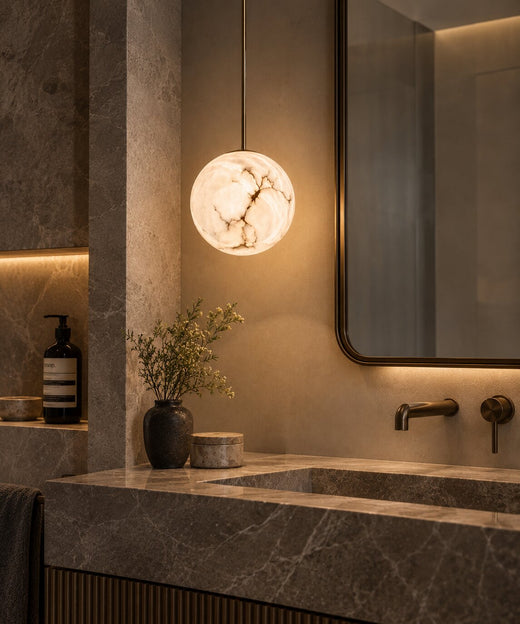
Downlights over tables are the second culprit. Light from directly above puts shadows in eye sockets and flattens a plate; a pendant that glows from the side as well as the bottom lifts faces and gives food its shape. Alabaster does this unusually well. The stone is a fine-grained gypsum that passes light through its full thickness, so a lit pendant has no hot spot, only a soft gradient of clouding and veining. At low output it looks like a candle inside stone. The material page explains why.

Dimmer than almost any first draft. As a rough guide, many designers aim for 50 to 150 lux on the tabletop in an evening fine-dining room, with circulation and walls falling away to half that, and run the whole room between 2000K and 2700K. Casual daytime rooms sit higher and a touch cooler, but rarely above 3000K.
Colour temperature is the part most owners get wrong by default. Builders' LED strip often arrives at 4000K, which turns a sauce grey and a face tired. At 2700K a room reads like evening; at 2000K to 2300K it reads like candlelight. Both flatter alabaster and skin. Ask for CRI 90 or better so red meat, tomato and wine render truthfully, and spend the light where the plates are.
Treat each table as its own small room. The pendant should relate to the table it serves, not to the ceiling grid, and hang so a seated guest can see the person opposite without looking through the shade. The figures below suit a 2.7 to 3.0 m finished ceiling; the home version of the rule is in how high to hang a pendant over a dining table.
| Table | Format | Bottom of shade above tabletop | Notes |
|---|---|---|---|
| Two-top, 60 to 75 cm wide | One small pendant, 15 to 25 cm shade | 75 to 85 cm (30 to 33 in) | Centre it on the table, not on the booth |
| Four-top, 90 cm square or round | One pendant, 25 to 35 cm shade | 75 to 90 cm (30 to 35 in) | Shade no wider than half the table |
| Long table, 2.4 m and over | Linear suspension, or pendants 60 to 75 cm apart | 80 to 90 cm (31 to 35 in) | Linear length about two thirds of the table |
| Round communal, 1.5 m and over | Cluster of three to five pendants | 80 to 90 cm to the lowest shade | Vary the drops by 10 to 15 cm |
| Bar counter | Slender pendants 60 to 75 cm apart | 75 to 90 cm above the counter | Keep 15 cm in from each end |
A restaurant changes mood through the day, and the lighting should move with it. Dimmable drivers cost little at specification stage and a great deal to retrofit, so ask for dimming on every piece; Teeshaa supplies it on request. Then set scenes in this order, with pendants, wall lights and coves on separate circuits.
A bar is a long task surface with a view. It suits slender pendants spaced 60 to 75 cm apart, hung 75 to 90 cm above the counter top; vertical forms do not block the bartender's sightline the way a wide shade would.
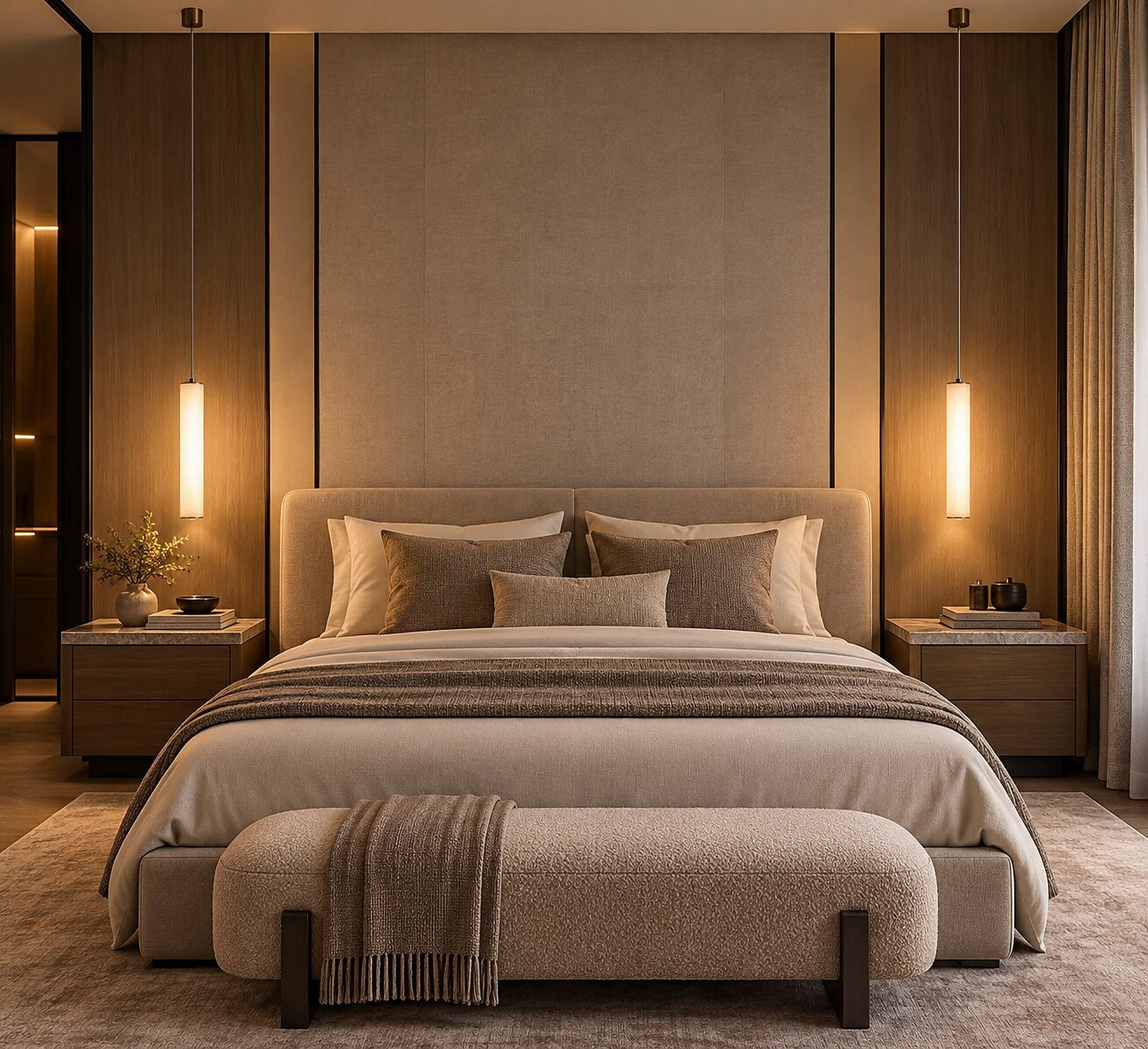
Open kitchens and grills are a different matter. Grease, steam and heat settle on any shade, and alabaster is soft and dislikes water and harsh cleaners. Keep stone over the tables and the bar, use wipeable metal or glass over the pass and cooking line, and clean the stone with a soft dry cloth as the care guide describes.
Plan for repeat orders at the outset. Every block differs, so a pendant ordered two years later will have its own character, so ask for the pendants in a batch to be reviewed together for colour, clouding and transmission. Keep the drawings and finish references from the first phase so later phases can match.
For a room of two- and four-tops, the Essenzo Pendant is the obvious start: a domed shade in Small or Medium, 2700K as standard, hiding the lamp completely so guests see a glowing form rather than a bulb. Hung at 80 cm over each table, a row of them reads as a calm rhythm rather than a feature.
For a long chef's table or communal bench, the Essenzo Linear Suspension P4 puts four domes in a line on a single suspension, so the light runs the length of the table without separate cables. Over a bar, the Alabaster Linea Pendant is a 30 cm column carved from a single block, on a rod cut to the drop you need.
On banquette walls and the corridor to the washrooms, the Aura Wall Mount washes the wall with a soft disc of light at 150 to 170 cm from the floor. Operators planning a restaurant inside a hotel can read the companion guide to alabaster lighting for hotels.
2700K for most dining rooms, 2000K to 2300K for bars and late-night rooms, and 3000K or higher only in kitchens and prep areas. Warm light flatters food and faces; cool light makes both look clinical. Ask for CRI 90 or above.
Bottom of the shade 75 to 90 cm (30 to 35 in) above the tabletop. Lower suits a two-top and a quiet room; higher suits a four-top or a lively one. Guests should see the person opposite without looking through the shade.
Yes, over the dining tables and the bar. Keep stone shades out of the direct steam and grease above the cooking line and pass, where a wipeable metal or glass fixture is the practical choice. Clean the stone with a soft dry cloth.
The restaurant lighting page gathers the pieces above with sizes and finishes, and the trade programme for projects covers samples, drawings and lead times.
 Buying Guides6 min read
Chandelier Size Guide for Indian Living RoomsThe length-plus-width rule for Indian room sizes, how low a chandelier can hang under 2.7 m, sharing a ceiling with a...Read the guide
 Buying Guides6 min read
Bedside Lighting: Wall Lights or Table Lamps?Wall lights, table lamps or a pendant at the bedside: how to choose, with mounting heights, colour temperature, switc...Read the guide
 Buying Guides6 min read
Linear or Round Pendant: Which Suits Your Table?Match the light to the table: linear for long rectangles, round for round and square tables. Length, diameter and hei...Read the guide
Teeshaa
Sculptural lighting in Spanish alabaster, designed in Bangalore and made in India. Tell us about the room and we will suggest the piece, the size and the finish.