Your cart
(0)
Made to order · dispatched by 18 November

By commission

A specifier's guide to alabaster in hotels: zone by zone, how variation is matched across many rooms, the spec checklist, maintenance and lead times.
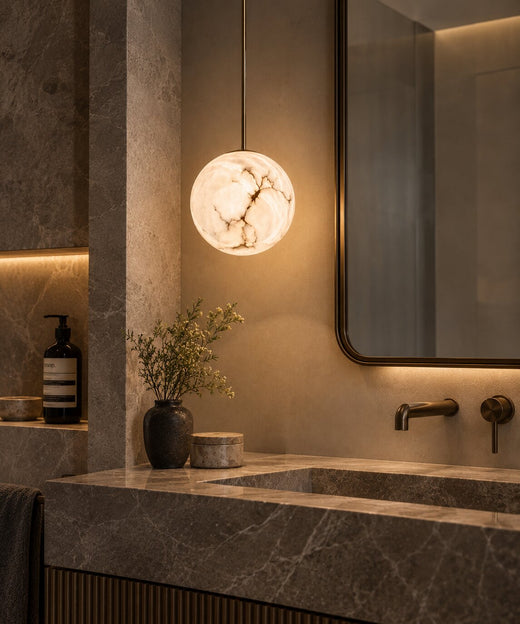
Hotel lighting design with alabaster works zone by zone: one or two signature pieces where guests arrive and gather, repeatable sconces and lamps through corridors and guest rooms, warm colour temperature throughout, and a specification that fixes finish, colour temperature, drop and driver location before procurement. The material is natural stone, so no two pieces are identical; the specifier's job is to decide where that variation is a feature and where it must be held within an agreed range.
Alabaster takes ambient and accent roles: the glowing form that sets the mood of a lobby, the sconce that warms a corridor, the lamp beside the bed. It is not a task light, so pair it with discreet downlights at reception desks, bar counters and work desks.
| Zone | Role | Form | Colour temperature | Note |
|---|---|---|---|---|
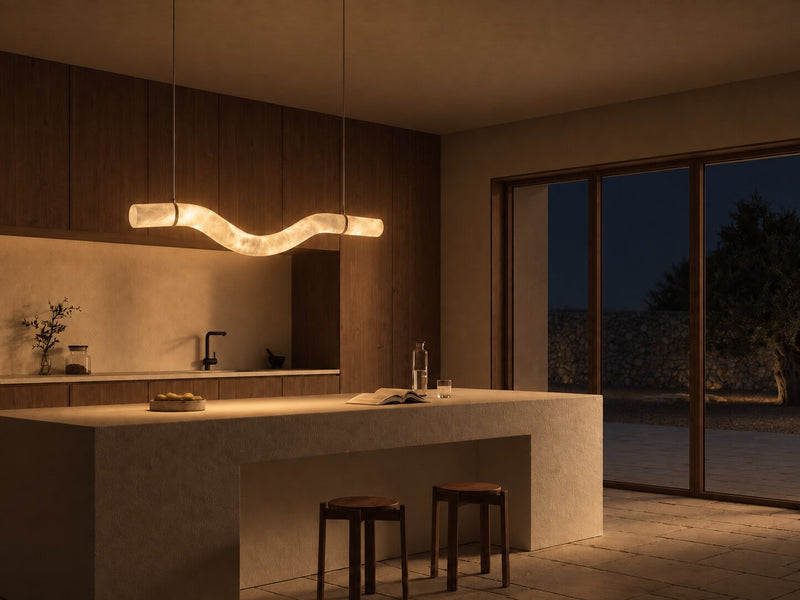
| Arrival and lobby | Signature, ambient | Long or nested suspension over the seating or desk axis | 2700K | Made to order; 2.1 m clearance in walkways; plan access for cleaning |
| Lobby bar | Ambient, intimate | Pendants over the counter, sconces at the banquette | 2000 to 2300K | Dim to 20 to 30 per cent late in the evening |
| Restaurant | Ambient per table | Single or clustered pendants, 75 to 90 cm above tables | 2000 to 2700K | Keep stone away from the open kitchen |
| Corridors | Accent, wayfinding | Sconces centred 150 to 170 cm, spaced 3 to 4 m | 2700K | Repeatable piece; E27 or integrated LED |
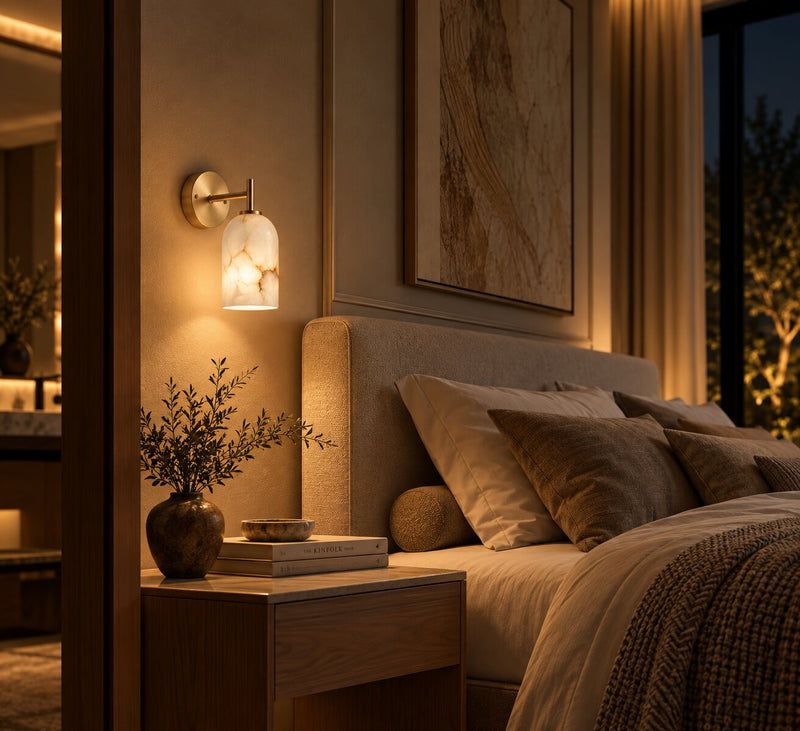
| Guest rooms | Accent beside task light | Bedside sconces 100 to 120 cm from floor; desk or console lamp | 2700K; 2300K on lamps | Dimmable at the bedside; standard lamp changes |
| Suites | Ambient | Small ring or sphere cluster in the living area | 2700K | Ready-to-order sizes where possible |
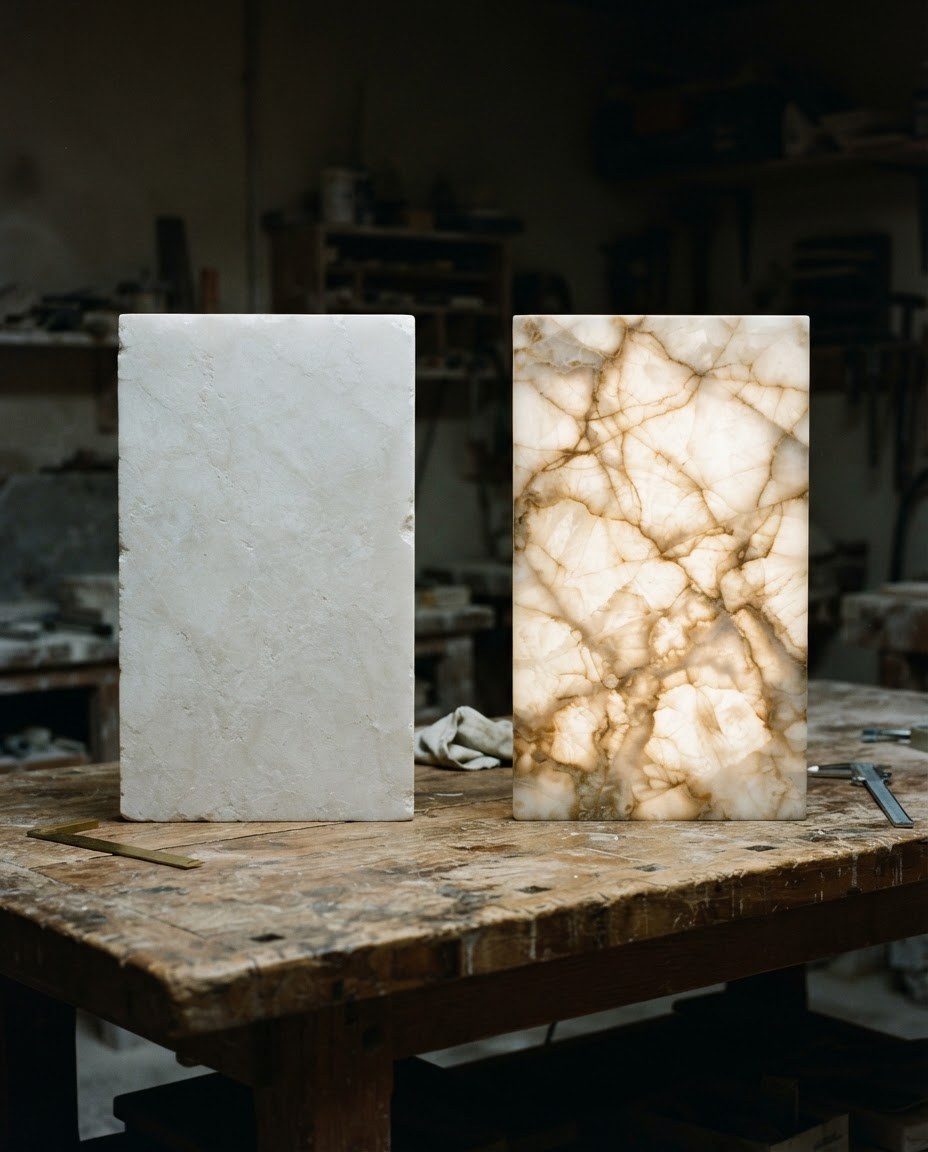
By approving a lit sample as the control and agreeing a range around it, rather than asking for identical pieces, which no natural stone can give. Teeshaa reviews every block unlit and lit and matches multi-part pieces for colour, clouding and transmission. For a programme of many rooms, agree the acceptable range of variation in writing before production.
In practice this means three things in the specification. Keep one installed piece as the lit reference for the snagging walk. State what matters most for each piece: for a corridor run, light transmission and colour; for a bedside sconce, colour against the headboard. And order attic stock with the main batch, so a replacement years later comes from the same selection of stone rather than the next quarry block.
Request samples early through the Trade Programme. Material samples are provided for active projects, and a lit tile held against the headboard fabric settles most questions before drawings are issued.
Enough that procurement can order without a second conversation: the piece, its size variant, finish, light source, colour temperature, dimming requirement, drop, driver location, mounting detail and quantities by zone, plus the care routine for the operator.
With a soft dry cloth for dust and a lightly damp cloth for marks, on a schedule, and nothing else. No sprays, no multi-surface cleaners, no abrasive pads. Alabaster is a soft gypsum stone, around 2 on the Mohs scale, and it is sensitive to water and chemicals, so the routine has to be written into the housekeeping manual rather than left to habit.
Three practical points. Dust gathers on upward faces, so corridor sconces and lobby rings want a monthly wipe. Pieces on E27 lamps, such as the Essenzo Dome Wall Sconce at 25 W maximum, can be relamped by the engineering team as a routine lamp change; integrated LED pieces are long-lived but their drivers should be reachable. And a signature piece in a tall lobby needs its access method decided at design stage: a mezzanine within reach, or a tower and a quiet morning once or twice a year.
Keep stone out of bathroom wet zones and exterior exposure; a porte-cochère or pool bar is not the place for alabaster unless the piece is fully protected from rain and spray.

For a lobby or bar axis, the Halo Nile Chandelier S1 is a long alabaster composition built for a counter or a run of seating, specified by enquiry with the length and drop agreed to the plan. Where the arrival is tall and centred, the Halo Infinia Chandelier nests rings in a 4 ft format and reads from a mezzanine as well as the floor.
For corridors and bedsides, the Essenzo Dome Wall Sconce is the repeatable piece: 27 cm high, 12 cm wide, 20 cm projection, satin brass, one E27 lamp to 25 W at 2700K, hardwired and ready to order. For a quieter vertical mark along a corridor or beside a mirror, the Alabaster Linea Wall Mount is a slender column from a single block. On the desk or console, the Totem Table Lamp at 49 cm tall and 8 W, in 2000K, 2300K or 3000K, gives the room its low warm layer.
2700K as the standard through lobbies, corridors and guest rooms, 2000 to 2300K in bars and dining, and 3000K only where a cleaner read is needed, such as a vanity. CRI 90 or above everywhere guests see skin, food or stone.
Typically 3 to 4 weeks for standard pieces. Signature compositions and large formats are made to order and scheduled with the project; confirm dates through the Trade Programme once quantities are known.
Yes. Signature pieces developed from the architecture go through Bespoke. Volume manufacturing of a brand's own designs in alabaster is handled by Teeshaa Design Labs, the OEM and contract arm.
See the hotel pieces and the ordering route on the alabaster lighting for hotels page. For a signature piece, start with Bespoke; for volume or OEM work, Teeshaa Design Labs; for dining rooms, see restaurant lighting.
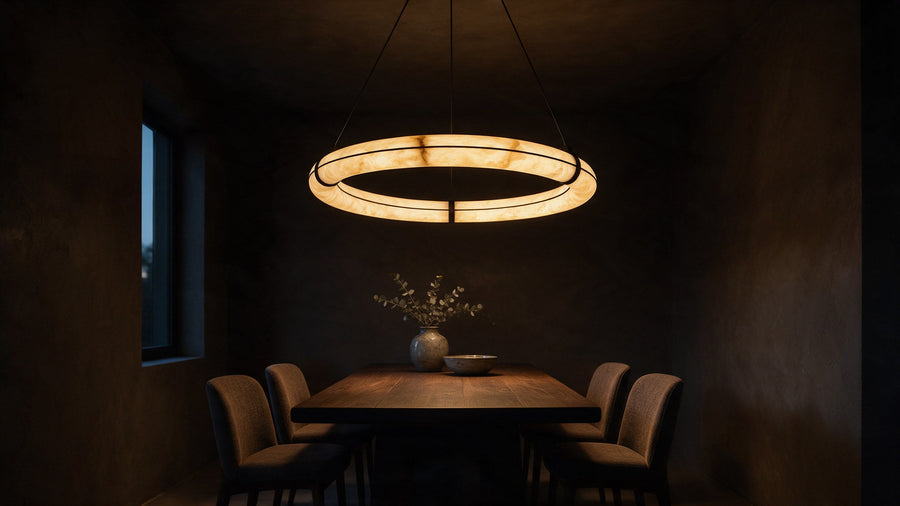 Buying Guides6 min read
Restaurant Lighting Design: Warmth Without GlareOne diffused pendant per table at 75 to 90 cm, 2000 to 2700K, three dimming scenes and a table-by-table size guide. H...Read the guide
 Buying Guides6 min read
Chandelier Size Guide for Indian Living RoomsThe length-plus-width rule for Indian room sizes, how low a chandelier can hang under 2.7 m, sharing a ceiling with a...Read the guide
 Buying Guides6 min read
Bedside Lighting: Wall Lights or Table Lamps?Wall lights, table lamps or a pendant at the bedside: how to choose, with mounting heights, colour temperature, switc...Read the guide
Teeshaa
Sculptural lighting in Spanish alabaster, designed in Bangalore and made in India. Tell us about the room and we will suggest the piece, the size and the finish.