Your cart
(0)
Made to order · dispatched by 18 November

By commission

Size the piece to the foyer, keep 2.1 m clear underneath, centre it on the view from the door and add low warm light at a console. A practical guide.
The best entrance lighting ideas come down to three decisions made in the first thirty seconds someone is inside your door: one piece of light at the right scale for the hall, a low warm layer at a console or on the wall, and nothing that glares at the person walking in. Size the main piece by adding the room's length and width in feet and reading the result in inches, keep 2.1 m (7 ft) clear beneath it, and run everything at 2700K. The rest is placement.
Add the length and width of the hall in feet; the total is a comfortable diameter in inches. A 3 x 3.6 m foyer (10 x 12 ft) gives 22 in, so a piece of 55 to 60 cm. A 4.5 x 4.5 m double-height entrance (15 x 15 ft) gives 30 in, about 75 to 80 cm, and because the ceiling is tall the body should be taller too.
Height works the other way round. Most designers allow 6 to 8 cm of fixture body for every 30 cm of ceiling height (2.5 to 3 in per foot), as long as the clearance rule below still holds. With a 2.9 m ceiling that is a body of 60 to 75 cm; with a 5.5 m double-height void it is 115 to 140 cm. See lighting a double-height space for the tall version.
| Foyer size | Ceiling height | Diameter (guide) | Body height (guide) |
|---|---|---|---|
| 2.4 x 3.0 m (8 x 10 ft) | 2.7 to 2.9 m | 45 to 50 cm | 45 to 55 cm, limited by clearance, or sconces |
| 3.0 x 3.6 m (10 x 12 ft) | 2.9 to 3.2 m | 55 to 60 cm | 60 to 75 cm |
| 3.6 x 4.5 m (12 x 15 ft) | 3.2 to 4.0 m | 65 to 70 cm | 80 to 100 cm |
| 4.5 x 4.5 m (15 x 15 ft), double height | 5.5 to 6.5 m | 75 to 80 cm | 115 to 160 cm |
At least 2.1 m (7 ft) from the floor to the lowest point of the piece wherever people walk. If the front door swings inward beneath the fixture, check the arc of the top edge of the door against the drop before the electrician fixes it. With a 2.9 m ceiling that leaves 80 cm for canopy, cable and body together.
In a double-height entrance the number changes. The visual centre should sit near eye level from the landing or stair, about 1.5 m above that floor, so the person coming down meets the stone rather than its cable. Teeshaa suspensions are cut to size, so the drop is set to your hall.
Stand in the open doorway and look in. Whatever sits on the axis of that view is what the hall is about. If the ceiling point is off that axis, move the point or ask your electrician about an offset canopy; a chandelier that is 40 cm off the view from the door looks like a mistake every time the door opens.
The same view decides what hangs behind the piece. A plain wall or a staircase makes the lit stone read; a window full of daylight makes it disappear until evening. In Indian apartments the entrance is often a passage 1.2 to 1.5 m wide rather than a room, and then the answer is a pair of wall lights rather than a pendant.
Choose one suspended piece if the hall is a room in its own right, at least 2.4 x 3 m, with a ceiling of 2.9 m or more. Choose a pair of sconces if the entrance is a passage, if the ceiling is under 2.7 m after the false ceiling, or if a fan already occupies the ceiling. Choose a console with a table lamp as the second layer in either case, because low light at hand height is what makes a hall feel occupied.
Mount sconces with their centre 150 to 170 cm (59 to 67 in) from the floor, roughly at eye level, and space a pair 1.5 to 2.5 m apart along a passage. A lit stone lamp on the console, such as the Totem Table Lamp at 49 cm tall on 8 W of LED, gives enough for a hall at night; see alabaster table lamps for the options.

The first judgement about a home is made by colour temperature more than by brightness. 2700K reads as evening light and makes alabaster and skin look right. On a dimmer, bring the hall down to a fraction of its daytime level after dark; stone lit low looks like a candle inside the block, and that is enough to find the keys by.
Put the entrance on its own circuit with a switch at the door and another where you leave the hall, and have the piece dimmed; dimming is available on request on Teeshaa pieces.
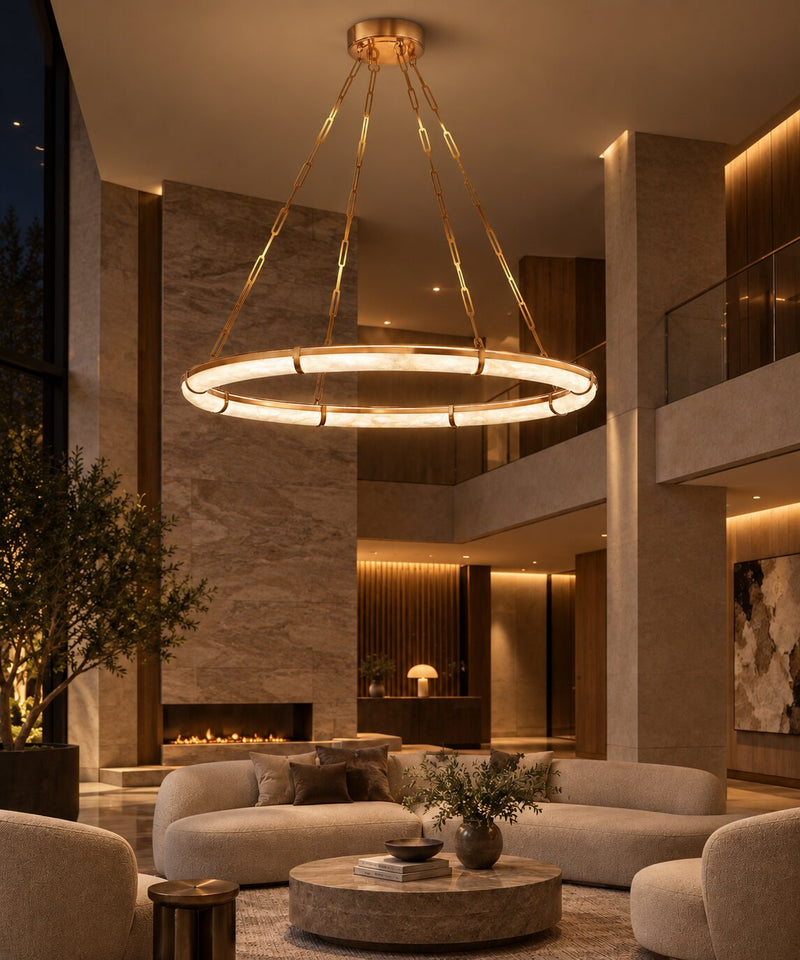
For a double-height foyer, the Halo Infinia Chandelier nests alabaster rings in a 4 ft format, with depth that reads from the stair as well as the door. It is made to order in Matte White, Brushed Brass, Antique Brass, Champagne Gold or Matte Black.
Where the hall is tall but you want something softer than a ring, the Lunar Series Pendant Lamp P10 groups hand-carved spheres, each a different stone, into a composition set to the volume. For a square single-height hall, the Lunar Branch Style 1 carries spheres on a branching frame that fills the plan without a wide disc.
For a hall of about 3 x 3.6 m with a standard ceiling, the Halo Crown Chandelier in its 60 cm Small size is ready to order online, with 80, 100 and 120 cm versions made to order for larger entrances. The ring tube is 4 cm and the piece hangs on stainless wire with transparent cable, cut to your drop.
Add the hall's length and width in feet and read the result as inches of diameter. A 10 x 12 ft hall suits about 55 to 60 cm; a 15 x 15 ft double-height entrance about 75 to 80 cm, with a taller body.
No. It should be warmer and lower at night, with a dimmer so it can be lifted when guests arrive. 2700K everywhere, and a second low layer at a console or on the wall.
Yes, and in a passage under 1.5 m wide or a ceiling under 2.7 m it is the better choice. Centre them 150 to 170 cm from the floor and space a pair 1.5 to 2.5 m apart.
See the pieces sized for halls on the foyer and entrance chandeliers page, and for an entrance that needs a composition built to its volume, start with Bespoke. For sconce heights in detail, see alabaster wall lights.
 Buying Guides6 min read
Chandelier Size Guide for Indian Living RoomsThe length-plus-width rule for Indian room sizes, how low a chandelier can hang under 2.7 m, sharing a ceiling with a...Read the guide
 Buying Guides6 min read
Bedside Lighting: Wall Lights or Table Lamps?Wall lights, table lamps or a pendant at the bedside: how to choose, with mounting heights, colour temperature, switc...Read the guide
 Buying Guides6 min read
Linear or Round Pendant: Which Suits Your Table?Match the light to the table: linear for long rectangles, round for round and square tables. Length, diameter and hei...Read the guide
Teeshaa
Sculptural lighting in Spanish alabaster, designed in Bangalore and made in India. Tell us about the room and we will suggest the piece, the size and the finish.