Your cart
(0)
Made to order · dispatched by 18 November

By commission

Which stone is best for lighting? Alabaster glows evenly, onyx shows bold bands, marble belongs in bases. Translucency, hardness, care and cost compared.
Alabaster vs marble vs onyx comes down to one question: do you want the stone to glow, to show a pattern, or to anchor the piece? Alabaster is the most translucent of the three and glows evenly, which makes it the natural choice for a shade. Onyx is translucent too, with strong bands, and is harder, heavier and usually more expensive. Marble is mostly opaque except in thin slices, so it is the right stone for a base and the wrong one for a shade.
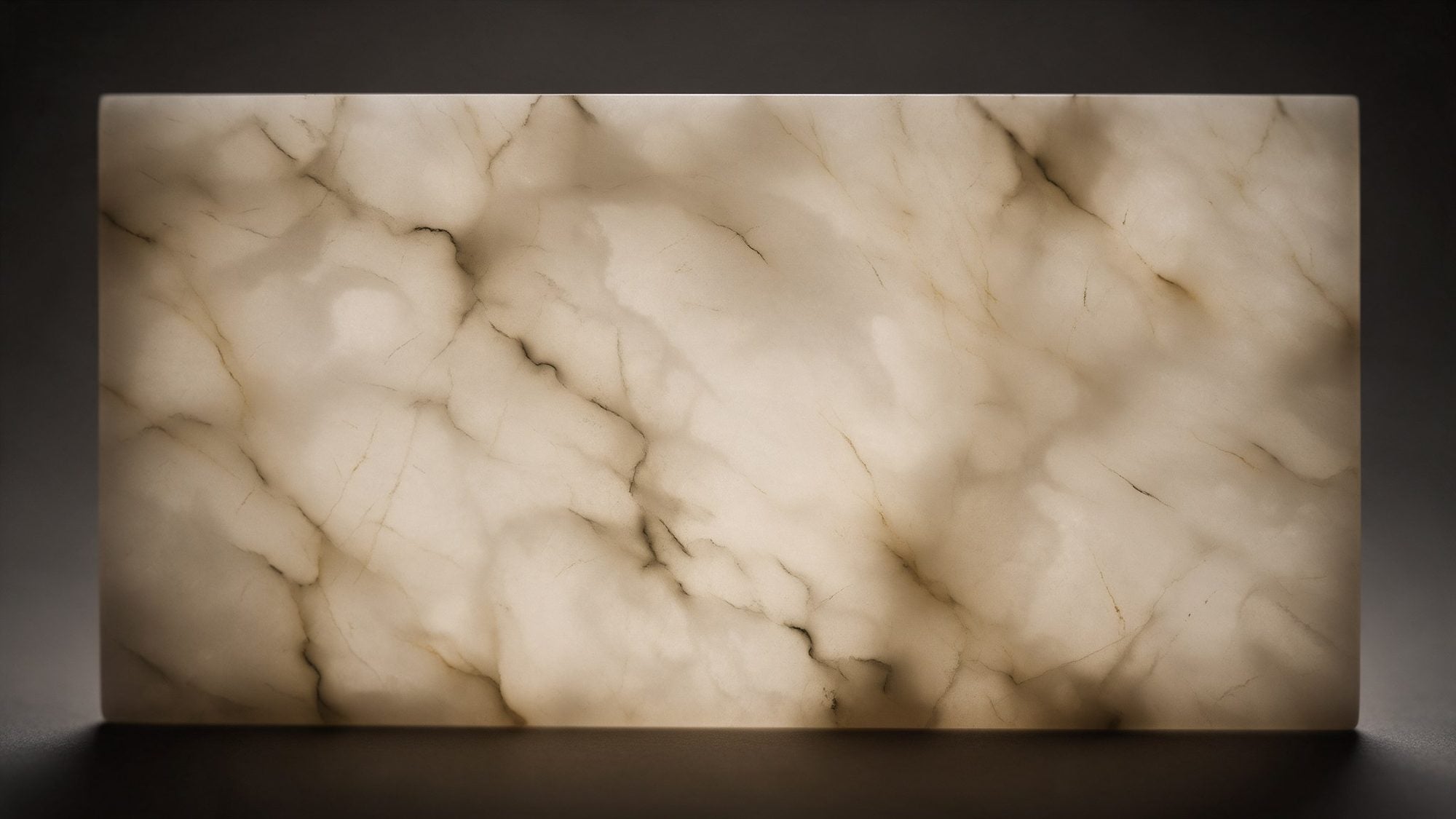
Alabaster, by a clear margin. Gypsum alabaster passes light through walls thick enough to carve into a dome or a column, and the light spreads evenly through the clouding. Onyx transmits light too, but its bands are denser than the ground between them, so it reads as stripes of bright and dark. Marble glows only in thin slices.
Thickness is the practical test. Alabaster can be carved to a wall that both glows and holds its shape. Onyx is usually sliced thin and used as flat panels on a frame. Marble must be sliced thinner still, which is why marble light is almost always a backlit panel rather than a carved form.
The names confuse things. What the ancient world called alabaster was often banded calcite, closer to onyx; the alabaster used in lighting today is gypsum. The material page and the post on what alabaster is and why it glows go deeper.
| Property | Alabaster (gypsum) | Onyx (banded calcite) | Marble (metamorphosed limestone) |
|---|---|---|---|
| Translucency | High; even glow through carved walls | Moderate to high, with strong bands | Low; only in thin slices |
| Pattern | Soft clouding and fine veins | Bold bands and swirls | Veins on an opaque ground |
| Hardness (Mohs) | About 2 | About 3 | About 3 |
| Weight | Lighter | Heavier | Heavier |
| Care | No water or harsh chemicals; dry cloth | Etches with acids; dry or barely damp cloth | Etches with acids; seal if used as a surface |
| Cost tier | Above glass | Usually the most expensive | Varies widely; common grades most accessible |
| Best lighting role | Shades, rings, spheres, columns | Panels and feature shades where pattern leads | Bases, plinths, opaque bodies |
No, if it is treated as stone, not glass. At about 2 on the Mohs scale, alabaster can be marked by a fingernail pressed hard and it takes in water, so it is wrong for a bathroom splash zone or an open balcony. A pendant out of reach, or a table lamp dusted with a dry cloth, is safe.
Softness is also what makes the glow possible. The stone can be carved into thin domes, slender columns and continuous rings, forms that would crack or go opaque in harder stones. Follow the care guide and it lasts; reach for a spray bottle and it marks.
Choose onyx when the pattern is the point. A backlit onyx bar front or reception desk is one of the great effects in hospitality interiors, and a thin onyx shade makes a strong, graphic statement. It is harder than alabaster, so it tolerates a little more handling, and its colours run from honey to green to deep red.
Weight and cost are the trade-offs. Onyx is denser than alabaster and typically the most expensive of the three for a given size, and its bands make an even glow difficult. You choose onyx for drama, not for calm; for a dining pendant that must flatter faces every night, that is usually the wrong brief.
Choose marble for what holds the light rather than what passes it: a lamp base, a plinth, a column body. It is durable, takes a fine polish and anchors a translucent shade visually. Thin backlit marble panels exist, but they glow faintly and show the frame behind them, so they belong on feature walls rather than in a shade.
Opaque carving stones do the same job with a different character. Teeshaa's Pebble Lamp pairs a hand-sculpted body in black or white Gorara stone with an alabaster shade, in three sizes. The dark, matt body makes the lit alabaster read brighter by contrast, which is why opaque and translucent stones belong together rather than in competition.

Teeshaa works in gypsum alabaster from Aragon in Spain because it is the stone that lets light be the material. Every block is reviewed unlit and lit, multi-part pieces are matched for colour, clouding and transmission, and the stone is carved, fitted with metalwork and integrated LED and assembled in our own facilities in India.
The Lunar Pendant, a hand-carved sphere of 20 or 25 cm, shows what only alabaster can do: a curved wall that glows evenly all round. The Halo Crown Chandelier is a continuous ring of 60 to 120 cm with a 4 cm tube at 2700K; in onyx the bands would break the ring into segments of light. The Totem Table Lamp stacks alabaster forms 49 cm tall at 2000K, 2300K or 3000K, where the stone is read at arm's length and its clouding matters most. More table pieces are gathered on the alabaster table lamps page.
Alabaster for a shade that must glow evenly and flatter faces; onyx when a bold banded pattern is the design and you accept more weight and cost. Alabaster is softer and dislikes water; onyx is harder but etches with acids. For dining, bedside and living room pieces, alabaster is usually the better fit.
Only as a very thin backlit panel, and even then it glows faintly and shows the frame behind. Marble is mostly opaque, so it does its best work as a lamp base, plinth or body under a translucent shade of alabaster or glass.
Alabaster used in lighting is gypsum: soft, light, evenly translucent with soft clouding. Onyx is banded calcite: harder, heavier, translucent in stripes of dense and open colour. Both are sold under confusing names, so ask for the mineral, not the trade name.
The natural stone lighting page gathers Teeshaa's alabaster pieces by form, and a piece drawn to your room, in stone chosen with you, begins through Bespoke.
 Buying Guides6 min read
Chandelier Size Guide for Indian Living RoomsThe length-plus-width rule for Indian room sizes, how low a chandelier can hang under 2.7 m, sharing a ceiling with a...Read the guide
 Buying Guides6 min read
Bedside Lighting: Wall Lights or Table Lamps?Wall lights, table lamps or a pendant at the bedside: how to choose, with mounting heights, colour temperature, switc...Read the guide
 Buying Guides6 min read
Linear or Round Pendant: Which Suits Your Table?Match the light to the table: linear for long rectangles, round for round and square tables. Length, diameter and hei...Read the guide
Teeshaa
Sculptural lighting in Spanish alabaster, designed in Bangalore and made in India. Tell us about the room and we will suggest the piece, the size and the finish.