Your cart
(0)
Made to order · dispatched by 24 December

By commission
TeeshaaWall
wall lamp or wall pendant: which one you need, and where each goes in an Indian home. alabaster wall lights delivered across India and worldwide to selected locations.
Wall hanging lights can mean a wall lamp fixed directly to the wall, or a wall pendant, a shade hanging from a wall arm. Choose a wall lamp for a glow close to the wall, and a wall pendant when you want a hanging light but the ceiling point is wrong. Teeshaa's alabaster wall lights are the first kind.
A wall lamp (also called a wall light or sconce) holds its light on or close to the wall. A wall pendant, sometimes called a pendant wall light, puts a hanging shade out in the room on an arm.
Ask three questions in order:
For definitions and types of wall lamp, see wall sconces and wall light types explained.
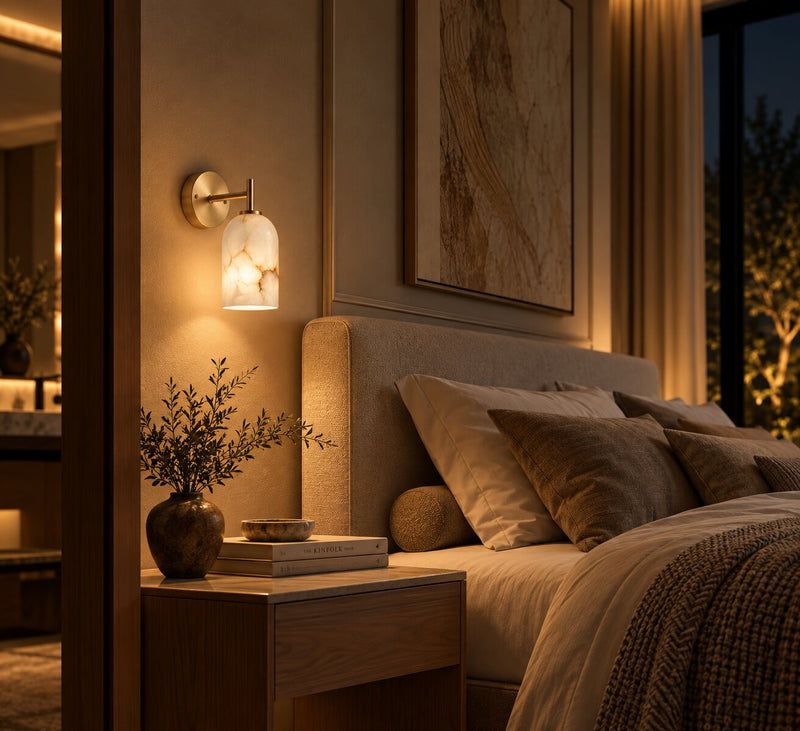
For wall lamps, centre them 150 to 170 cm from the floor in a living room or hall, and 100 to 120 cm at a bedside. These are guidance figures from Teeshaa's wall sconce height and placement guide, not rules.
In many Indian flats the builder's 5A wall points serve plugs and appliances, so their height may not match these figures. Decide the lamp position first, then ask a licensed electrician to extend or move a point before the wall is finished. In a bedroom, a wall lamp frees the bedside table; see bedside lighting: wall lights or table lamps.
A wall mounted pendant light solves a problem when you want a hanging light but the ceiling point is wrong, missing or unusable.
Reach depends on where the light must land. Drop is set by what sits below it: a table, a pillow or a walkway.
Over a table, Teeshaa's rule for pendants is the bottom of the shade 75 to 90 cm above the surface. Beside a bed, keep the shade clear of the headboard and of your head when you sit up. Where people walk beneath, about 2.1 m of head clearance is a common general guide; confirm on site.
A swinging arm needs a clear arc, so check its path against the headboard, curtains and the wall. The cable should run inside or along the arm and down the wall to a power point. Plan that route before plastering and painting. The arm must suit the shade and the wall must take the load: ask a licensed electrician, and seek structural advice if the wall type is uncertain.
The table is general guidance, not a specification for any one piece.
| Point | Wall lamp | Wall-arm pendant | Ceiling pendant |
|---|---|---|---|
| Wiring needed | A wall point at the chosen height | A power point below, plus a cable route down the wall | A ceiling point, often with a false-ceiling drop |
| Reach into the room | Short; light stays near the wall | Set by the arm; can reach a bed or table edge | Wherever the ceiling point is |
| Drop | None | Set by the cable or rod below the arm | Set by the cable or rod below the ceiling |
| Glare at seated height | Low if the lamp is above eye level | Higher if the shade hangs at eye level | Depends on the drop and the shade |
| Dust and cleaning | Easy to reach on the wall | Exposed shade; wipe on a routine | Often out of reach |
Near a wall, an exposed shade collects dust, and an attached bathroom wall can carry humidity.
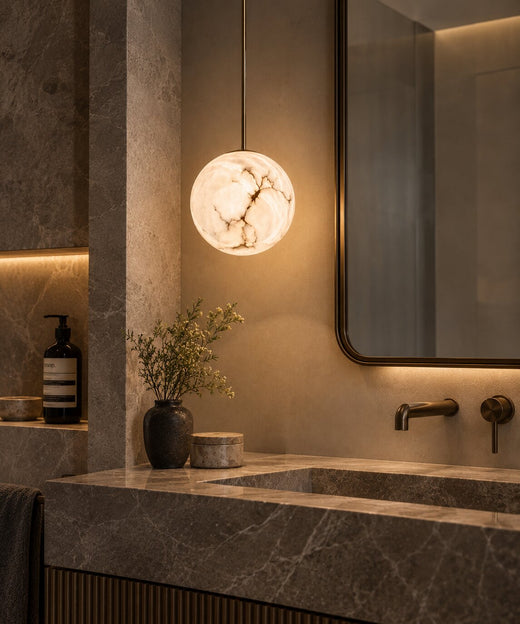
Lighting alabaster is gypsum, which is slightly soluble in water. Keep it away from bath and shower splash zones and open balconies, and think about monsoon humidity on walls that share a bathroom. Teeshaa's one-year warranty does not cover water or humidity damage. More on this is in can you use alabaster lighting in a bathroom.
For cleaning, use a soft, dry or lightly damp cloth, avoid harsh chemicals and abrasive cleaners, and follow the care guide supplied with the piece.
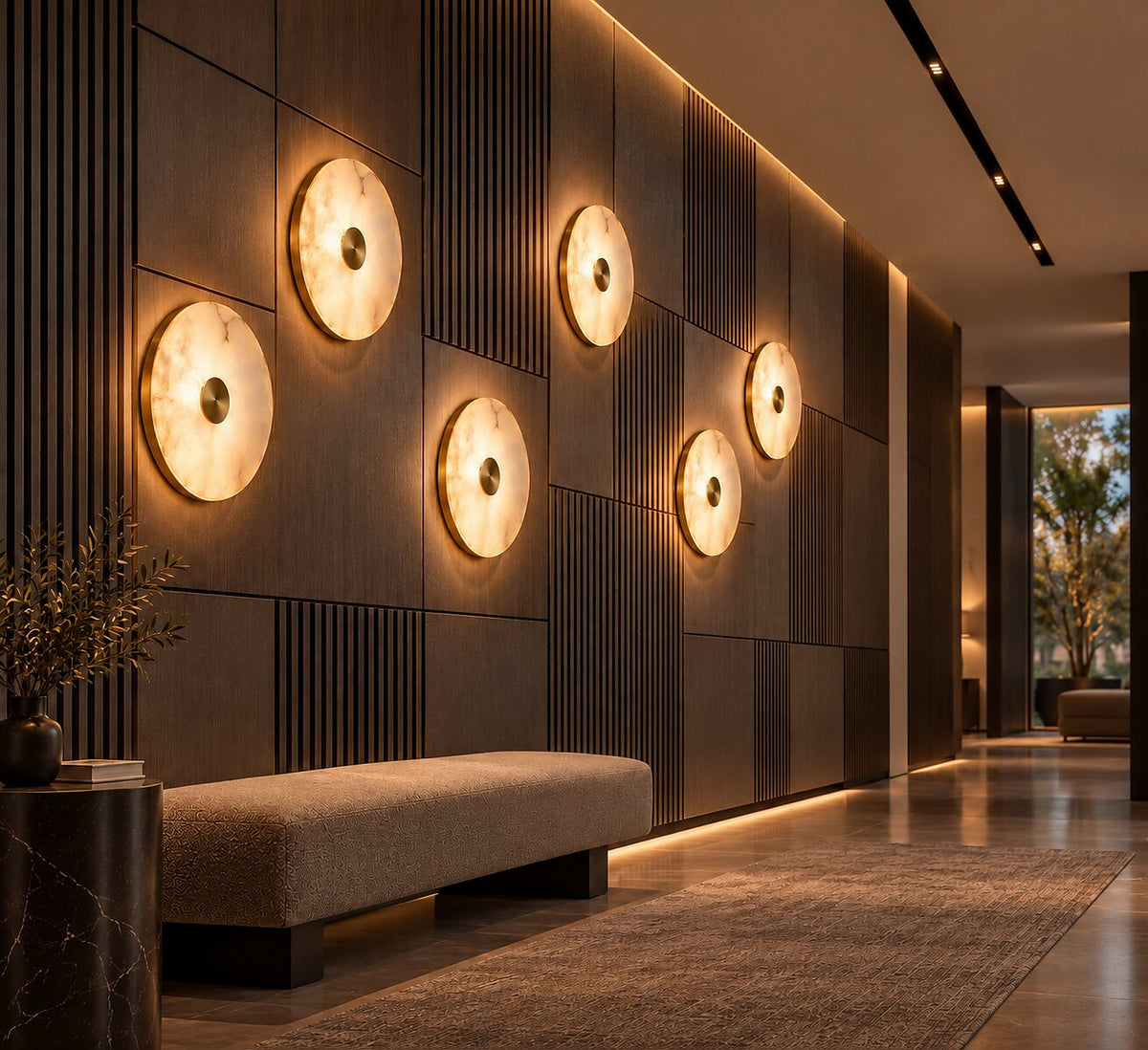
Teeshaa's own collection, listed under alabaster lighting, is Spanish alabaster, and its wall pieces are wall lights, not wall-arm pendants. See the wall collection and alabaster wall lights. The Aura Wall Mount is a round alabaster disc lit from behind, in three sizes and seven metal finishes. The Alabaster Linea Wall Mount is a slim column set flush against the wall. The Essenzo Dome Wall Sconce holds a rounded shade on a backplate in Satin Brass and lists a projection of 8 in (about 20 cm). All three can be ordered online. Finishes and ordering vary across the collection, so check each product page.
Installation of Teeshaa's wall lights is by your own licensed electrician or, on request, Teeshaa's team; ask the studio. The one-year warranty against manufacturing defects does not cover damage caused by an installation done by anyone other than Teeshaa's team. You may use your own electrician, but then the installation cannot be guaranteed.
If you want a hanging light from a wall, tell the studio the room, the wall and the position through the contact page. The studio reviews project-specific adaptations case by case, so ask whether yours is possible. Teeshaa Design Labs develops lighting in wood, metal, stone, crystal and glass to a brief, including one-off pieces. Share a drawing or a reference through the Design Labs page and the team confirms what is possible.
Wall hanging lights is a loose phrase. It can mean a wall lamp, which is fixed directly to the wall, or a wall pendant, which hangs from an arm fixed to the wall. Teeshaa's alabaster wall lights are the first kind; a wall pendant is chosen when the ceiling point is in the wrong place.
Yes, on an arm or bracket fixed to the wall, with the cable routed down the wall to a power point. The arm and its fixing must suit the shade, and the wall must hold it. Have a licensed electrician do the wiring and ask for structural advice where the wall type is uncertain.
Teeshaa suggests centring wall lamps 150 to 170 cm from the floor in living rooms and corridors, and 100 to 120 cm at a bedside. Adjust for the fitting and the wall. A wall pendant is set by its drop instead.
They suit a bedroom with a bed against a wall or no room for a bedside table. Teeshaa suggests centring a wall lamp 100 to 120 cm from the floor at a bedside. A wall pendant must hang clear of the headboard and of your head when you sit up.
Teeshaa's own collection does not include wall-arm pendants; its wall pieces are alabaster wall lights. The studio reviews project-specific adaptations, and Teeshaa Design Labs develops lighting in wood, metal, stone, crystal and glass to a brief, including one-off pieces. Share a drawing or reference and the team confirms what is possible.
Last updated 6 November 2026.
 Wall Sconce Height and Placement: Bedside, Corridor, MirrorMounting heights for wall sconces by location, with a table, corridor spacing, when to use pairs, how to switch and d...Read the guide
 Bedside Lighting: Wall Lights or Table Lamps?Wall lights, table lamps or a pendant at the bedside: how to choose, with mounting heights, colour temperature, switc...Read the guide
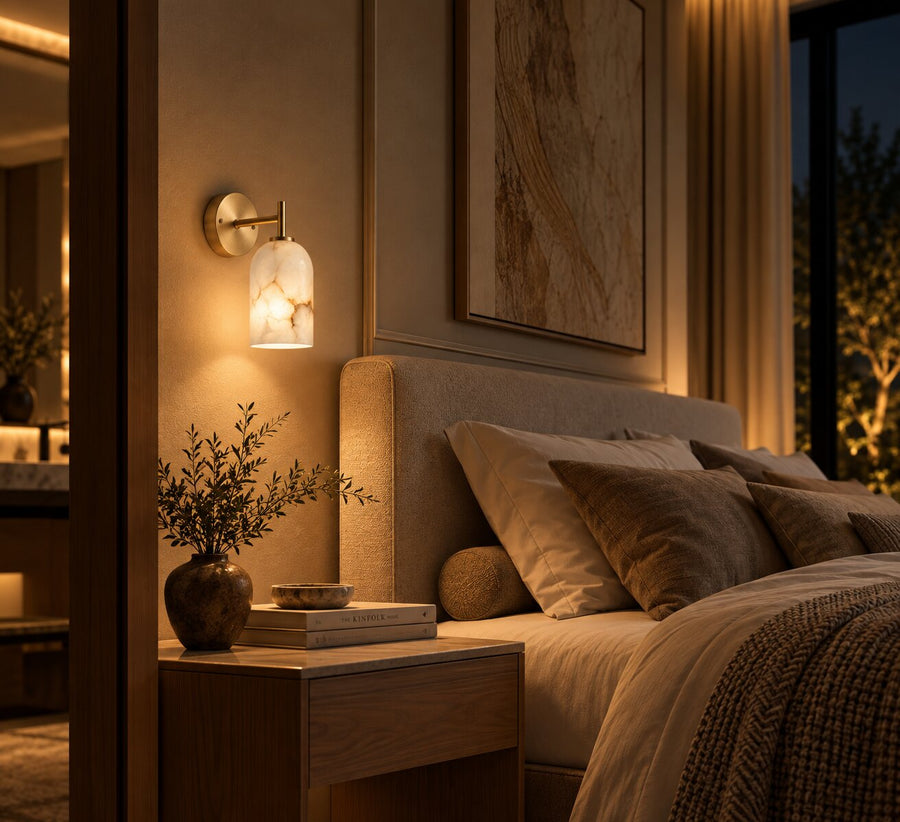 Can You Use Alabaster Lighting in a Bathroom?Alabaster belongs at the vanity and dressing area, not above the bath or in the shower. Zones explained, mirror heigh...Read the guide
Tell the studio the room, the wall and where you want the light, and ask which wall piece suits.