Your cart
(0)
Made to order · dispatched by 20 November

By commission

Alabaster is a translucent gypsum stone. Why it glows from within, why no two blocks match, how thickness changes the light, and what to check before buying.
Alabaster is a soft, fine-grained stone that lets light pass through it. The alabaster used in lighting is a form of gypsum, and when a lamp sits inside it the stone does not simply brighten: its clouding, veins and denser mineral passages show up inside the light. That is the short answer to what is alabaster and why it glows. The longer answer covers why no two pieces match, why thickness matters, and what to check before buying.
Alabaster is a compact form of gypsum, a calcium sulphate mineral laid down in ancient evaporating lakes and seas. It is fine-grained, slightly waxy to the touch, and translucent in thin sections, which is why it has been carved into vessels, windows and lamps for thousands of years.
Two different stones have carried the name. The alabaster of ancient Egypt was calcite, a harder banded stone now usually sold as onyx. The alabaster of Europe, and of modern lighting, is gypsum: softer, and more evenly translucent, which is what you want in a shade. The natural stone lighting page compares alabaster, marble and onyx side by side.
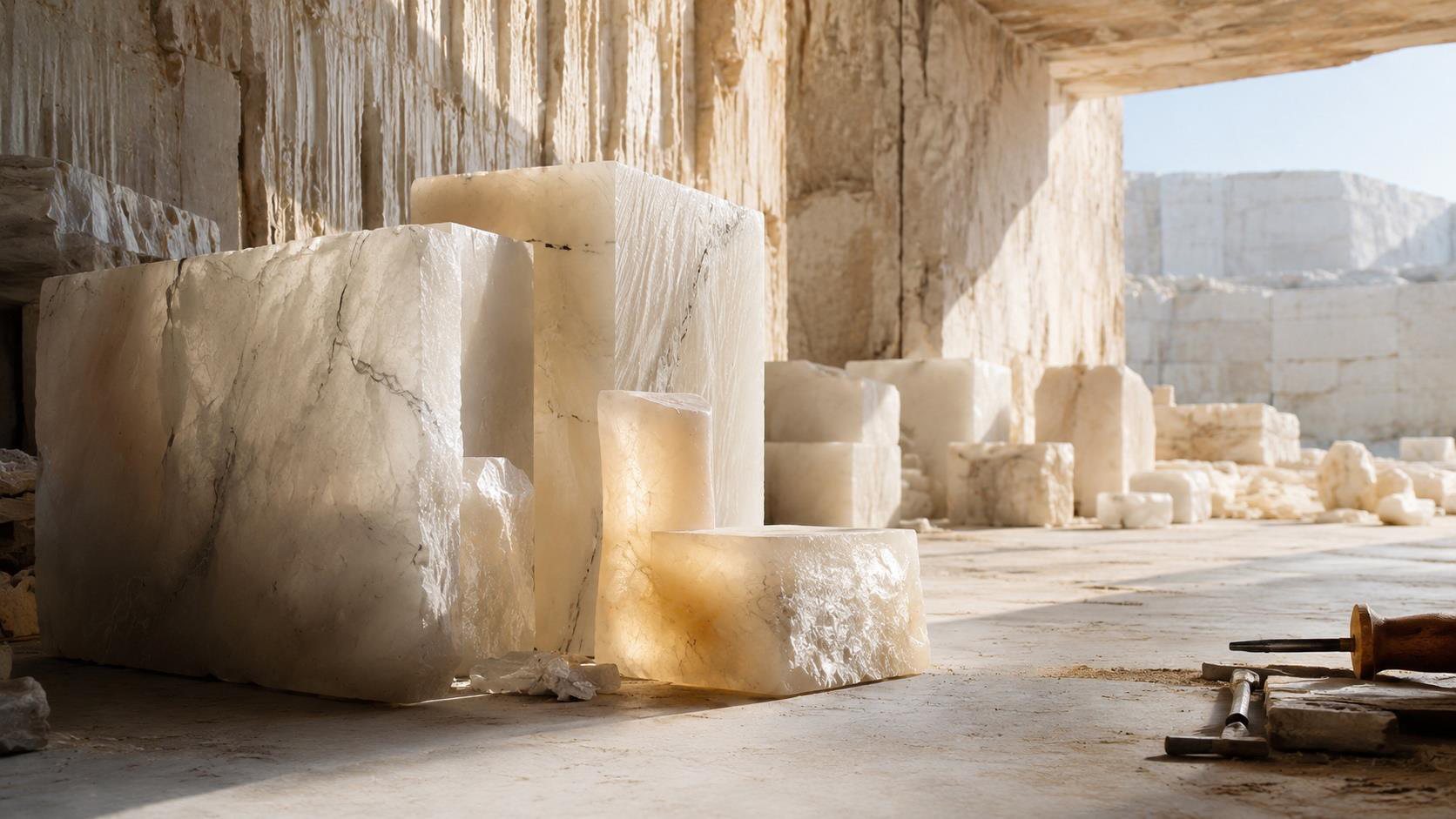
The quarry towns of La Puebla de Hijar and Gelsa, in Aragon near Zaragoza, sit on gypsum beds that yield blocks of unusual clarity. Teeshaa's pieces are made from this Spanish alabaster, with the stonework, metalwork and assembly carried out in its own facilities in India.
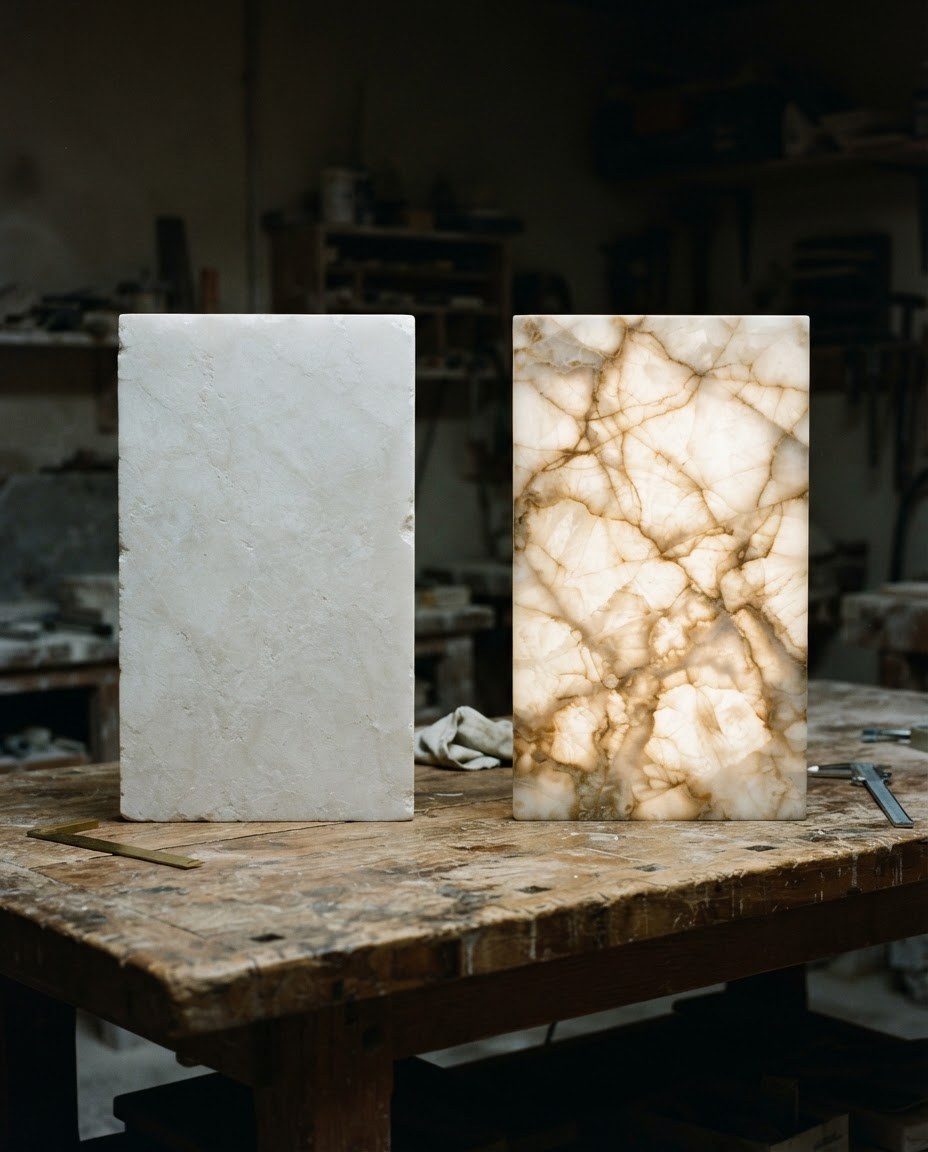
Alabaster glows because its crystals scatter light inside the stone instead of letting it pass straight through. Light enters, bounces between fine gypsum grains, and leaves from the whole surface at once. The result is an even, soft glow with no visible lamp, and a surface that looks lit from within rather than lit from behind.
This is the difference from glass. A frosted shade diffuses light at its surface; you still sense the lamp behind it. Alabaster takes the light into its depth, so the stone itself becomes the source. Veins and dense passages transmit less and read as soft shadows; lighter clouding reads warmer and brighter. The pattern you see when the piece is on is the geology of that block.
Warm light suits this. At 2700K the stone reads like evening light; at 2000K to 2300K it is close to candlelight. Most designers keep alabaster at 2700K or lower and add a dimmer, because at low output the stone looks like a lit candle inside stone. There is more in why alabaster reads differently from other materials.
Thickness is the biggest single control over the glow. A thin wall transmits a great deal of light and shows every vein, which is why the sides of a sphere or a slender column look so alive. A medium wall gives an even, calmer glow with the veining softened. A thick wall glows mostly where the light is closest and holds shadow elsewhere.
Curvature and edge detail matter too, because they change the distance from stone to light source across the surface. A maker controls thickness, curvature, LED position and output, and the colour of the block together. This is why a photograph of one piece will not predict the next: a cloudier block glows brighter and softer, a denser block warmer and more shadowed. Both are correct.
Because the stone varies, selection decides the quality of a piece. Blocks are reviewed unlit, to judge colour and surface, and then lit, to judge how they carry light. Nothing is corrected away. It is selected and composed.
Multi-part pieces raise the stakes. A ring made from several arcs, or a cluster of five spheres, must read as one object when lit, so sections are matched for colour, clouding and transmission. The piece should look consistent without pretending the material is uniform. Teeshaa's material page describes the process. To judge a piece yourself:
Alabaster is soft. At around 2 on the Mohs scale it can be marked by a dropped key, and water or acidic cleaners dull the surface. None of this matters in a living room, bedroom or dining room, where a light is rarely touched.
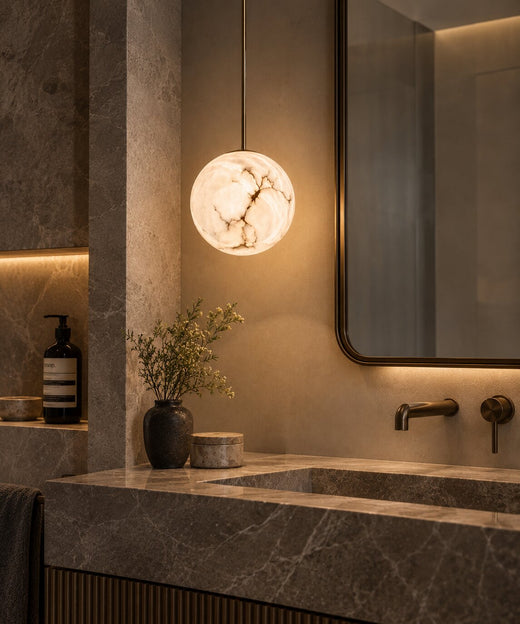
It matters in a few places. Keep stone fixtures out of bath and shower splash zones, and off open balconies and verandas where rain or sea air reaches them. A vanity away from the splash is fine with an electrician's sign-off; so is a kitchen island, since the stone hangs well above the steam line. Choose alabaster for ambient or accent light seen as an object; choose glass or metal where a fixture will be handled or washed. The care guide covers cleaning.
The clearest demonstration of the material is a single block of it, lit. The Lunar Pendant is a hand-carved sphere, 20 cm or 25 cm across, and because the wall curves continuously you can see the glow shift with thickness all the way round. The Alabaster Linea Pendant is a column 30 cm tall and 6 cm wide from one block, so the veining runs unbroken down its length.
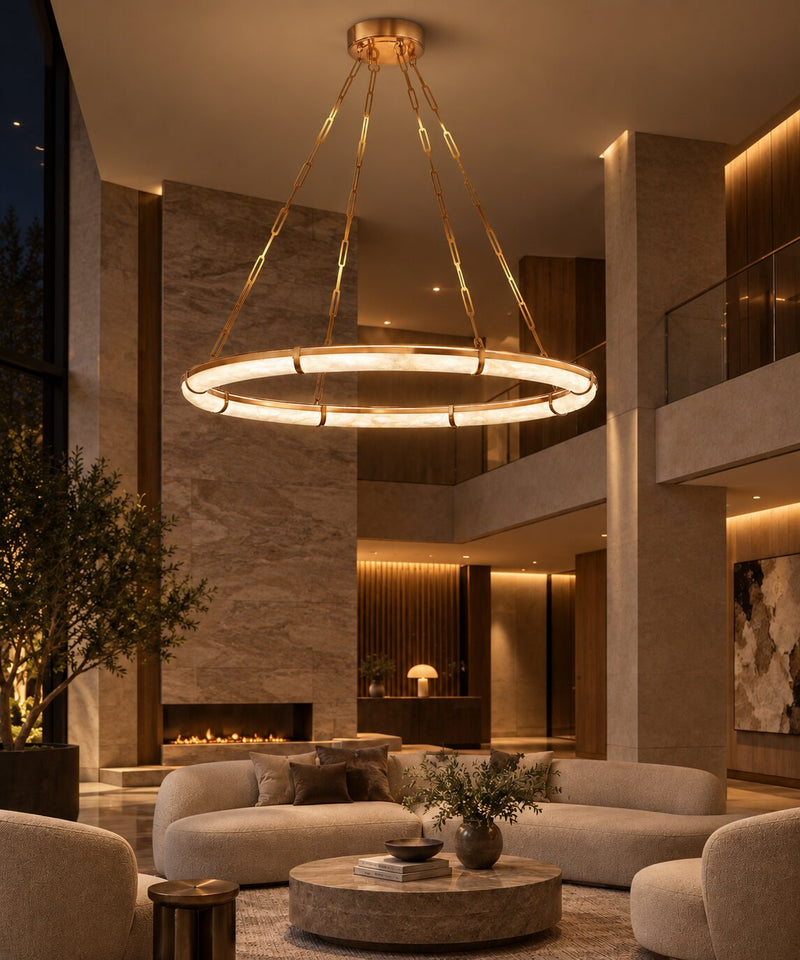
Matching shows best in the Halo Crown Chandelier, a continuous ring from 60 cm to 120 cm across that has to read evenly in colour and transmission. The Totem Table Lamp, 49 cm tall, puts the stone at arm's length, where you can watch the clouding change as you dim it.
No. Marble is metamorphosed limestone, a calcium carbonate, and is mostly opaque except in very thin slices. Alabaster is gypsum, a calcium sulphate, and is translucent in sections thick enough to carve.
The stone itself is stable indoors. What changes a piece over years is handling, moisture and cleaning products, which dull or mark the surface. Kept dry, dusted with a soft cloth and away from direct water, alabaster ages quietly and keeps its translucency.
Each piece starts as a quarried block that is selected, cut, hollowed and finished by hand, then matched to its neighbours. Waste is high because the stone is soft and veins run where they will. Glass is moulded in quantity. You are paying for a natural material and the time to work it well.
If you are now deciding what to put where, the alabaster lighting page lays out chandeliers, pendants, wall lights and table lamps by room. For a piece sized to a particular room or project, bespoke commissions start from the architecture and the stone.
 Buying Guides6 min read
Chandelier Size Guide for Indian Living RoomsThe length-plus-width rule for Indian room sizes, how low a chandelier can hang under 2.7 m, sharing a ceiling with a...Read the guide
 Buying Guides6 min read
Bedside Lighting: Wall Lights or Table Lamps?Wall lights, table lamps or a pendant at the bedside: how to choose, with mounting heights, colour temperature, switc...Read the guide
 Buying Guides6 min read
Linear or Round Pendant: Which Suits Your Table?Match the light to the table: linear for long rectangles, round for round and square tables. Length, diameter and hei...Read the guide
Teeshaa
Sculptural lighting in Spanish alabaster, designed in Bangalore and made in India. Tell us about the room and we will suggest the piece, the size and the finish.