Your cart
(0)
Made to order · dispatched by 19 November

By commission
TeeshaaAll Lighting
five checks you can do at home, and what a real alabaster glow looks like beside resin or glass.
Real alabaster lighting feels heavy and cool in the hand, glows unevenly with clouds and veins that run through the stone, and shows no mould seams or trapped air bubbles. Resin or glass imitations are usually lighter, warmer to the touch and more evenly lit. No single check is conclusive, so use several together.
Use five checks in this order: look at the piece unlit, lift it, touch it, switch it on, and inspect the edges. None of them harms the piece.
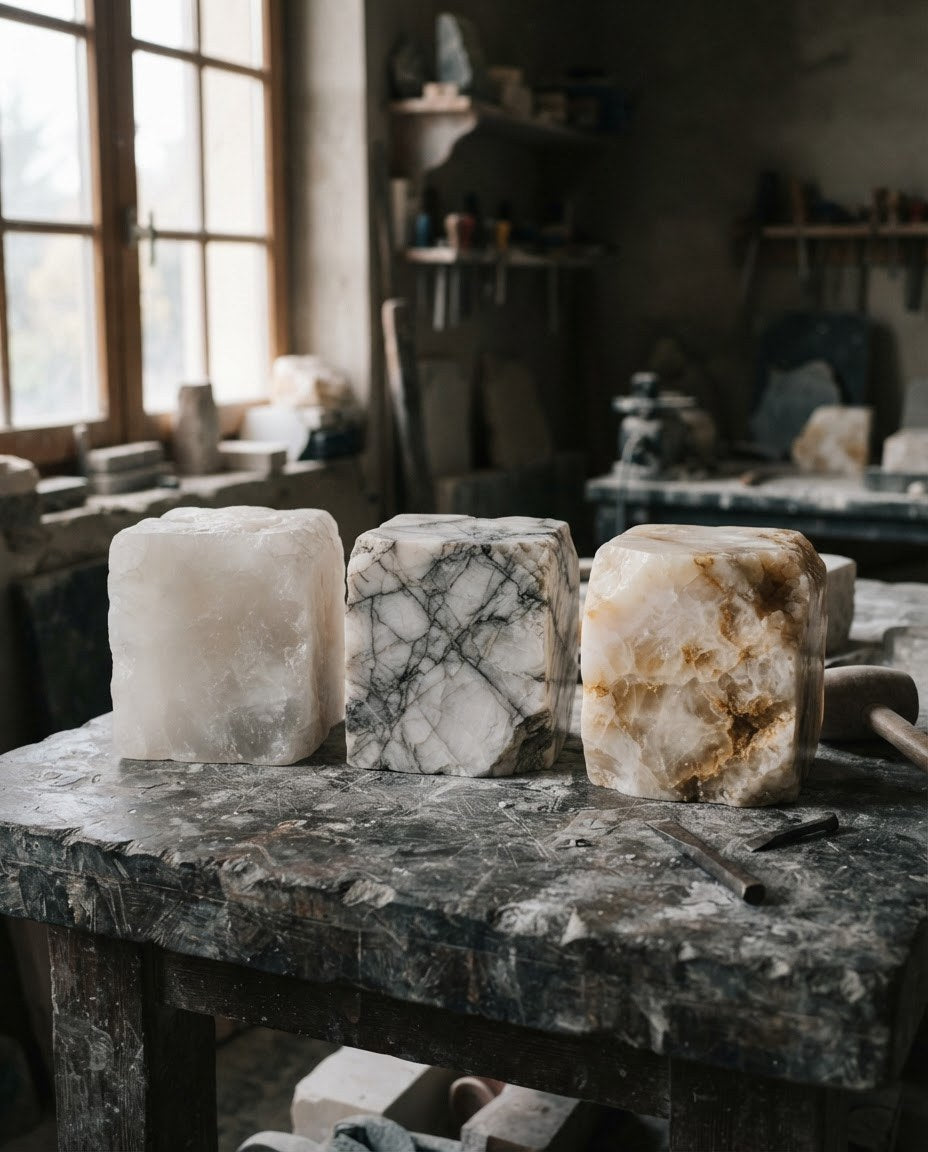
Real alabaster glows with depth. Light enters the stone, scatters and leaves it softened, with brighter and darker zones that follow the clouding. Resin tends to glow evenly, like frosted plastic, and glass is either clear or uniformly frosted.
Watch the veins as you move around the lamp. In stone they seem to sit inside the material and shift slightly with your angle. In an imitation a print or paint layer stays flat. A bright hot spot directly above the light source points to thin or uneven material, but it does not by itself tell you what the material is.
Calcite, sold as Egyptian alabaster, is also real alabaster. It is a different mineral, covered in Spanish alabaster vs Egyptian alabaster.
| Check | Real alabaster | Resin or glass imitation |
|---|---|---|
| Weight | Dense and heavy for its size | Resin is usually lighter; glass is heavy but looks clear or frosted |
| First touch | Cool, then slowly warms | Resin feels close to room temperature |
| Pattern | Clouding and veins differ on every piece | Pattern repeats from piece to piece |
| Veins when lit | Appear inside the stone and shift with angle | Sit on the surface and stay flat |
| Glow | Uneven, with depth and soft gradients | Even and flat, or sparkling in glass |
| Edges | Tool and polishing marks | Mould seams or tiny round bubbles in cast pieces |
| Fingernail on a hidden spot | Soft gypsum can take a faint mark | Glass will not mark |
No. A fingernail on a hidden spot of a piece you already own is the most you should try, and it can leave a mark on soft stone. Never use acid on a finished lamp.
Hydrochloric acid is a geologist's method for separating calcite from gypsum alabaster, and it damages a polished surface. Conservation sources note that visual identification can be difficult and that a certain answer may need destructive testing. That is why the seller's written material statement and the look of the piece matter more than a risky home test.
Not on its own, but it is worth a question. Alabaster lighting involves quarried stone, careful carving and polishing and, on larger pieces, matching of sections. When a large piece sold as alabaster costs far less than comparable stone pieces, ask what the shade is made of.
A low price does not prove imitation and a high price does not prove stone. The material statement, the photographs and the answers you get carry more weight than the figure.
Teeshaa makes sculptural lighting in Spanish alabaster. Design is led from Bangalore, and the stonework, metalwork, engineering and assembly happen in Teeshaa's own facilities in India. Each stone is reviewed unlit and lit, and sections of multi-part pieces are matched for colour, clouding and transmission.
Natural variation is part of the material and is not treated as a defect under the returns policy. Read the material page for how the stone is chosen, or the guide to what alabaster is and why it glows. To compare stone with other natural materials, see alabaster vs marble vs onyx lighting.
To see the stone, visit the Bangalore design studio and workshop by appointment through the contact page. It is not a retail showroom, and there is no showroom in any other city. Pieces such as the Alabaster Linea Pendant and the Essenzo Porcini Table Lamp show the variation clearly. The full range sits under alabaster lighting.
Combine several checks. A real alabaster lamp feels heavy and cool, shows clouding and veins that differ from piece to piece, glows unevenly with depth when lit, and has tool marks rather than mould seams at the edges. Ask the seller to state the material in writing.
Usually yes. Gypsum is a dense stone, so a solid alabaster shade of a given size is noticeably heavier than a resin shade. Weight is only a clue, because filled resin can be heavy and a thin stone shell can be light.
Stone draws heat from your hand, so alabaster feels cool at first and warms slowly. Resin feels nearer to room temperature. Alabaster feels less icy than marble, so compare it with a stone you know before relying on this test.
A well made cast resin can look convincing at a glance, with a soft diffused glow. Differences show in the detail: the pattern repeats between pieces, veins stay flat on the surface, and the light lacks the depth and uneven gradients of natural stone.
Yes. Egyptian or Oriental alabaster is calcite, a harder calcium carbonate stone, while the alabaster used in most lighting, including Teeshaa's Spanish alabaster, is gypsum. Both are natural stone, but they are different minerals with different hardness and care needs.
Reviewed by the Teeshaa studio, 19 October 2026.
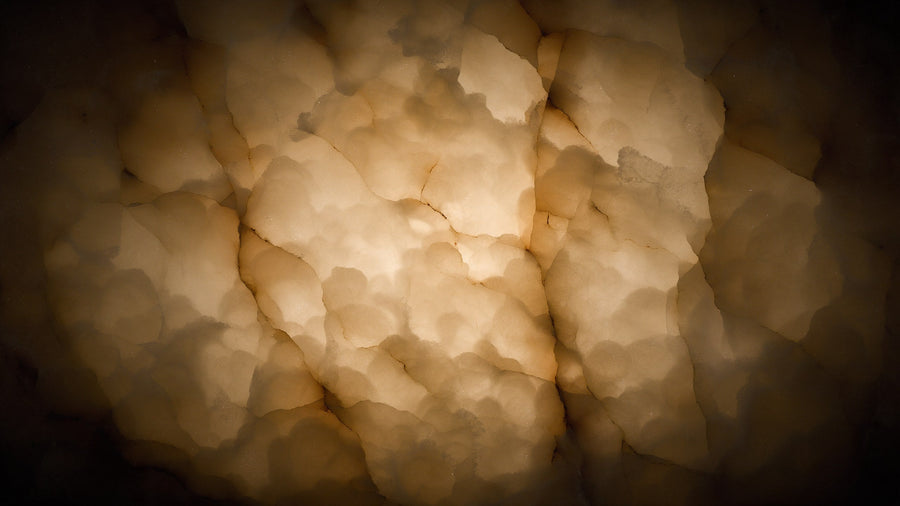 What Is Alabaster, and Why Does It Glow?Alabaster is a translucent gypsum stone. Why it glows from within, why no two blocks match, how thickness changes the...Read the guide
 Alabaster vs Marble vs Onyx: Which Stone Is Best for Lighting?Which stone is best for lighting? Alabaster glows evenly, onyx shows bold bands, marble belongs in bases. Translucenc...Read the guide
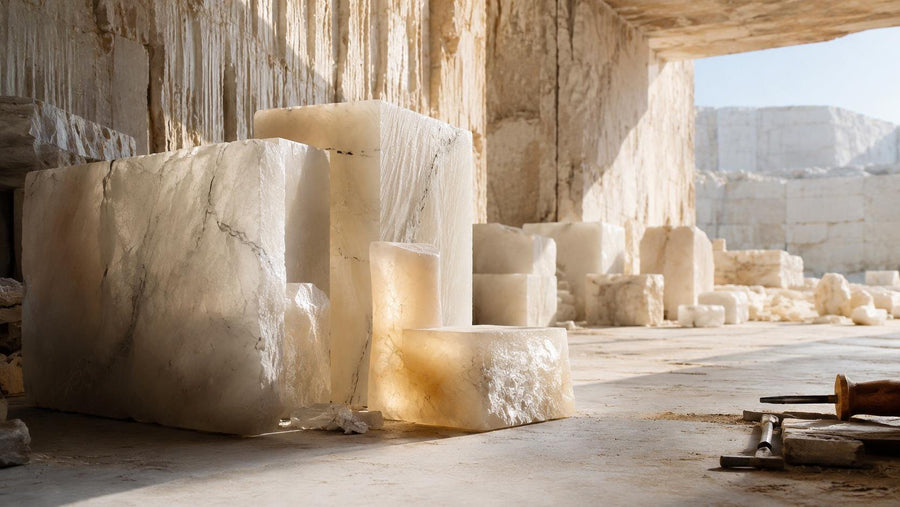 Designed in Bangalore: How an Alabaster Light Is MadeFrom Aragon quarry block to lit piece: selection, matching, carving, thickness, LED and assembly, plus a checklist fo...Read the guide
Visit the Bangalore studio by appointment to see unlit and lit alabaster beside each other, or send the studio your questions.