Your cart
(0)
Made to order · dispatched by 18 November

By commission
TeeshaaAll Lighting
two minerals share one name: how gypsum and calcite alabaster differ in hardness, chemistry and use in lighting.
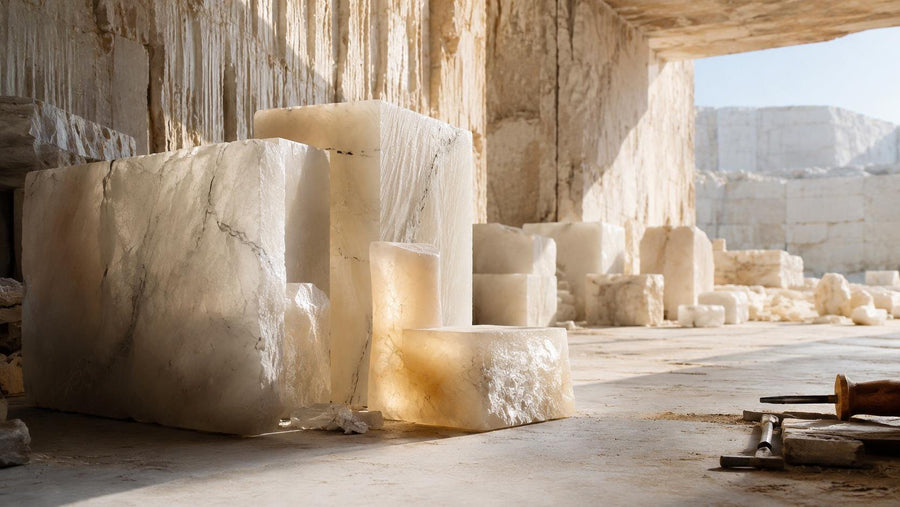
Spanish alabaster is gypsum alabaster, a soft, fine-grained calcium sulfate stone of about 2 on the Mohs scale. Egyptian alabaster is calcite alabaster, a harder calcium carbonate stone of about 3, often banded. Both are called alabaster, and Teeshaa makes its lighting in Spanish alabaster.
The name describes a look and a use, not one mineral. Archaeologists and traders have long called any fine-grained, translucent, easily carved white or tinted stone alabaster, and both gypsum and calcite fit that description.
Gypsum alabaster is a very fine-grained variety of gypsum, the same mineral that is processed into plaster. Calcite alabaster is a banded form of calcium carbonate that geologists class as a travertine, a kind of limestone. The "Egyptian" label refers to calcite alabaster worked near Suez and Assiut.
They differ in chemistry, hardness and behaviour. Gypsum alabaster is softer, takes a fingernail scratch and does not fizz in acid. Calcite alabaster is harder, resists a fingernail, shows more banding and fizzes in acid.
| Property | Gypsum alabaster (Spanish) | Calcite alabaster (Egyptian) |
|---|---|---|
| Mineral | Gypsum, calcium sulfate dihydrate | Calcite, calcium carbonate |
| Mohs hardness | About 1.5 to 2 | About 3 |
| Fingernail | Can be scratched | Cannot be scratched, but a knife cuts it |
| Hydrochloric acid | Little or no reaction | Fizzes |
| Typical look | Fine-grained, cloudy white to cream, grey veins or amber tones | Often banded in cream, honey and brown |
| Water | Slightly soluble | Slightly soluble |
| Use in lighting | Common for lamps and shades because it carves and polishes easily | Used for vessels, carvings and some lamps |
Gypsum alabaster is soft enough to be shaped into thin, even walls and polished to a smooth finish, and it scatters light into a soft, shadow-free glow. Those qualities make it a natural material for shades, rings and lamp bodies.
The trade-off is the softness. Gypsum marks easily, dulls if it is wiped with water-based cleaners and should be kept clear of heat. Teeshaa's care guidance is written around exactly that, and the guide to why alabaster glows explains the light behaviour.
Spanish alabaster is gypsum alabaster quarried in Spain. The Ebro Valley in Aragon is a well-known source of gypsum alabaster, and Aragonese stone has been used for large translucent panels in buildings.
Gypsum alabaster also occurs elsewhere in the world, so the name tells you the origin of the stone, not a different mineral. Ask any maker which mineral and which country the stone comes from.
Calcite alabaster is harder, so it resists scratching better. That does not make either stone a rugged material. Both are slightly soluble in water, both are far too soft for outdoor use, and both belong in dry, ventilated interiors.
Calcite also reacts with acids such as vinegar and lemon, while gypsum is more sensitive to water and heat. For a lamp or chandelier the practical rule is the same for both: dusting with a soft, dry or lightly damp cloth, no harsh chemicals and no splash zones.
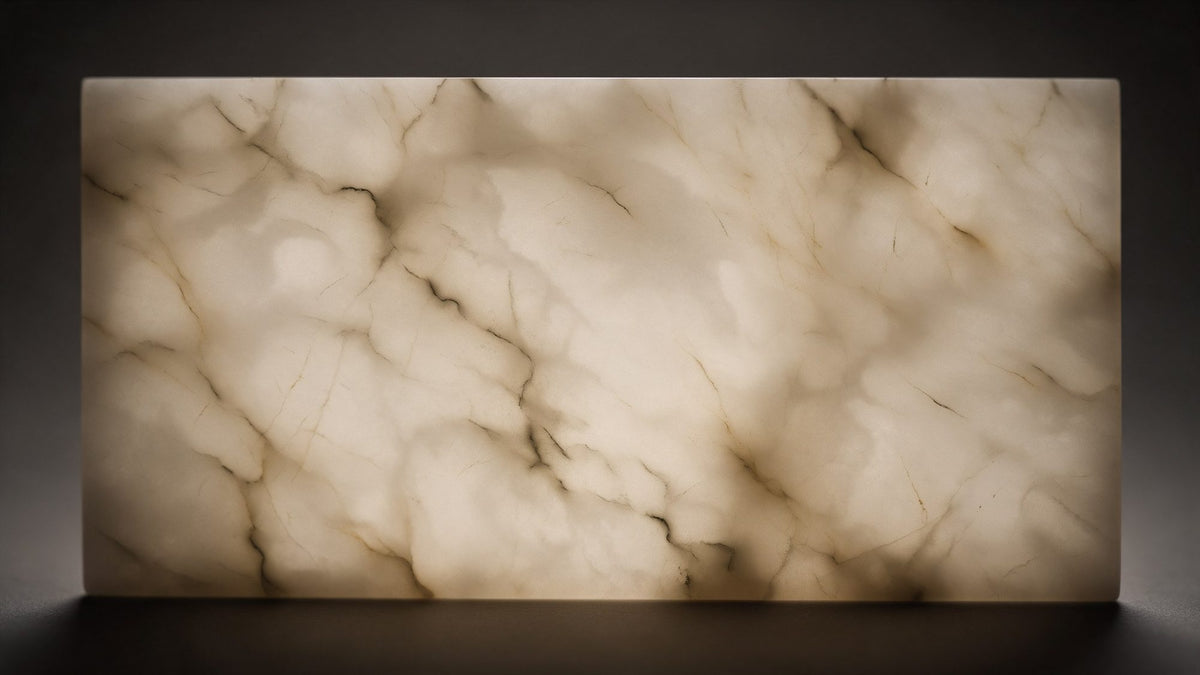
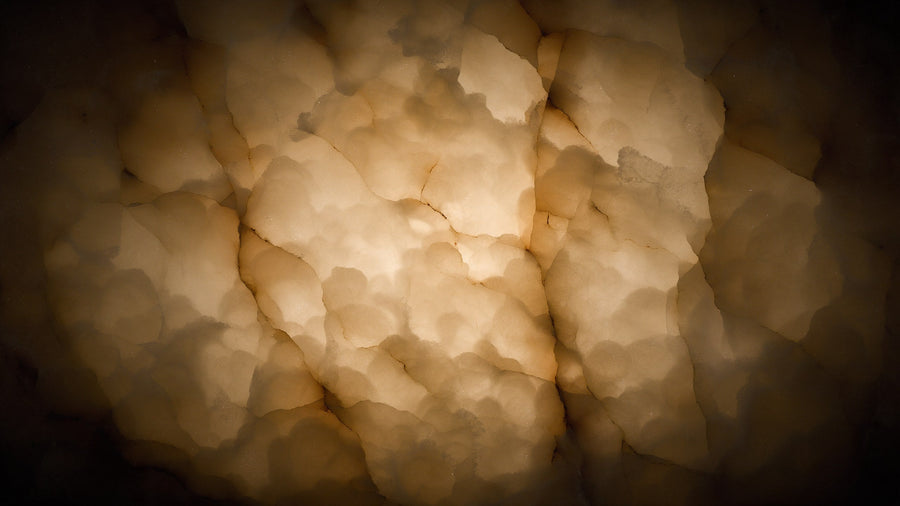
Both stones transmit light, and the difference is subtler than the names suggest. Fine-grained gypsum tends to give an even, cloudy diffusion with soft gradients, while banded calcite shows its stripes more clearly when lit from behind.
Wall thickness matters as much as the mineral. Thinner walls glow brighter and reveal more of the internal structure, and thicker sections look denser. The colour of the stone and its inclusions also tints the light, so look at photographs of the actual piece switched on, not only unlit.
Teeshaa makes sculptural lighting in Spanish alabaster, which is naturally translucent. Clouding, veining and mineral inclusions differ block to block, so no two pieces are the same. Stone is reviewed unlit and lit, and sections of multi-part pieces are matched for colour, clouding and transmission.
The range runs from the Essenzo Pendant and Alabaster Lana Style 1 to table lamps such as the Pebble Lamp. Read the material page for more, or how to tell real alabaster from resin if you are comparing sellers. Browse everything under alabaster lighting.
Spanish alabaster is gypsum alabaster, a soft calcium sulfate stone of about 2 on the Mohs scale. Egyptian alabaster is calcite alabaster, a harder calcium carbonate stone of about 3 that is often banded. They are different minerals that share the name alabaster.
Yes. Calcite alabaster, often sold as Egyptian or Oriental alabaster, is a natural translucent stone. It is a different mineral from the gypsum alabaster used in most lighting, and it is harder and more banded.
Gypsum alabaster is the usual choice for lamps and shades because it is soft enough to carve into thin, even walls and polish smoothly, and it diffuses light evenly. Calcite is harder and can also glow, but it is chosen more for vessels and carvings.
Gypsum can be scratched with a fingernail and barely reacts to hydrochloric acid, while calcite resists a fingernail and fizzes in acid. Do not test a finished lamp with acid or scratches. Ask the maker which mineral and country of origin the stone has.
No. Teeshaa makes its lighting in Spanish alabaster, a naturally translucent gypsum alabaster. The stone is reviewed unlit and lit, and sections of multi-part pieces are matched for colour, clouding and transmission. Natural variation between blocks is part of the material.
Reviewed by the Teeshaa studio, 19 October 2026.
 What Is Alabaster, and Why Does It Glow?Alabaster is a translucent gypsum stone. Why it glows from within, why no two blocks match, how thickness changes the...Read the guide
 Alabaster vs Marble vs Onyx: Which Stone Is Best for Lighting?Which stone is best for lighting? Alabaster glows evenly, onyx shows bold bands, marble belongs in bases. Translucenc...Read the guide
 Designed in Bangalore: How an Alabaster Light Is MadeFrom Aragon quarry block to lit piece: selection, matching, carving, thickness, LED and assembly, plus a checklist fo...Read the guide
Send the studio your questions about alabaster, or arrange a visit to see the stone unlit and lit.