Your cart
(0)
Made to order · dispatched by 24 December

By commission
TeeshaaWall
where bedroom wall lights go beyond the bedside: headboard pairs, dresser, TV and wardrobe walls, with heights, dimming and sightlines.
Wall lamps for bedrooms suit a pair either side of the headboard, a pair flanking the dresser mirror, and a low glow beside the TV unit, all placed so the light source stays out of sight when you lie down. Teeshaa's alabaster wall lights give a soft, diffused glow, but they are not reading lights.
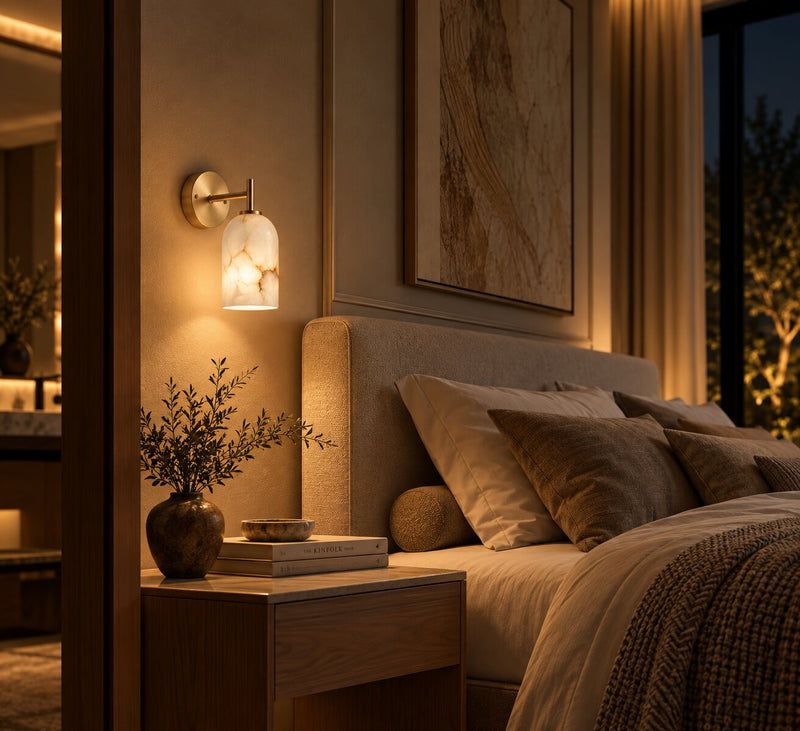
Centre each lamp over its own bedside table, so the two centres span about one table width more than the bed.
Bed sizes vary by maker, so measure yours. For a queen of about 150 to 160 cm or a king of about 180 to 190 cm, with a 45 cm bedside table each side, the lamp centres land roughly 200 cm apart on a queen and 230 cm apart on a king. If there are no tables, set each lamp just outside the mattress edge.
Height is the 100 to 120 cm centre from the wall sconce height and placement guide. Where a lamp sits above the headboard rather than beside it, leave a gap between its lower edge and the headboard top, about a hand's width (10 cm) to start; confirm with a card mock-up. Tall upholstered headboards, and how to switch the lamp from the bed, are covered in the wall bedside lamp guide. For the choice between a wall lamp and a table lamp at the bed, and for reading light, see the bedside lighting guide.
It changes which forms are comfortable. Open-bottom fixtures show the bright source to someone on the pillow, while diffused forms show a lit surface instead of a point; ask the studio how the source is shielded on the piece you choose.
In a bedroom you view a wall light from a low eye line, often tired, in a dim room. A bare source at 100 to 120 cm sits close to that line and reads as glare.
The simple test: tape a card the size of the lamp to the wall at the planned centre, lie down on each pillow, then sit up. If you would be looking up under the lamp, where a bare source could show, choose a more enclosed form or move the position.
Dresser or vanity wall. Place one lamp either side of the mirror, centred at your eye level when seated or standing at it, so the light falls beside the face and not from above. Alabaster gives soft light, so add a dedicated mirror light for close grooming; Teeshaa does not make mirror lights. See the dressing table and wardrobe guide.
TV wall. Keep lamps to the side wall or beside the unit, at a low level, never behind the screen. A lamp on the wall facing the screen reflects on it.
Wardrobe wall. Set the lamp beside the wardrobe, clear of the door swing or the slide track. A standing eye line in the 150 to 170 cm band used for corridors is a reasonable starting point.
A single sconce. In a guest room or a child's room, one lamp beside the bed, dimmed if the piece allows, usually does the job.
| wall | centre height | single or pair | dimming | must not do |
|---|---|---|---|---|
| headboard | 100 to 120 cm | pair, one per side | yes, with a low night setting | show a bare source to someone lying down |
| dresser or vanity | eye level at the mirror | pair, one each side of the mirror | useful, to soften evenings | light the face from above or stand in for a mirror light |
| TV wall | low, beside the unit | single or pair on the side wall | yes, low for viewing | sit behind the screen or reflect on it |
| wardrobe | standing eye line, about 150 to 170 cm | single | optional | sit in the door swing |
| guest or child's room | 100 to 120 cm at the bed | single | yes, with a low setting | stand in for a reading lamp |
Switch the wall lights from the door and from the bed, with the main light on its own circuit, and ask for dimming so night-time use stays low.
A two-way arrangement, one switch at the door and one by the bed, lets you turn the lamps off without crossing the room. Ask the studio whether your piece can be dimmed and which dimmer type it needs before wiring; see dimming and drivers for alabaster lighting.
Fitting is by your own licensed electrician or, on request, Teeshaa's team; ask the studio. The warranty does not cover damage caused by an installation done by anyone other than Teeshaa's team. You may use your own electrician, but then the installation cannot be guaranteed.
Indoor AC units are usually high on a wall and often above the headboard. Keep wall lamps out of the unit's airflow path and its service access. A ceiling fan only matters for a lamp set high on the wall of a small room: keep it clear of the blade sweep.
Warm light on a dry interior wall. Most Teeshaa pieces use integrated LED at 2700K; check the product page for the piece you want.
Alabaster is a soft stone that is slightly soluble in water, so wall conditions matter. During the monsoon, external walls, top-floor walls and walls with seepage patches can stay damp. Do not mount a lamp on one. Also avoid walls near bathroom doors, shower zones and open balconies. The warranty does not cover physical damage, or water or humidity damage; see alabaster lighting in humid and coastal homes for more.
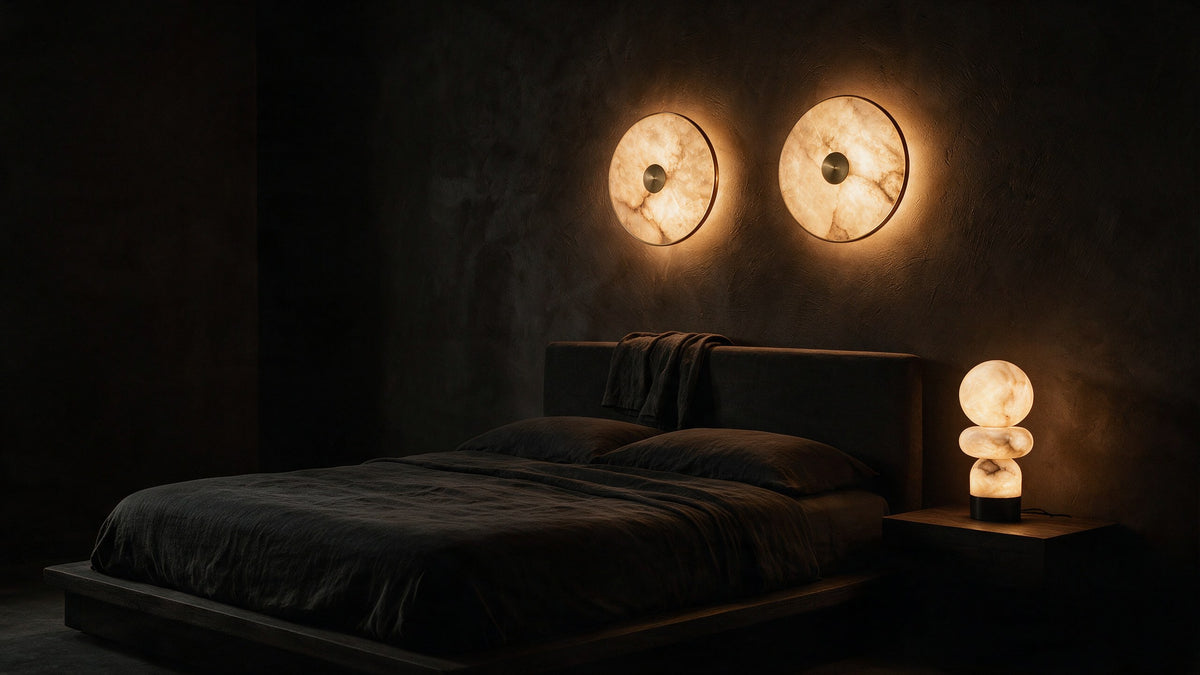
Teeshaa makes wall lights in Spanish alabaster, designed in Bangalore and made in its own facilities in India. Ready to order online are the disc-form Aura Wall Mount, about 30, 40 or 50 cm across; the slim Alabaster Linea Wall Mount, a flush column that suits the side of a bed; and the Essenzo Dome Wall Sconce in Satin Brass, with a listed projection of about 20 cm, so check it clears the bed.
Halo pieces such as the Vanta Halo Riflessio are on enquiry and quoted by the studio. At about 140 or 160 cm long, the Vanta is a single composition for a wide wall, not a bedside lamp. Made-to-order pieces are not eligible for returns, exchanges or refunds.
Browse the wall collection and the alabaster wall lights page. For the whole room's layers, see bedroom lighting and how many lamps a bedroom needs, and for the stone, the alabaster lighting hub. To talk through a room, use the contact page.
For evening use, often yes: a pair of wall lamps at the bed plus one or two more on other walls gives a calm, low glow. They are ambient and accent sources, though, not task lights. Keep the ceiling or cove circuit for dressing, cleaning and finding things, and put it on its own switch.
Start from the usual 100 to 120 cm centre at a bedside, then mock the position up with card and tape while you lie down and sit up. If a tall headboard rises past that band, mount the lamp above it with the lower edge clear of the top, or on the panel itself if a carpenter builds it to carry the lamp and its wiring.
A pair suits a bed with access on both sides, and lets each sleeper control a side. A single sconce suits a bed pushed against one wall, a guest room, or a wardrobe wall. Whatever you choose, plan the switching first so one lamp never leaves the other side in the dark.
One sconce beside the bed, on a dimmer with a low setting, is usually enough alongside the room's main light. Choose a diffused form, so a guest lying down is not looking at a bright point, and ask the studio how the source is shielded and whether the piece you choose can be dimmed.
It can work, but Teeshaa makes no safety claim for it. Alabaster is a soft stone and the warranty does not cover physical damage, so mount the lamp where play and knocks will not reach it, on a dry interior wall. It gives a gentle glow but is not a homework or reading light, so add a separate directional lamp for that.
Last updated 6 November 2026.
 Bedside Lighting: Wall Lights or Table Lamps?Wall lights, table lamps or a pendant at the bedside: how to choose, with mounting heights, colour temperature, switc...Read the guide
 Wall Sconce Height and Placement: Bedside, Corridor, MirrorMounting heights for wall sconces by location, with a table, corridor spacing, when to use pairs, how to switch and d...Read the guide
Tell the studio your room, bed width and wall positions, and ask which wall lights suit.