Your cart
(0)
Made to order · dispatched by 24 December

By commission
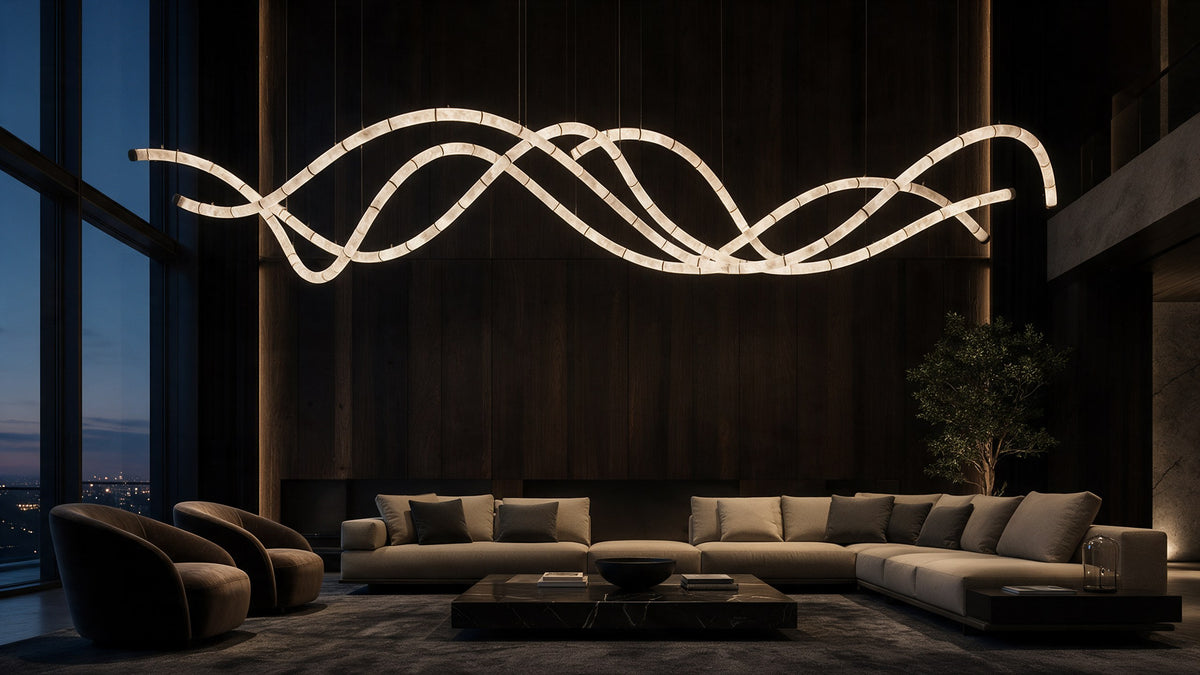
TeeshaaChandelier
a room-by-room guide to the ceiling point, the fan and what to hang or fix instead of a main light.
No, most Indian rooms do not need a centre light. Many homes have one central ceiling point, and in most rooms the fan takes it. Teeshaa alabaster lighting works better where people sit, eat or sleep: pendants over tables, wall lights and table lamps, each with its own switching.
Usually because a standard layout puts one ceiling point in the middle of each room. It is a wiring habit, not a considered way to light a room.
Light from directly overhead throws shadows under the eyes and brows, glares off glossy floors and tables, and leaves the walls dark. So the useful question is where the light should go when the fan has the centre.
No. Keep one only where no fan holds the point and the centre of the ceiling is also the centre of the activity, such as a dining table, a small entrance or a fan-free living room. Elsewhere, light the furniture and the walls instead.
Your plan, furniture and ceiling will change the answer, so treat this table as a starting point.
| room | fan on the centre point? | keep a centre light? | what to do |
|---|---|---|---|
| living room | often yes | only if no fan holds the point and the seating is centred under it | an off-centre pendant or chandelier over the seating group, or wall lights at 150 to 170 cm, plus table lamps |
| bedroom | almost always | no | wall lights centred 100 to 120 cm at each bedside, or table lamps on the side tables |
| dining room | sometimes | yes, if the table is centred under it and no fan holds the point | a pendant over the table with its bottom 75 to 90 cm above it; move the point if the table is off-centre |
| study | often yes | no | a table lamp on the desk, a wall light for the room, a separate task light for reading |
| passage or corridor | rarely | sometimes | a small pendant or wall lights at 150 to 170 cm; a centre light only if the passage is short and wide |
| entrance foyer | rarely | yes | a single hanging piece at the centre that clears head height |
A fan owns the centre of its room, so any hanging light has to sit outside the circle its blades sweep.
Measure your fan's sweep and keep the light well outside it. Small rooms rarely have the space, so use the walls. Never hang a light from the fan's fixing. Follow the fan maker's instructions and have a licensed electrician confirm clearances on site. Living-room layouts with a chandelier and a fan are worked through in chandelier with a ceiling fan.
Living room: over or beside the seating. Bedroom: beside the bed. Dining room: over the table.
In a living room, find the seating group and put the anchor light over it, even if that is off the room's centre. Wall sconces at 150 to 170 cm do the same job from the sides. See living room chandelier for forms and sizes.
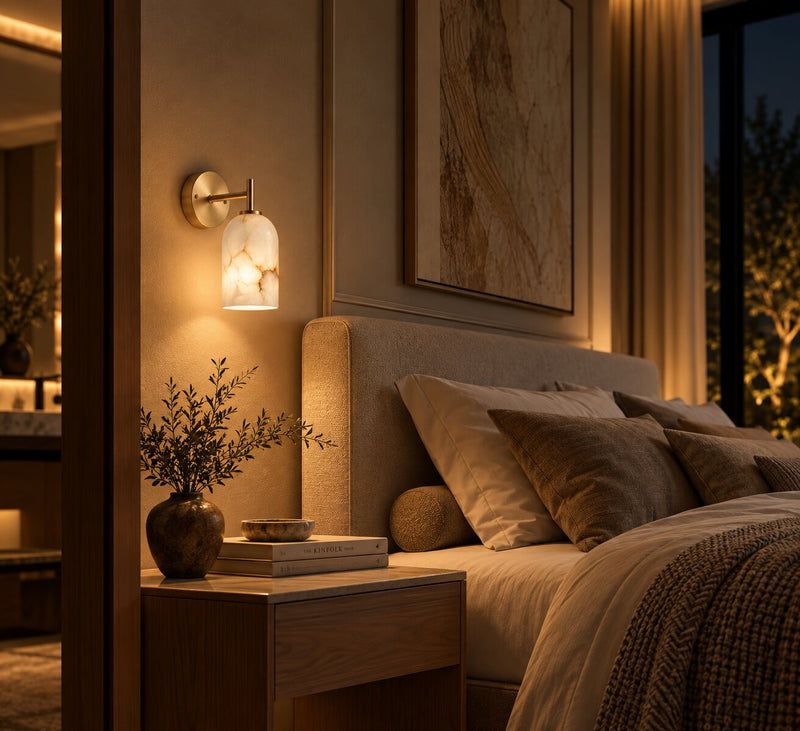
In a bedroom, put a pair of wall lights at 100 to 120 cm from the floor on either side of the bed, or use table lamps, so you can wind down without lighting the whole room. If you read in bed, add a directed light. Our guide to wall lights or table lamps by the bed covers the choice.
In a dining room the table is the centre, and how high to hang a pendant over a dining table gives the height. If the table is not under the existing point, read off-centre ceiling point above a dining table first.
Subtract the cove from the slab height before you choose anything. A 2.7 to 3.0 m slab with a 20 to 30 cm cove leaves a net ceiling of roughly 2.4 to 2.8 m.
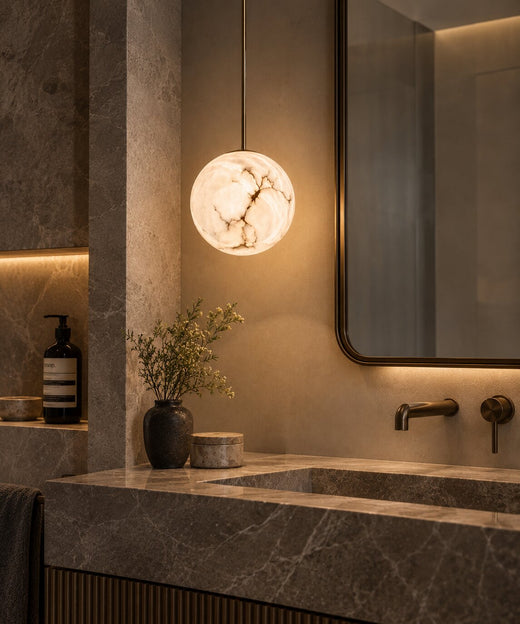
That net figure decides whether a long hanging drop is comfortable or whether a wall or table light is wiser. As general guidance, leave about 2.1 m from the floor to the bottom of a hung light over a walkway, and confirm it on site. Where that leaves too little drop, a flush or cove light is the better tool. Pendants such as the Alabaster Linea Pendant hang on a stainless rod cut to size, up to about 178 cm (70 in) overall on that piece, so ask the studio to set the length to your measured height. Alabaster wall lights need no drop at all.
Yes, and the time to do it is before the false ceiling closes. Relocating a point afterwards means opening finished work.
In a new flat, decide your lighting plan first, then ask your electrician to place points where the pendants and sconces will go, not only at the middle. If the ceiling is already closed, a table lamp avoids new work, and a wall light leaves the ceiling alone but needs a feed in the wall. Dimming is available on request, and on an LED piece the driver can sit in the canopy or remotely, so tell the studio where there is access above the ceiling or behind a wall. Have all wiring done by a licensed electrician, or ask the studio about installation by Teeshaa's team. The one-year warranty does not cover damage caused by an installation done by anyone other than Teeshaa's team; you may use your own electrician, but then the installation cannot be guaranteed.
Teeshaa makes ceiling-hung pieces (chandeliers, pendants and suspensions), wall lights and table lamps in Spanish alabaster, designed in Bangalore and made in its own facilities in India. It does not make fans, flush ceiling lights, downlights or task lights, though Teeshaa Design Labs may develop a flush fitting to a brief.
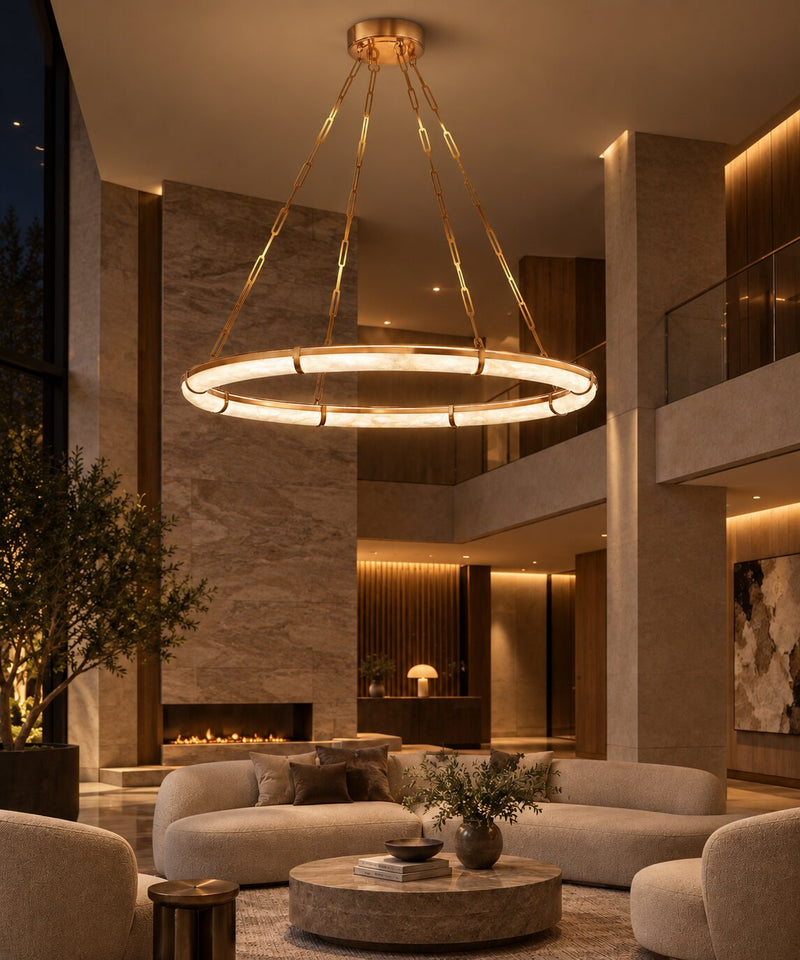
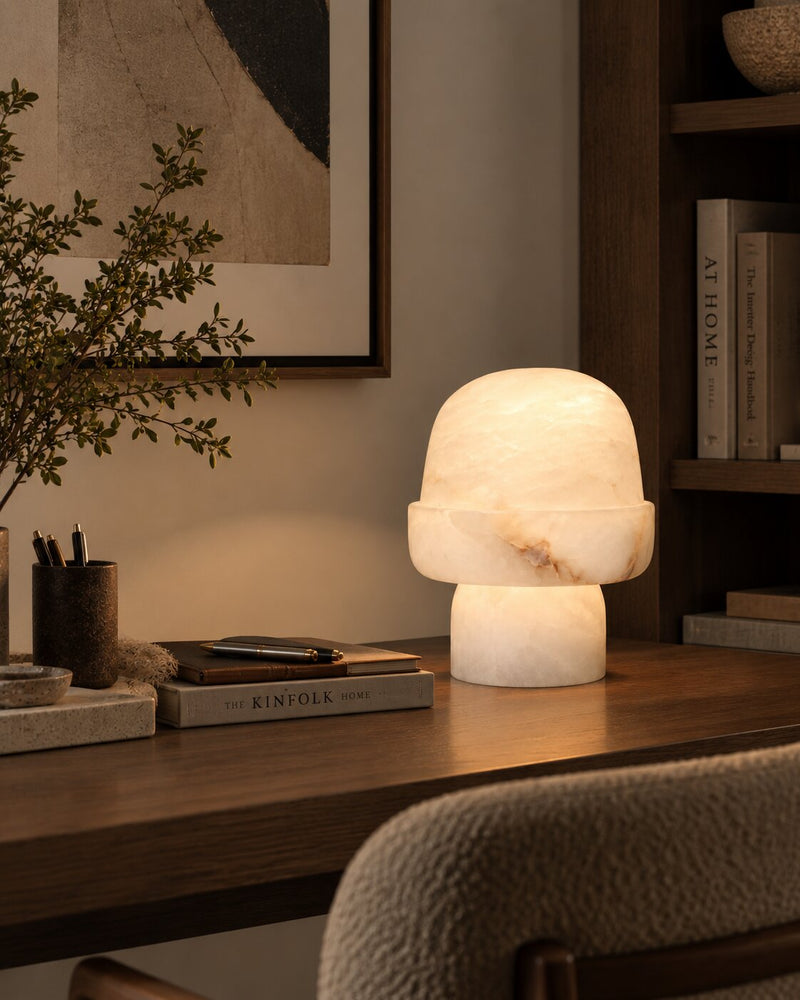
For a hung piece, the Halo Crown Chandelier (a ring from 60 to 120 cm across: the 60 cm is ready to order, larger rings are on enquiry) and the Alabaster Linea H (a single illuminated bar) can hang off-centre over a sofa or table from their own ceiling point. For the walls, the Essenzo Dome Wall Sconce works at a bedside or beside a seating group, but its listed projection is 8 in (about 20 cm), so check that against the space. The Aura Wall Mount, an alabaster disc 7 to 9 cm deep, gives ambient wall light where a passage leaves less room. The Essenzo Porcini Table Lamp suits a bedside or console and needs no ceiling point. Alabaster is a soft, diffused source rather than a task light, so add a directed light where you read or cook. Browse the alabaster lighting hub, or send the studio your room plan through the contact page.
Yes, if each has its own support and the chandelier sits outside the area the blades sweep. Offset a horizontal piece from the fan, or light the room with wall and table lamps. Follow the fan maker's instructions and have a licensed electrician confirm clearances on site.
Yes. A second point lets you keep the fan at the centre and hang a light over a table or seating group. Ask your electrician to add it before the false ceiling is closed, and put the two on separate switches so each can be used alone.
Not always. A short, wide passage can take one hanging light at the centre. A long, narrow corridor is usually better served by wall lights at 150 to 170 cm from the floor, spaced along its length, or a few small pendants in a row if they clear head height.
Yes. Many bedrooms can be lit by wall lights at 100 to 120 cm at the bedside and table lamps, with the fan on the ceiling. For low light at night, ask for dimming: Teeshaa offers it on request, and the dimmer type should be confirmed with the studio before wiring.
Give the finished ceiling height after the cove, where the fan, table and seating will stand, and where each light should hang or be fixed. Ask for any pendant to be supported from the structure, not the false-ceiling board, and for separate switching and the driver location to be agreed.
Last updated 6 November 2026.
 Bedside Lighting: Wall Lights or Table Lamps?Wall lights, table lamps or a pendant at the bedside: how to choose, with mounting heights, colour temperature, switc...Read the guide
 How High to Hang a Pendant Light Over a Dining TableThe 75 to 90 cm rule, a drop table by ceiling height, what a false ceiling changes, one piece or a row by table shape...Read the guide
 Wall Sconce Height and Placement: Bedside, Corridor, MirrorMounting heights for wall sconces by location, with a table, corridor spacing, when to use pairs, how to switch and d...Read the guide
Send the studio your room plan, finished ceiling height and fan position, and ask which hung piece, wall light or table lamp suits the room.