Your cart
(0)
Made to order · dispatched by 24 December

By commission
TeeshaaPendant
four ways to light a dining table when the builder's ceiling point is somewhere else.
To get lights above a dining table when the ceiling point misses it, move the point if a false ceiling exists or is planned. If not, a long linear alabaster pendant may reach both the point and the table centre, so ask Teeshaa's studio where its canopy sits. Otherwise use a sideboard lamp with wall lights.
There is no fixed rule, so it is a judgement by eye. Hang a string or a cardboard mock-up from the point and look at it from the chairs and the doorway. The eye compares the light with the table edges, so a small miss can pass as deliberate and a large one cannot.
Measure both directions, with the table in its real position. An offset along the length can sometimes be absorbed by a longer piece. An offset across the width shows more, because a table is narrow, and a linear piece running along the table cannot absorb it.
Move the point, build an offset run, span the gap with the fixture, or give up the overhead light. The first two need ceiling work, the last two usually do not.
On a slab with no false ceiling planned, spanning or dropping the overhead light is usually simplest. A false ceiling, existing or planned, opens up moving the point.
| Situation | Suggested fix | Trade-off | Who does the work |
|---|---|---|---|
| Bare slab, owned flat, no renovation planned | Span the gap with a linear or multi-point fixture | Works only if the offset runs along the table and the canopy can sit on the point | A licensed electrician; ask the studio about the piece |
| Existing false ceiling, no work planned | Offset run or span the gap | Opening the board for a new run means patching and repainting | Electrician and the person who finishes the ceiling |
| Renovation under way, false ceiling not yet closed | Move the point | Needs a decision on the table position now | Electrician, with the designer or contractor |
| Rented flat, no changes allowed | Sideboard lamp near a socket; wall lights only with the owner's permission | No overhead centre piece; light comes from the side | You for a lamp; an electrician for hardwired wall lights |
Whatever the route, a heavy piece should normally be supported from the structural slab, not the false-ceiling board. The page on installing an alabaster chandelier on a false ceiling covers that, and a licensed electrician or structural adviser should confirm it for your ceiling.
Sometimes. It works when the offset runs along the table, the piece is long enough, and its canopy can sit on the point.
Hang it with the bottom 75 to 90 cm above the table. For length, a general starting point is one half to two thirds of the table. On a 180 cm table that is up to 120 cm, so each end sits 60 cm from the centre, and a point further away is out of reach. The guides to hanging a pendant over a dining table and linear or round pendants go into more detail.
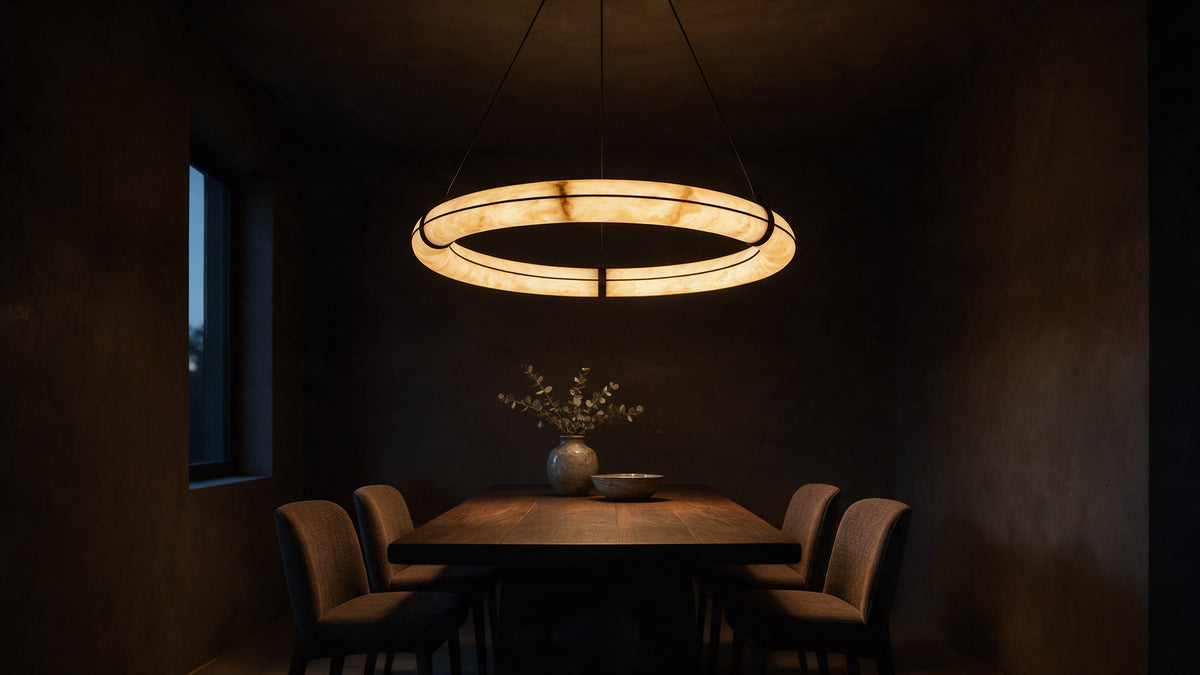
Where a suspension uses a stainless rod, the rod is cut to size, so the drop can be set to your finished ceiling. The Alabaster Linea H, a single illuminated bar, is a starting point: check its length on the product page, and ask the studio how it hangs and where the canopy sits.
Drops hang straight down, so a multi-pendant piece covers an offset only if its total width is large enough. Check the width on the product page, and ask the studio how the canopy and drops are arranged.
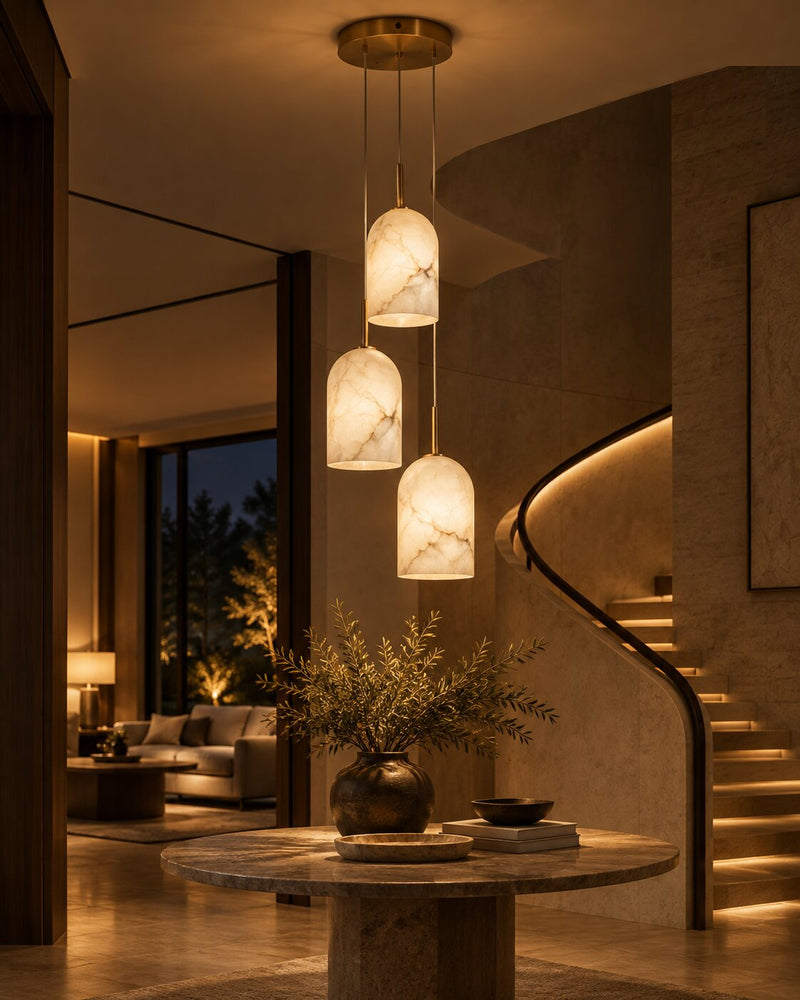
The Essenzo Pendant Cluster P5, listed at about 112 cm (44 in) total width, is the wider starting point. The Essenzo Pendant Cluster P3, about 25 cm (10 in) wide, and the Alabaster Aura Suspension Style 1P3, about 36 cm (14 in) across, are vertical compositions, which suit a point you have already moved over the table.
If the fan sits on the only ceiling point, a pendant there will clash with the blades. The fan usually stays where its box is, so a pendant needs a new point, run through a false ceiling if you have one.
Without a false ceiling, a wall light and sideboard lamp plan often works better than any overhead piece. It gives a side glow, avoids the fan, and leaves the ceiling untouched. See chandelier with a ceiling fan in an Indian living room and confirm any clearances with your electrician.
A Totem Table Lamp, 49 cm tall, suits a sideboard, and the Essenzo Dome Wall Sconce works on the wall beside the table. The page on table lamps for the dining room sideboard goes deeper. Alabaster is a soft glow, not a task light, so add a discreet downlight where the ceiling allows one. Teeshaa does not supply downlights.
Teeshaa makes sculptural lighting in Spanish alabaster, including pendants, linear pendants and dining room lighting, typically hung on stainless rod or wire. Drivers can sit in the canopy or remotely, which helps when the canopy must go into an awkward spot. Keep alabaster away from open balconies, which matters if the dining area opens onto one. See the full range on the alabaster lighting hub.
The one-year warranty does not cover damage caused by an installation done by anyone other than Teeshaa's team. You may use your own electrician, but then the installation cannot be guaranteed. Made-to-order pieces are not eligible for returns, so settle the table position before you order. Ask the studio what is possible for your flat.
Not neatly. On a bare slab, moving a point usually means running surface conduit or cutting into the slab, which needs structural advice. A false ceiling is far easier to work in. Ask a licensed electrician what your building allows, and consider a longer linear fixture instead.
It can be, if a licensed electrician plans it and the hook is fixed to the structure. A swag runs the cable along the ceiling from the point to a hook over the table. Teeshaa suspensions are typically on rod or wire, and a rigid rod cannot swag, so ask the studio whether a piece can be offset first.
As a general starting point, use one half to two thirds of the table length, with the bottom 75 to 90 cm above the table. If the ceiling point is off-centre, check that the canopy can sit on the point while the light stays centred on the table, and ask Teeshaa's studio before ordering.
Teeshaa suspensions are typically a stainless-steel rod cut to size or stainless wire, so give the studio your finished ceiling height when you order. Whether a given piece can be recut later, and on what terms, is a question for the studio.
Teeshaa's custom-made, made-to-order and specially commissioned pieces are not eligible for returns, exchanges or refunds. Other pieces can be returned only if they arrive damaged or with a manufacturing defect, reported within 48 hours of delivery. If you may move, ask the studio whether the rod can be recut.
Last updated 6 November 2026.
 How High to Hang a Pendant Light Over a Dining TableThe 75 to 90 cm rule, a drop table by ceiling height, what a false ceiling changes, one piece or a row by table shape...Read the guide
 Linear or Round Pendant: Which Suits Your Table?Match the light to the table: linear for long rectangles, round for round and square tables. Length, diameter and hei...Read the guide
 Alabaster Pendant Lights: Single, Cluster or Linear?Which pendant format suits which spot, with drop heights by location, a spacing table for islands and tables, and the...Read the guide
Share your ceiling type, table size and where the ceiling point sits, and ask the studio which piece might suit.