Your cart
(0)
Made to order · dispatched by 18 November

By commission

Which pendant format suits which spot, with drop heights by location, a spacing table for islands and tables, and the Teeshaa series to look at for each.
Alabaster pendant lights come in three formats, and the right one follows the spot. A single pendant suits a bedside, a reading corner or a small round table. A cluster suits a stairwell, a double height or a square table, where the eye needs several points of light at different heights. A linear suspension suits a long dining table or a kitchen island, where the light has to run the length evenly. The rest of this guide gives drops, spacing and the series to look at for each.
Choose a single pendant where one point of light is enough and the fitting will be seen close to: a bedside, a corner chair, a small round table or a dressing table. Choose a cluster where the volume is tall or the table is square. Choose a linear piece where the surface below is long.
When a spot could take more than one answer:

Hang pendants 60 to 75 cm (24 to 30 in) apart, centre to centre, with the outer pendants at least 15 cm in from the ends of the island, and the bottom of each 75 to 90 cm (30 to 35 in) above the counter. Divide the island length by that spacing to find how many you need.
Two pendants cover an island up to about 1.5 m. Three cover 1.8 to 2.4 m. Beyond that a linear suspension lights the length more evenly than four separate drops. Slender forms like the Linea column, 6 cm wide, can sit closer together than a 25 cm sphere, which wants the wider end of the range so the forms do not crowd. The kitchen island pendant page has a fuller count by island length.
| Surface | Count and format | Spacing, centre to centre |
|---|---|---|
| Island or table up to 1.5 m (5 ft) | 2 singles | 60 to 75 cm (24 to 30 in) |
| Island or table 1.8 to 2.4 m (6 to 8 ft) | 3 singles | 60 to 75 cm (24 to 30 in) |
| Table or island over 2.4 m (8 ft) | 1 linear suspension | Linear length about two thirds of the table |
| Round or square table 1.2 to 1.5 m (4 to 5 ft) | 1 cluster of 3 or 5 | Cluster width one half to two thirds of the table |
Over a dining table or an island, the bottom of the pendant sits 75 to 90 cm above the surface. Lower reads intimate and suits a small table; higher keeps sightlines open across a kitchen. Where people walk under a pendant, keep 2.1 m (7 ft) to the floor.
At a bedside, most designers hang the bottom of the pendant 100 to 120 cm from the floor, roughly 60 to 75 cm above the mattress top, so it lights the pillow and the book without being in the way of sitting up. Centre it over the outer third of the bedside table, not the pillow. A pendant here frees the table of a lamp base, which is why the bedroom lighting page treats it as a serious alternative to a sconce.
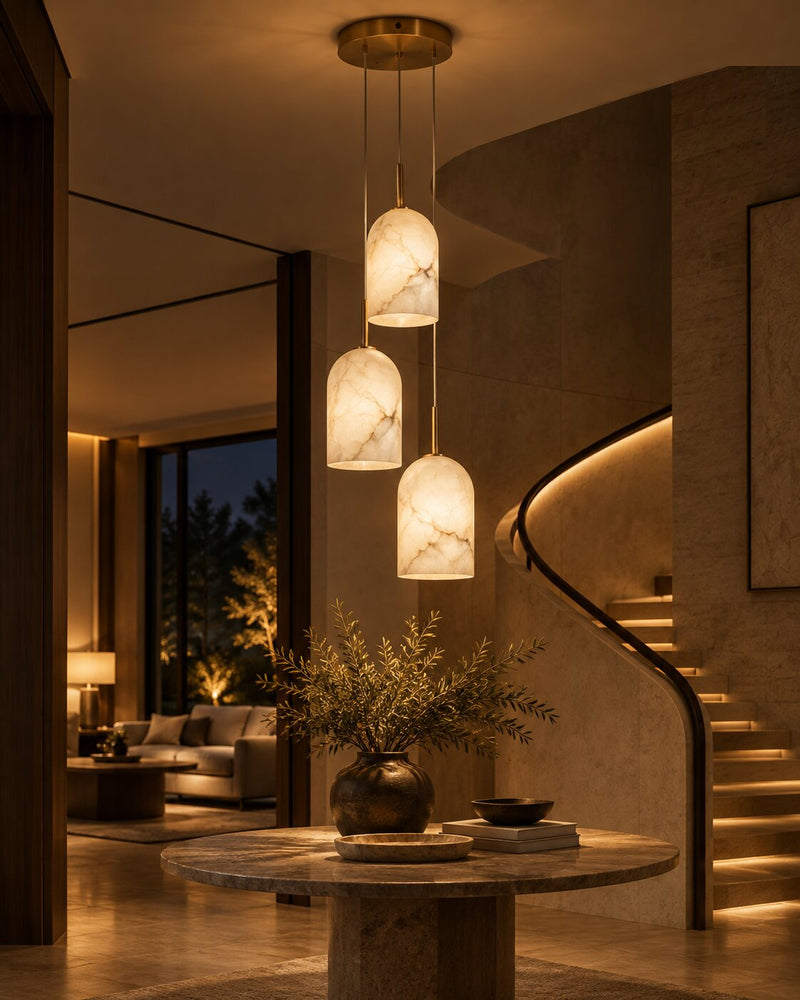
In a stairwell, hang the lowest element of a cluster at least 2.1 m above the treads beneath it and set the visual centre near the eye line of the upper landing. A 2.7 m apartment ceiling with a false-ceiling cove leaves room only for a single or a tight row; double heights of 5.5 to 7 m are where clusters belong. Teeshaa cuts the stainless rod to the drop you give, up to 178 cm on the Linea Pendant.
Teeshaa's pendants come from six series, and the form matters as much as the size. Lana is soft and rounded with organic veining. Totem stacks forms in a vertical rhythm, in Small and Large. Essenzo is domed, in a single pendant, clusters of three and five, and a linear suspension of four. Linea is a slender column cut from a single block, 30 cm tall and 6 cm wide, in singles, a five-piece cluster and a horizontal Linea H. Lunar is a hand-carved sphere at 20 or 25 cm, singly or in a five-piece constellation. Aura is a disc, singly or in threes. The pendant collection shows every one.

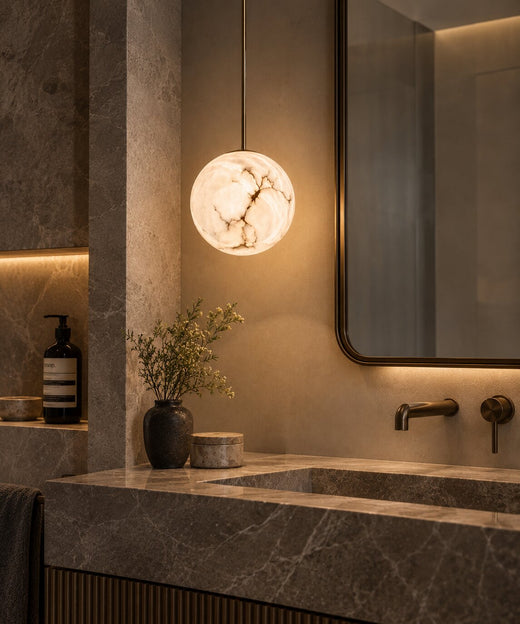
For a single, the Alabaster Linea Pendant is the most adaptable: a 30 cm column at 2700K, slender enough to hang in threes over an island at 60 cm centres and quiet enough to hang alone beside a bed. The Lunar Pendant, a 20 or 25 cm sphere in Champagne Gold, Brass Gold, Black or White, is the single to choose where the form should be seen as an object.
For a cluster, the Essenzo Pendant Cluster P3 puts three domes on one canopy for a round or square table or a small stairwell. For a linear, the Essenzo Linear Suspension P4 runs four domes along one bar for a table of 2.4 m and more; the Linea H does the same with horizontal columns of stone.
Two or three. A 1.8 m (6 ft) table takes two pendants at about 75 cm centres, or three at 60 cm. Keep the outer pendants 15 cm in from the ends of the table so the light stays over the plates, not the chairs.
Yes. Hang the bottom 100 to 120 cm from the floor, centred over the outer third of the bedside table, and put it on a dimmer at 2700K or warmer. It frees the table of a lamp and gives a softer light than a downlight.
Single pendants are hung from a standard ceiling point on a stainless rod, with the driver in the canopy or remote. Clusters and linear pieces carry more weight on one canopy, so fix through to the slab, not gypsum board alone, and have an electrician confirm the anchor.
Browse all three formats on the alabaster pendant lights page, and read the material page for how the stone is selected so that a cluster of five reads as one. For a long table, the dining room lighting page compares a linear piece with a ring.
 Buying Guides6 min read
Chandelier Size Guide for Indian Living RoomsThe length-plus-width rule for Indian room sizes, how low a chandelier can hang under 2.7 m, sharing a ceiling with a...Read the guide
 Buying Guides6 min read
Bedside Lighting: Wall Lights or Table Lamps?Wall lights, table lamps or a pendant at the bedside: how to choose, with mounting heights, colour temperature, switc...Read the guide
 Buying Guides6 min read
Linear or Round Pendant: Which Suits Your Table?Match the light to the table: linear for long rectangles, round for round and square tables. Length, diameter and hei...Read the guide
Teeshaa
Sculptural lighting in Spanish alabaster, designed in Bangalore and made in India. Tell us about the room and we will suggest the piece, the size and the finish.