Your cart
(0)
Made to order · dispatched by 24 December

By commission
TeeshaaChandelier
classic, modern and contemporary lighting compared by form, finish and light, with rules for mixing styles in one home.
Classic lighting suits traditional rooms with symmetry and warm metals, modern lighting suits simple, clean-lined apartments, and contemporary lighting suits homes led by sculptural form and natural material. Let your metals, ceiling height and furniture choose. Teeshaa's alabaster pieces lean contemporary but can sit in a classic scheme, because finish, form and light set the style, not the stone.
Classic lighting is a symmetrical, ornamented look built around a central body with curved arms, warm metals and a glittering or candle-like light. Traditional and antique are close relatives: traditional borrows period references, and antique means an original old piece with patina. An antique look is a new piece finished to look aged.
The root is the candle chandelier. Wikipedia notes that chandeliers were originally designed to hold candles, and that gas and then electric versions followed. Many classic fixtures still echo that arm-and-flame shape.
Modern lighting uses clean geometry, plain surfaces and few ornaments, with roots in the twentieth century. Contemporary lighting is the design of now, so it is not one look: it is often sculptural and led by the material.
The same split exists in architecture. Wikipedia describes modern architecture as a movement prominent in the twentieth century, and contemporary architecture as the architecture of the twenty-first century, with no single dominant style. Lighting follows the same logic.
This table is a guide, not a rule; individual pieces cross the lines.
| Style | Typical forms | Materials and finishes | Light quality | Rooms it suits | Risk of dating |
|---|---|---|---|---|---|
| Classic and traditional | Symmetrical, curved arms, tiers, candle shapes | Brass, gold, crystal or glass drops, patinated metal | Sparkle, exposed or candle-style bulbs, warm | Formal living and dining rooms, foyers, pooja corners | Low if well made; ornament can look heavy in small rooms |
| Antique | Original period pieces | Aged metal, old glass | Warm, uneven, often dim | Rooms built around inherited or collected pieces | Not applicable; value is in age, but have a licensed electrician check old wiring |
| Modern | Discs, spheres, straight lines, simple rings | Metal, glass, painted finishes | Clear, even, neutral to warm | Apartments, open-plan rooms, kitchens | Low for plain geometry; high for trend finishes |
| Contemporary | Sculptural, organic, material-led | Stone, wood, metal in black, white or warm tones | Diffused glowing bodies, warm | Living rooms, bedrooms, staircases, hospitality | Depends on how much the look follows a moment |
As a rule of thumb, a light lasts when its geometry is simple, its material is natural, its finish ages well and its light source can be serviced.
Simple geometry such as a ring, a column or a disc does not belong to one period. Natural materials carry their own variation, so they do not read as a copy of a trend.
Serviceable light sources matter too. Before you buy, ask the studio whether a piece's integrated LED can be serviced or replaced.
Indian homes often blend styles: a traditional pooja corner, inherited furniture and a contemporary open-plan living and dining room. That works if you control sightlines and finishes.
Ceilings shape the choice. Apartment ceilings are commonly 2.7 to 3.0 m, and a false-ceiling cove often takes 20 to 30 cm, so measure the finished ceiling, not the slab. Where a ceiling fan holds the centre, a horizontal piece or a pair of wall lights is easier than a tall tiered classic chandelier; see the guide to a chandelier with a ceiling fan.
A pooja corner suits warm, low light; the mandir and pooja room lighting page covers that. For room-by-room buying, see designer lights for home in India.
Finish and light do most of the work. Brass and gold finishes tend to read classic, black and white contemporary, and exposed bulbs or sparkle read classic where a diffused glowing body reads contemporary.
Metal options differ by piece. Most Teeshaa pieces offer Champagne Gold, Brass Gold, Black and Stainless Steel, while some list their own set: the Aura Wall Mount, for example, includes Antique Brass, Brushed Brass, Polished Nickel and Brushed Nickel. Check each product page; the metal finishes page explains how they pair with alabaster.
Colour temperature also matters. Warm 2700K light suits classic and traditional rooms, and some Teeshaa pieces offer 2000K or 2300K for a softer, candle-like tone.
Keep one style per sightline, one finish family across the room and a consistent scale.
Pick one metal and repeat it in the light, the hardware and a lamp. Change style at a doorway or a clear break, not mid-view. Keep scale consistent too: size the pieces you can see together to the room, so one does not dwarf the others.
| If your home is | Lean towards | Why |
|---|---|---|
| Traditional, with inherited pieces | Classic form in a brass or gold finish | Matches the metals and symmetry already in the room |
| A new apartment with low ceilings | Contemporary or modern, compact or horizontal | Simple forms read lighter under a cove |
| Mixed: pooja corner and open-plan living | Contemporary anchor with warm finishes | A warm finish links the two zones, and the pooja corner keeps its own low light |
| Rented flat | Table lamps | They move with you; ask the studio how a piece is powered |
| Minimalist, neutral palette | Modern or contemporary in white or black | Quiet geometry with soft glow |
Teeshaa's lights are in Spanish alabaster, designed in Bangalore and made in its own facilities in India. They are sculptural and diffused rather than ornamental, so they lean contemporary, and a brass or gold finish can bring them into a classic room.
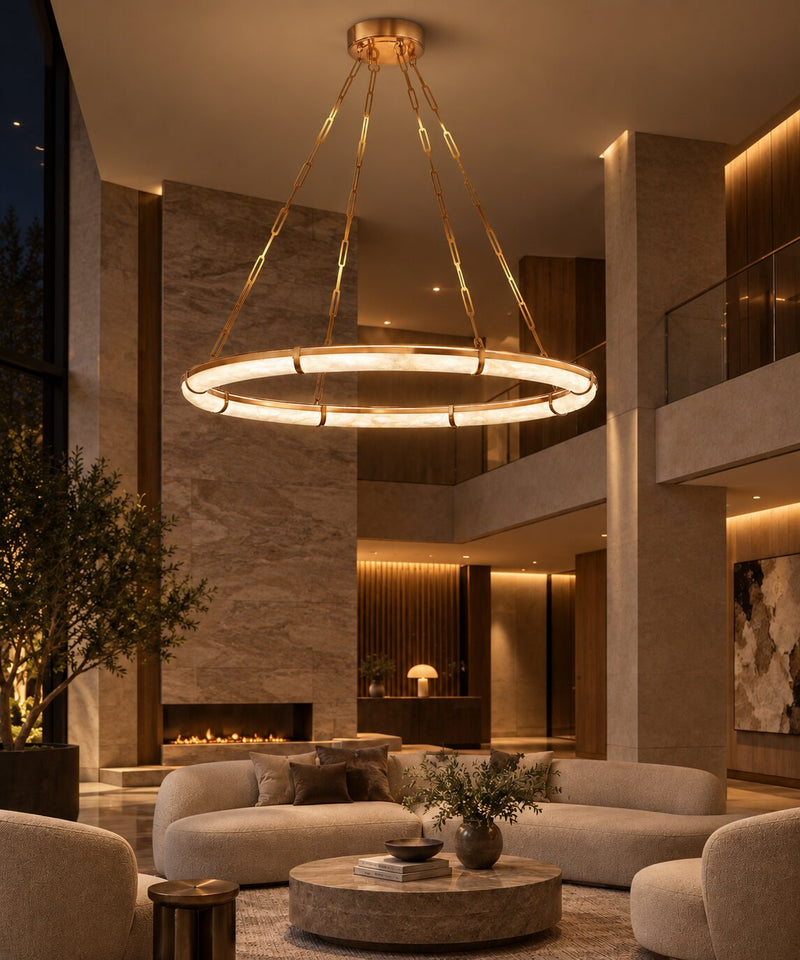
The Halo Crown Chandelier is a ring form that suits modern and contemporary rooms. The Alabaster Linea Pendant is a clean column. The Totem Table Lamp is an easy way to test a style in a room. See the material page and living room chandelier page.
Alabaster is a soft, diffused ambient source, not a task light. For reading or cooking, pair it with discreet downlights; Teeshaa does not supply downlights or bulbs. If you want crystal, wood, glass or an antique-style piece, Teeshaa Design Labs develops lighting in wood, metal, stone, crystal and glass to a brief, including one-off pieces. Share a drawing or a reference through the Design Labs page and the team confirms what is possible. Browse all alabaster lighting to start.
A ring is a plain geometric form, so it reads modern or contemporary by default. Metal finish and light quality shift it: a brass or gold ring with warm light can sit comfortably in a classic room, while black or white metal pushes it contemporary. Teeshaa's ring chandeliers are diffused alabaster, not exposed-bulb sparkle.
Yes. A warm diffused glow suits traditional rooms. Choose a brass or gold finish, a symmetrical form and warm light. Teeshaa's pieces are sculptural rather than period reproductions, so they read classic by finish and placement, not by ornament.
Anything tied to a passing finish or a very specific look dates fastest, whatever the style label. Simple geometry, natural materials and finishes that age well tend to last longer. A light source you cannot service also dates a fitting, because the whole piece may need replacing when the source fails.
Pick a style that is easy to move: a table lamp travels with you. Neutral geometry in a contemporary or modern vein fits most rented interiors. Teeshaa's table lamps, such as the Totem and Pebble Lamp, suit this; ask the studio how a piece is powered. Ask your landlord before drilling or changing ceiling points.
Yes. The look comes mainly from form, finish and colour temperature, so LED can carry it. Use a warm 2700K or 2300K source, an aged-looking brass finish and a symmetrical shape. Teeshaa's own collection is Spanish alabaster, with no antique or crystal pieces, and it does not supply bulbs. Teeshaa Design Labs develops lighting in wood, metal, stone, crystal and glass to a brief, and the team confirms what is possible.
Last updated 6 November 2026.
 How to Choose an Alabaster Chandelier: Size, Drop and RoomA size table for Indian rooms and tables, drop heights for false ceilings and double heights, and how to choose betwe...Read the guide
 Chandelier Size Guide for Indian Living RoomsThe length-plus-width rule for Indian room sizes, how low a chandelier can hang under 2.7 m, sharing a ceiling with a...Read the guide
 Alabaster vs Marble vs Onyx: Which Stone Is Best for Lighting?Which stone is best for lighting? Alabaster glows evenly, onyx shows bold bands, marble belongs in bases. Translucenc...Read the guide
Describe the room and ceiling height, and ask the studio which forms and finishes to consider.