Your cart
(0)
Made to order · dispatched by 24 December

By commission
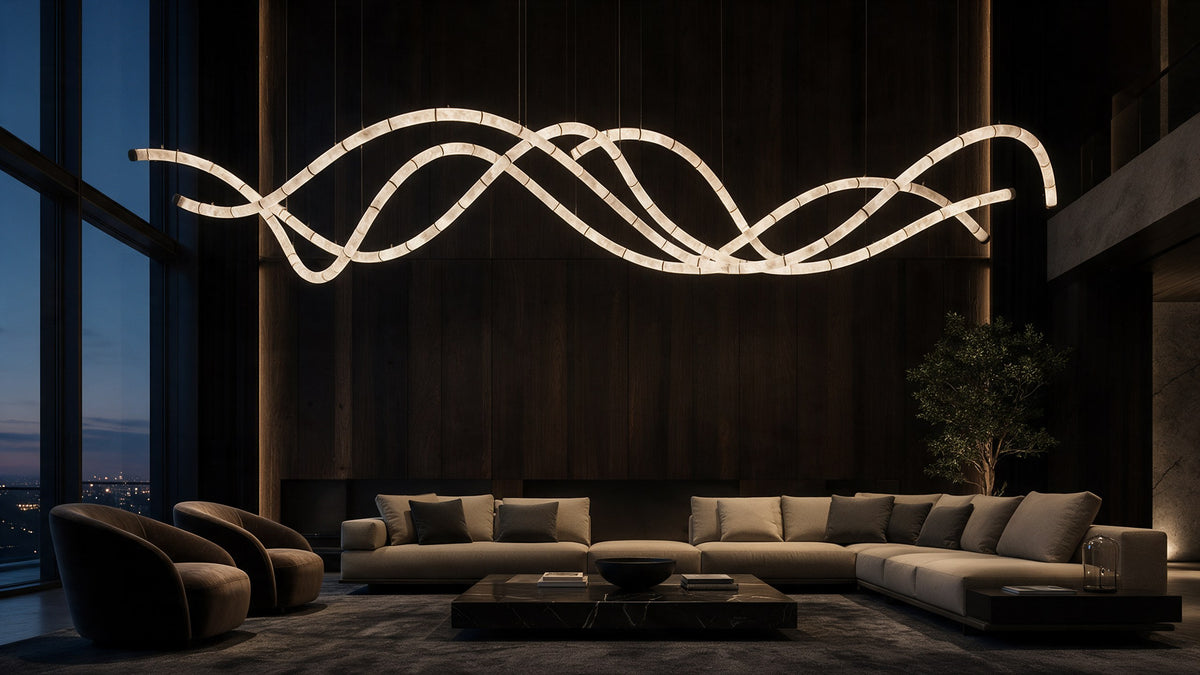
TeeshaaAll Lighting
a zone-by-zone scheme for the hall, from the ceiling fan and cove to the wall lights, lamps and switches.
Good living room lighting design in India splits the room into zones and gives each one its own light: a soft hung source or cove glow for ambience, wall lights and table lamps at the seating, console and corner, and low indirect light at the TV wall, all on separate switches. Teeshaa's alabaster lighting suits the ambient and accent layers.
Give each zone a small source of its own rather than relying on one central fitting. For lamp design in a living room, ask where the light lands before you ask how the fixture looks.
| zone | light | mounting height | switch group | mistake to avoid |
|---|---|---|---|---|
| seating | a hung chandelier or ring, plus a table lamp beside the sofa | set by the finished ceiling and the fan | ceiling group, and a separate lamp group | one overhead source doing every job |
| TV wall | low, indirect light beside or behind the screen | out of the viewing line | its own switch | a bright source facing the screen |
| console or entry edge | a pair of wall lights, or one table lamp | wall lights centred 150 to 170 cm from the floor | wall group | mounting at a height chosen by habit |
| corner | a shelf or table lamp, or one wall light | lamp on a shelf or low table; wall light at 150 to 170 cm | lamp group | leaving the corner with no light of its own |
| balcony door | a wall light or table lamp set back inside the room; no alabaster on the balcony or in a splash zone | wall light at 150 to 170 cm; lamp on a low table | wall or lamp group | stone near rain or spray |
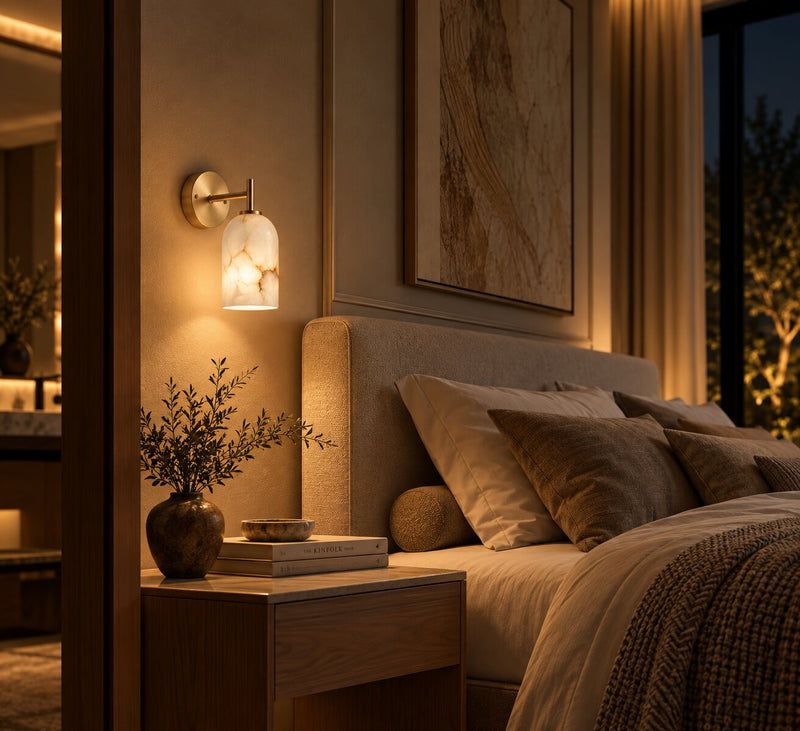
See the wall sconce height guide and wall lights for the living room.
If a fan holds the centre, offset the chandelier or ring to one side of it, over the seating, or let wall lights and table lamps carry the room.
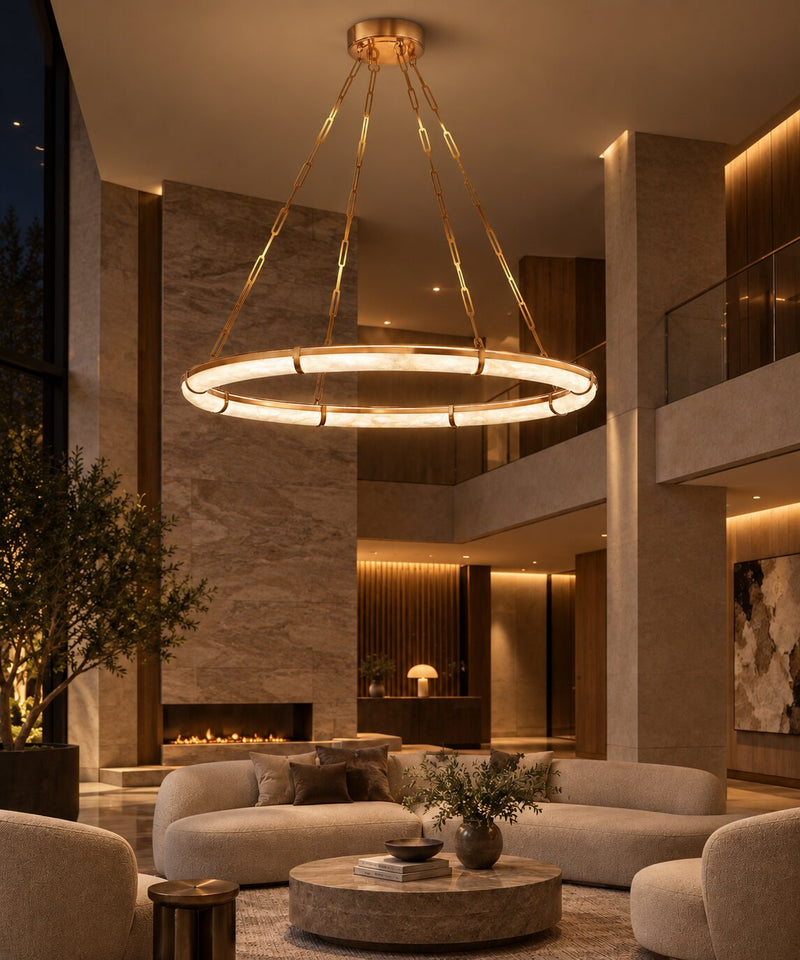
As general guidance, keep a hung piece outside the circle the blades sweep, and confirm clearance on site with a licensed electrician. Horizontal and ring forms often sit better beside a fan than a tall drop. Our guide to a chandelier with a ceiling fan goes through the layouts.
If the false ceiling is dropped across the room, the finished height may be roughly 2.4 to 2.8 m (slab height less the cove), and that net height sets the drop left for a pendant or chandelier. A common rule of thumb, not a cited standard, keeps the lowest point over a walkway about 2.1 m above the floor. Where that leaves no room for a drop, a flush or cove light is the better tool, or leave the ceiling to wall lights and lamps. Any hung piece needs a support that reaches the structural slab, not the false-ceiling board, so use a licensed electrician or structural adviser. For sizing, see the chandelier size guide for Indian living rooms.
| ceiling situation | main piece | supporting layers | note |
|---|---|---|---|
| no false ceiling, no fan at centre | a hung chandelier or ring, centred on the seating | wall lights at 150 to 170 cm, a lamp at the sofa | plan the wiring before painting |
| cove only | cove glow as the base, a hung piece as focus | lamps and one wall pair | confirm the net drop |
| cove plus a fan at centre | an offset ring or horizontal piece, or no hung piece at all | wall lights and table lamps do most of the work | licensed electrician confirms clearance from the blades |
For more on the hanging choice itself, see hanging lights for the living room in India.
Keep bright sources off the wall opposite the screen, and choose diffused light. Reflections depend on where the source sits relative to the seats.
Alabaster is a diffused source rather than an exposed one. Place wall lights on the side walls or beside the screen, not facing it, and check from the sofa that the screen does not show them. The same applies to balcony doors and large windows, so check the reflection from your seat after dark. Some designers add low indirect light behind the TV; Teeshaa does not supply LED strips, so ask your electrician or designer.
Put the ceiling, wall and lamp layers on separate switches, and dim the ambient layer.
A workable evening setting is the ambient piece low, with wall lights and one or two lamps on. Teeshaa offers dimming on request, and on integrated LED pieces the driver can sit in the canopy or remotely. Ask the studio which dimmer to specify before wiring.
Treat each arm or end as its own zone, and let one family of form, finish and warmth run through them.
Where the hall opens onto the dining table, hang a pendant with its bottom 75 to 90 cm above the table, or a chandelier no wider than one half to two thirds of the table width, and keep the sofa side lit by lamps and wall lights. For narrow plans, lights for a long narrow living room goes into the detail.
Use fewer, quieter sources and let one piece lead. Where these rooms are used mostly in the evening, lamps and wall lights matter more than a bright ceiling.
Choose one hung piece or a pair of wall lights as the focus, add two lamps, and dim what you can. For contemporary lounge lighting, keep the form restrained, such as a ring, a column or a plain wall disc.
Teeshaa Lighting makes sculptural lighting in Spanish alabaster, designed in Bangalore, with stonework, metalwork, engineering and assembly in Teeshaa's own facilities in India.
Teeshaa does not supply bulbs, strips, downlights, or flush or outdoor fittings. For a form or material the collection does not use, Teeshaa Design Labs develops lighting in wood, metal, stone, crystal and glass to a brief, including one-off pieces. Share a drawing or a reference through the Design Labs page and the team confirms what is possible.
Installation is by your own licensed electrician or, on request, Teeshaa's team (ask the studio). The one-year warranty does not cover damage caused by an installation done by anyone other than Teeshaa's team; you may use your own electrician, but then the installation cannot be guaranteed.
Start from the alabaster lighting hub or the living room chandelier page, then contact the studio with your room dimensions.
Yes. Without a false ceiling the full slab height is usable, so a hung chandelier or ring can carry the general room light, offset if a fan holds the centre. Add wall lights and table lamps at the sofa, console and corner, and plan the wiring early.
Treat each arm of the L as its own zone: one for seating, one for dining or the entry edge. Give each arm its own ceiling light and switch group, and repeat one finish and colour temperature across both.
Light them as two zones that share one form, finish and colour temperature. Hang a pendant over the dining table, its bottom 75 to 90 cm above the surface, and light the sofa side with lamps and wall lights. Give each zone its own switch.
There is no fixed number. Think in layers instead: one ambient source overhead, one accent source such as a wall light or table lamp in each zone you use, and task light only where you read, with each layer on its own switch.
Wall lights keep the floor and side tables free, so they suit a narrow or small hall, centred 150 to 170 cm from the floor. Table lamps need a surface and a socket, but they are movable and easy to add later.
Last updated 6 November 2026.
 Chandelier Size Guide for Indian Living RoomsThe length-plus-width rule for Indian room sizes, how low a chandelier can hang under 2.7 m, sharing a ceiling with a...Read the guide
 Wall Sconce Height and Placement: Bedside, Corridor, MirrorMounting heights for wall sconces by location, with a table, corridor spacing, when to use pairs, how to switch and d...Read the guide
 A Lighting Plan for a Villa, Room by RoomVilla lighting room by room: double-height volumes, stairwells, dining, bedrooms, corridors and verandas, with height...Read the guide
Send the studio your room dimensions and ceiling details and ask which pieces suit each zone.