Your cart
(0)
Made to order · dispatched by 24 December

By commission
TeeshaaTable
warm lighting room by room: where it belongs, where it fails, and how to pair it with task light.
Warm lighting suits the rooms where you relax: living room, dining, bedroom, a pooja corner and night-time corridors. It fails over kitchen counters, study desks and make-up mirrors, which need neutral task light. Teeshaa's alabaster lighting is a warm, diffused source, so pair it with discreet task lights where you work.
Warm lighting is light on the amber side of white: from a deep candle-like glow to a soft, cosy white. It is measured in kelvin, and the lower the number, the warmer the light. The colour temperature page explains the scale.
In a warm climate, warm light reads as cosy rather than hot. The colour does not change the temperature of the room. Many people find warm light more relaxing in the evening, which is why it suits the rooms you rest in.
Living areas, dining spaces, bedrooms and quiet corners want warm lighting. Rooms where you cut, read small print or check your face need a second, neutral layer.
| room or moment | warm light role | watch out for | practical note |
|---|---|---|---|
| living room | main ambient glow from a hung piece, plus table or wall lights | one overhead source feels flat; add lamps at sofa height | a fan often holds the ceiling centre, so hang the piece away from the blades or lean on wall and table lamps |
| dining area | warm pendant over the table | full brightness can be too much for a late meal, so ask for dimming | hang the bottom 75 to 90 cm above the table |
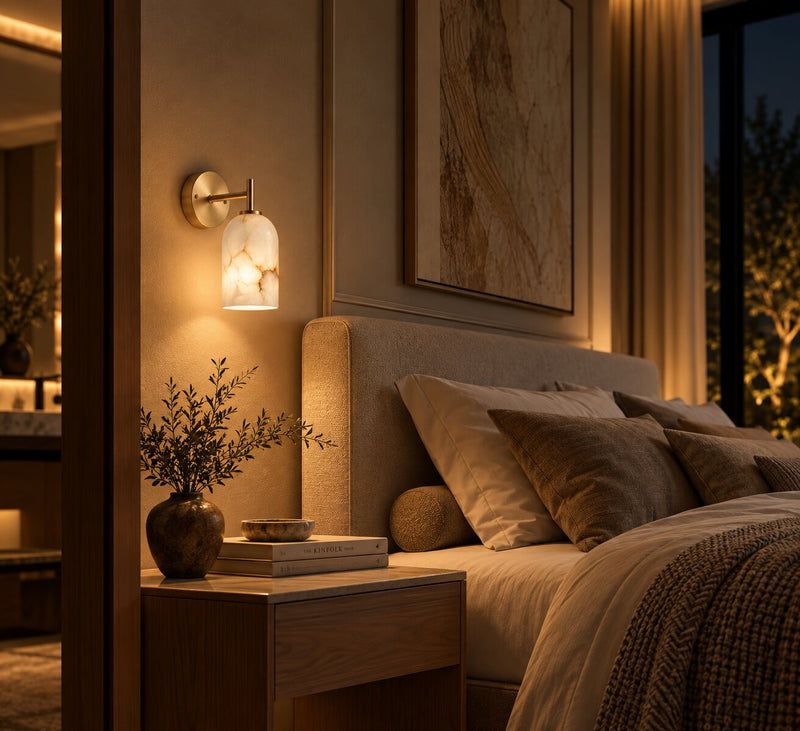
| bedroom | low, dimmable warm lamps at the bed | a bright ceiling light feels harsh late at night, even a warm one | centre bedside wall lights 100 to 120 cm from the floor |
| pooja corner | soft warm accent on the shelf | detail work and reading need a small neutral light | keep fixtures a safe distance from open flames and diyas |
| corridor at night | soft warm wall light, dimmed | avoid glare when you wake | wall lights sit 150 to 170 cm from the floor in corridors |
| kitchen worktop | not the main source | shadows and misread colours on food | use neutral task light under cabinets |
| study desk | warm ambient behind, not on the page | a diffused glow puts too little light on the page | a directed desk light does the work |
| make-up or dressing mirror | warm room light only | skin and colour look different under warm light | use neutral light at the mirror |
Warm-only lighting fails wherever you judge colour or need crisp detail: kitchen counters, desks, make-up mirrors and small print at a pooja shelf. The cure is not to give up warmth but to add a separate neutral task light.
Alabaster is a diffused ambient and accent source, not a task light, so it sets the mood while a discreet downlight or small lamp handles the job. Neutral here simply means a whiter light than the alabaster; your lighting supplier can advise on the exact rating. Put the two on separate switches.
For two of these corners, see lighting a study or work-from-home corner and lighting a home mandir or pooja room.
The surface that the light passes through or lands on changes how warm it looks. A translucent stone body can make the glow look warmer than the LED rating on the label.
Clouding and veining differ block to block, so the same 2700K source can read differently from piece to piece, as the colour temperature page explains. Judge a piece lit, not unlit: look at photographs of it switched on, and ask the studio what can be seen during a visit.
Room surfaces matter too:
Keep one warmth in each view. If you can see two lights from the same spot, they should match, or the room looks patchy: one cool-looking and one yellow-looking.
The common cause is mixed bulbs: shop-bought bulbs labelled "warm white" that differ in colour temperature end up side by side. Choose one rated colour temperature for every bulb you buy, and replace a whole set together.
Keep to three habits:
Task lights are the one exception to matching. A neutral light at a worktop, desk or mirror can share a room with warm light if it is aimed at the work, shielded from the seat and on its own switch. Where a downlight stays in the same view as the alabaster, keep it at 3000K or below.
Choose 2700K for most rooms, 2300K or 2000K for late-evening rooms and quiet corners, and 3000K where warm light has to share the space with work. Check the product page, since the options vary by piece.
| option | how it reads | suits | watch out for |
|---|---|---|---|
| 2000K | deep amber, close to a candle or oil-lamp glow | pooja corner, bedside, a lounge used at night | dim and reddish in the day; colours look muted |
| 2300K | soft amber | bedroom, night-time corridor, evening living room | needs a neutral task light nearby |
| 2700K | soft warm white, the usual default | living room, dining, most hung pieces | keep it away from a cooler light in the same view |
| 3000K | warm white, crisper | kitchen-adjacent dining, a room with little daylight | can feel less cosy in a bedroom |
Teeshaa makes lighting in Spanish alabaster, designed in Bangalore and made in its own facilities in India. It is a warm, ambient source, so it covers the "warm" half of the plan above. Teeshaa does not sell bulbs or task lights, so plan those separately. The alabaster lighting hub shows the whole range.
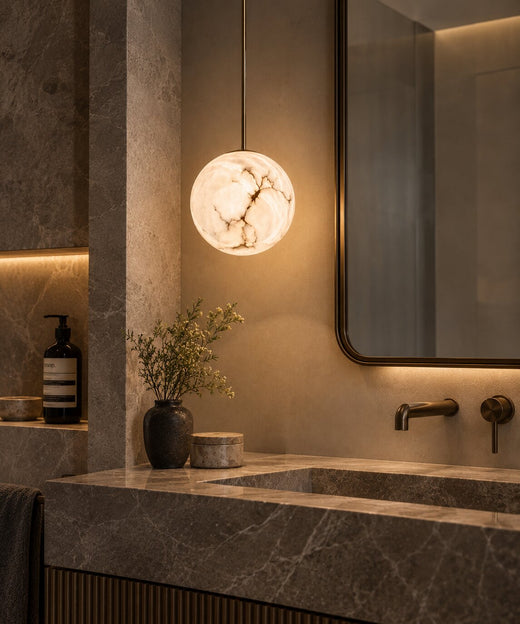
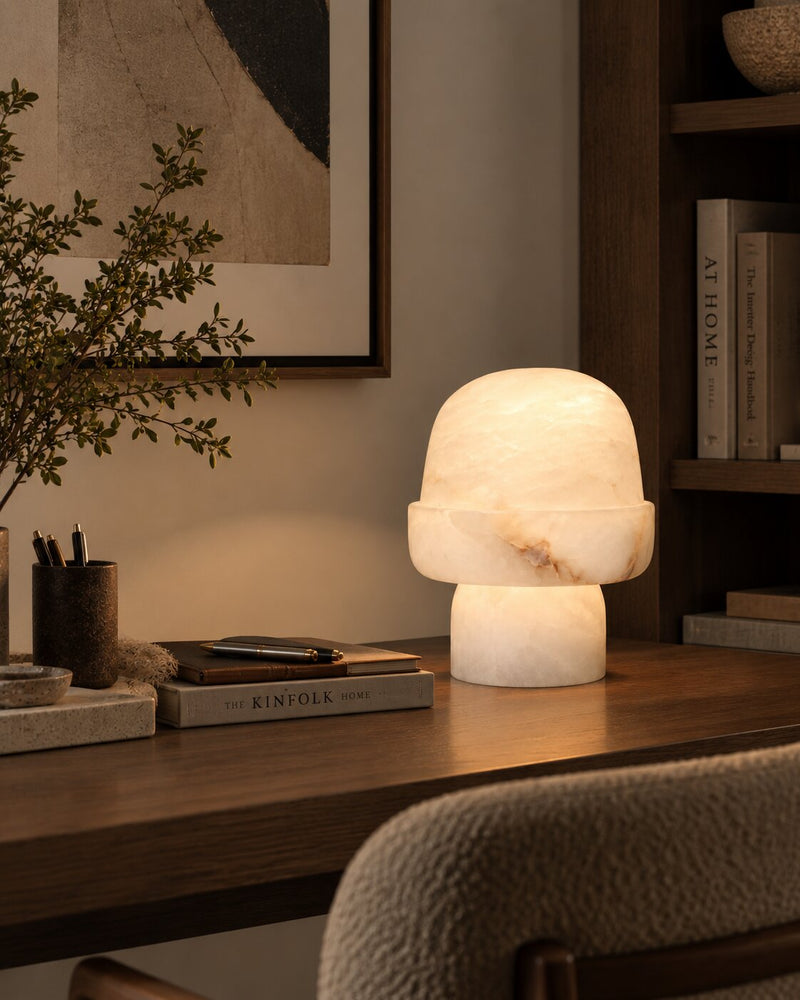
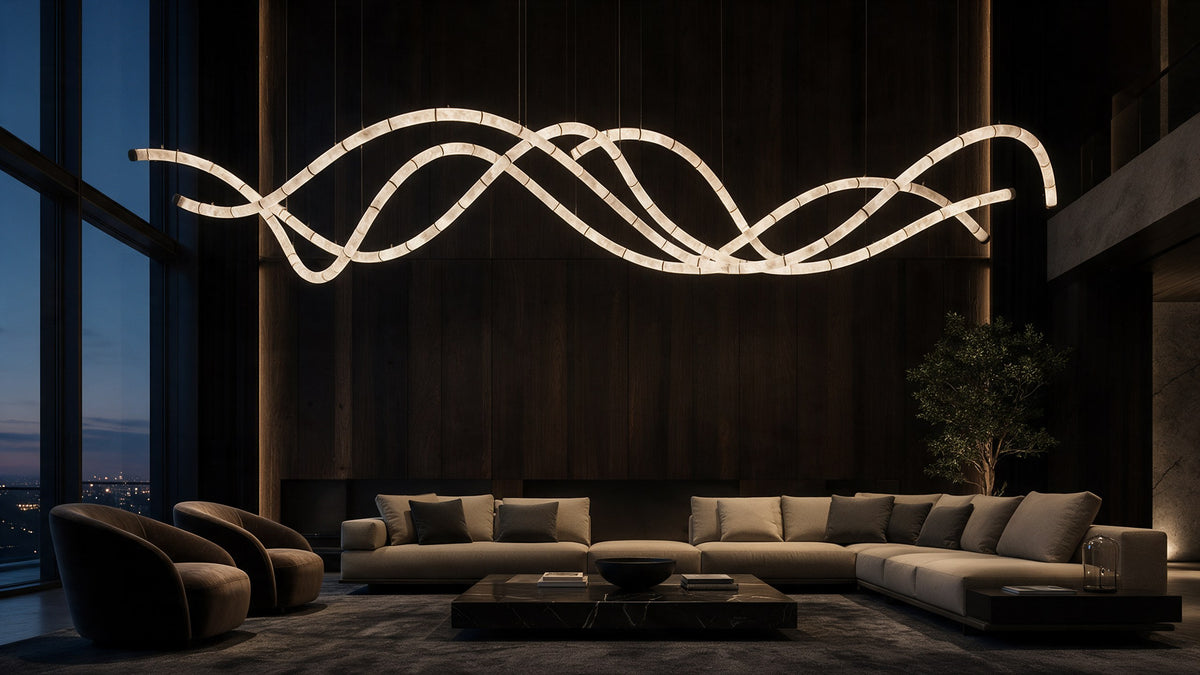
For a dining table or a living-room corner, look at the Alabaster Linea Pendant, a narrow alabaster column, or the Lunar Pendant, a sphere from 20 to 40 cm across. A larger living room may want a chandelier. For the bedside, look at the Totem Table Lamp, the Pebble Lamp or the Essenzo Porcini Table Lamp, which lists an E26/E27 bulb fitting at 2700K, so keep any replacement at that rating. For a bedside wall or a corridor, the Essenzo Dome Wall Sconce gives a diffused accent; its product page lists an 8 inch (about 20 cm) projection, so check that against the corridor width. Browse table lamps or the bedroom lighting page.
No. Many people read comfortably under warm light. What matters more is enough light, aimed at the page, without glare. Alabaster gives a diffused glow, so for long reading or small print add a directed reading light beside the chair or bed, and keep the alabaster piece as the soft background.
Warm light is a low colour temperature, roughly 2000K to 3000K, which looks amber to soft white. In everyday speech, "yellow light" usually means the same thing. A light looks more yellow beside a cooler one or on a cream wall, so keeping one warmth in each view stops the room reading as patchy.
It depends on the piece. Where a light takes a replaceable bulb, a different bulb changes the warmth. Where the LED is integrated, the colour temperature is set when the piece is made, so ask the studio before assuming it can change. Dimming, available on request, lowers the level, but on most LED fittings it does not make the light warmer.
Yes. Colour temperature describes the colour of the light, not the heat in the room, and the fan still cools it. Where the fan holds the ceiling centre, put warm light into wall lights, table lamps and a hung piece placed away from the blades. Confirm clearances with a licensed electrician before fixing anything.
It can be, with care. A flat that gets little direct sun leans on artificial light all day, and a single warm source can look dim and heavy on a grey afternoon. Use several warm sources at different heights, keep walls light, and consider 3000K in rooms that must feel brighter.
Last updated 6 November 2026.
 Bedside Lighting: Wall Lights or Table Lamps?Wall lights, table lamps or a pendant at the bedside: how to choose, with mounting heights, colour temperature, switc...Read the guide
 A Lighting Plan for a Villa, Room by RoomVilla lighting room by room: double-height volumes, stairwells, dining, bedrooms, corridors and verandas, with height...Read the guide
Tell the studio your rooms, ceiling heights and preferred warmth, and ask which pieces suit.