Your cart
(0)
Made to order · dispatched by 18 November

By commission
TeeshaaAll Lighting
a visual guide to the colour, clouding, veining and glow of alabaster, and what is normal in the stone.
Alabaster is a soft, translucent stone that ranges from snow white through cream and honey to pale grey and amber, usually marked with cloudy patches and veins. Teeshaa's Spanish alabaster lighting looks quiet and pale when unlit and glows from within when lit, and no two blocks look alike.
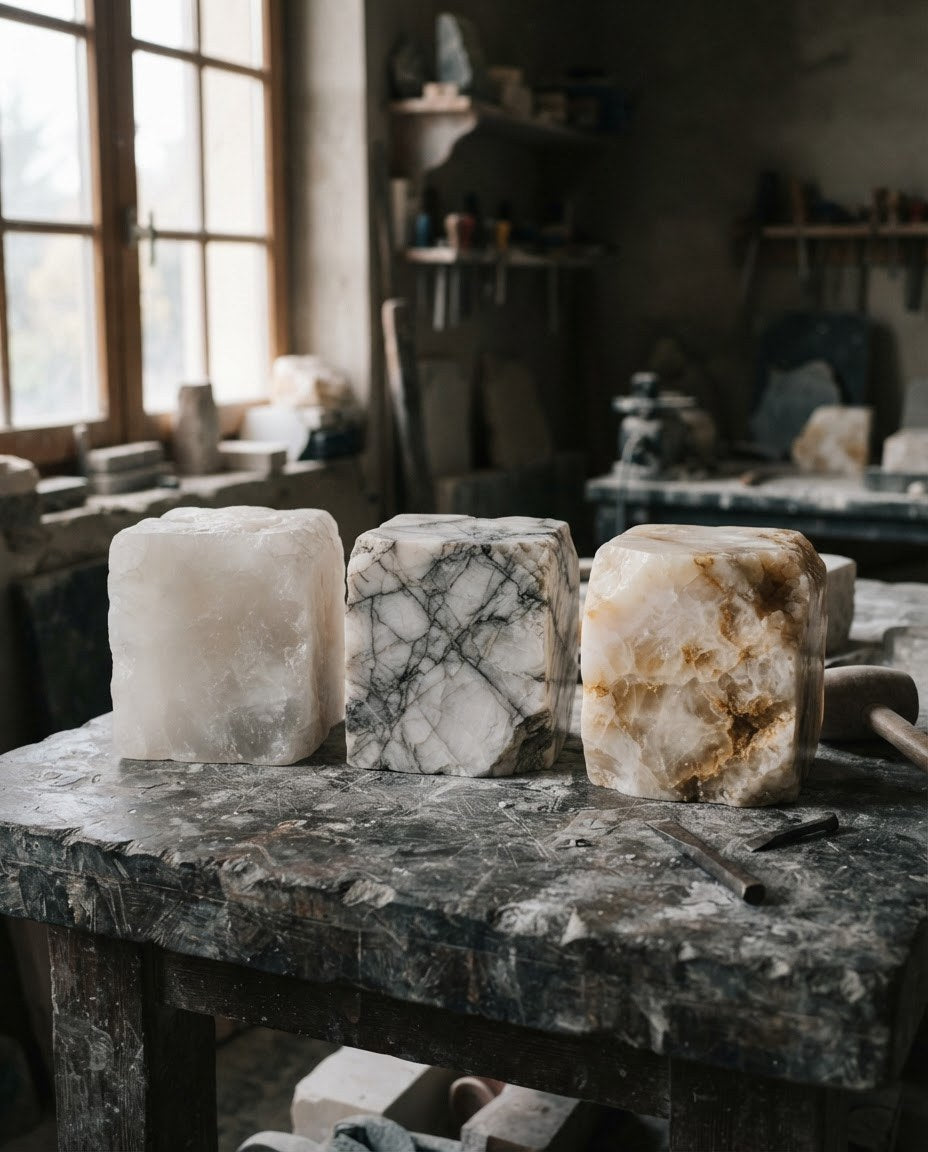
Alabaster runs from white to cream, honey, pale grey and amber, and most blocks mix several of these tones. The purest alabaster is white, and mineral impurities add the rest.
Iron oxides are the usual cause of brown clouding and veining in gypsum alabaster. Calcite alabaster, the other stone sold under the name, is often banded in cream and brown. The stone is also porous and can be dyed, so a very bright or even colour is a reason to ask the seller what has been done to it.
For a buyer this means a range, not a single shade. Read the difference between Spanish and Egyptian alabaster if the two minerals are confusing you.
They are the stone's own mineral structure, not surface decoration. Clouding appears as soft, hazy patches, veins as thinner lines running through the block, and inclusions as small pockets or passages of other mineral, often read as amber or honey.
Teeshaa describes the variation in its stone in three broad ways: some blocks read soft and cloudy, some carry grey veins, and some hold warmer amber inclusions or denser mineral passages. Because veins run through the stone rather than sitting on it, they continue around edges and cut faces. The guide to telling real alabaster from resin explains why that matters when you compare pieces.
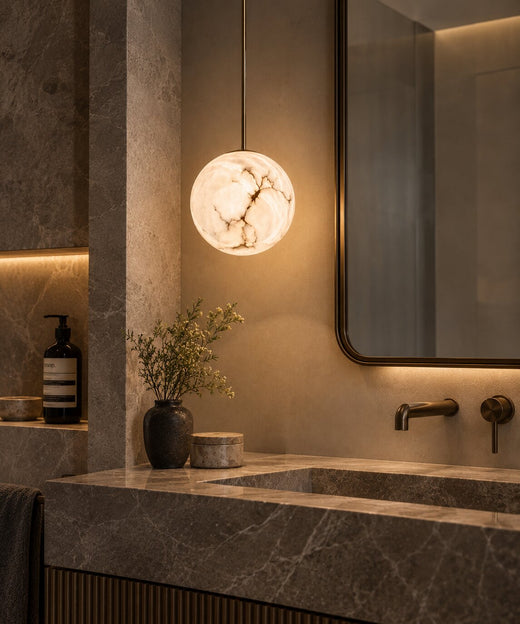
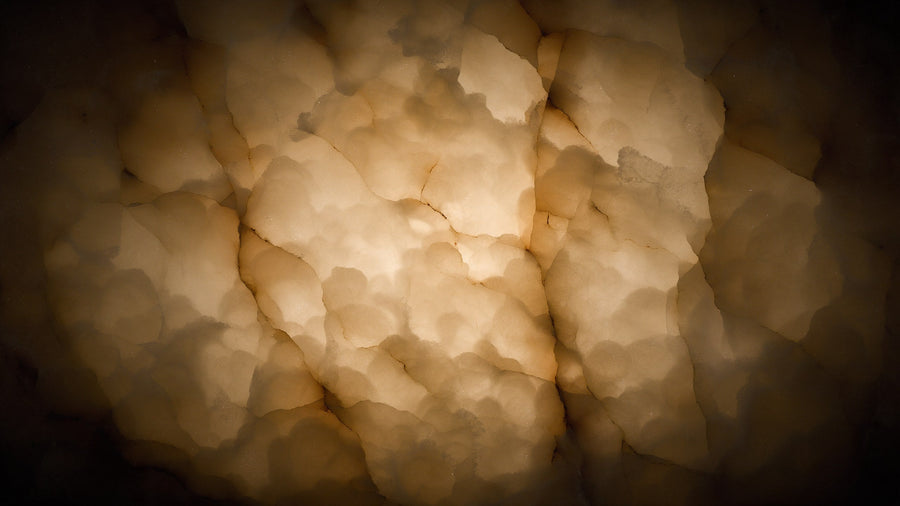
Unlit, alabaster looks pale, soft and sculptural. Lit, light scatters inside the stone and the piece seems to glow from within, with clouds turning into gentle gradients.
Switched off, most of what you notice is surface: the overall tone, the outline of the veins and how the light of the room falls on the form. Switched on, the veins read as darker lines against the glow, denser passages glow less and amber areas turn warm. A warm light source adds to this, and most Teeshaa pieces use an integrated LED at 2700K, which makes cream stone look warmer than daylight does.
This is why Teeshaa reviews the stone both unlit and lit. A photograph taken in one state tells you only half of the story, so ask to see both before you choose.
Yes. Alabaster can be polished to a high gloss, which looks smoother and more glass-like, while a matte surface looks softer and chalkier. Thickness, curvature, edge detail and distance from the light source also change how the stone glows.
A thin wall passes more light and shows more of the internal structure. A thick section looks denser and holds its colour more strongly. Because of this, the same block can look different as a ring, a column and a disc. Check the product photographs for the exact form you are buying.
As a colour name, alabaster means a whitish off-white, named after the mineral. The stone itself is more varied than any single swatch.
Wikipedia's list of shades of white includes a colour called alabaster, described as representing the whitish colour of the mineral. Paint and fabric makers use the name for slightly different off-whites, so a shade called alabaster on one chart will not match another. Treat it as a family of soft whites, and judge any paint or fabric from a physical sample. The real stone adds cloud, veins and glow that no flat colour can copy.
Use this table to match what you see in a piece of alabaster to its likely cause. Most of what looks unusual is the stone doing what alabaster does.
| What you see | What it is | Is it normal? |
|---|---|---|
| Soft, hazy white patches | Clouding in the stone | Yes. It is one of the defining traits of the material. |
| Grey lines running through the stone | Veining | Yes. Natural variation is not treated as a defect under the returns policy. |
| Warm amber or honey patches | Mineral inclusions, sometimes tinted by iron oxides | Yes. They often glow warm when lit. |
| Overall cream or ivory tone | The natural colour of the block, warmed further by a warm light source | Yes. |
| Darker, denser spots that glow less | Denser mineral passages | Yes. |
| Regular stripes or bands in layers | Banding is typical of calcite alabaster | Ask the maker which mineral the stone is. |
| Perfectly even colour with no variation | Possibly a resin or glass imitation | Uncommon in natural stone. Compare against the real-versus-resin checks. |
| A surface that has turned whiter, rougher or dull | Surface damage, for example from detergent or moisture | No. Follow the care guide supplied and contact the studio. |
| A yellow or brown cast that deepens over time | Several possible causes, from natural tone to handling and residue | Depends on the cause. See whether alabaster turns yellow. |
Ask to see the piece or its stone both unlit and lit, from more than one angle, and compare it with the room you plan to put it in. Photographs and screens vary, so use them as a guide, not a match.
Some Teeshaa pieces are made to order, and made-to-order pieces are not eligible for returns, exchanges or refunds, so it helps to look closely before you order. Architects and interior designers can request alabaster samples against an active project through the trade programme. Anyone can arrange a studio visit in Bangalore by appointment through the contact page. The studio is a workshop, not a retail showroom, and there is no showroom in any other city. The refund policy sets out the exact terms.
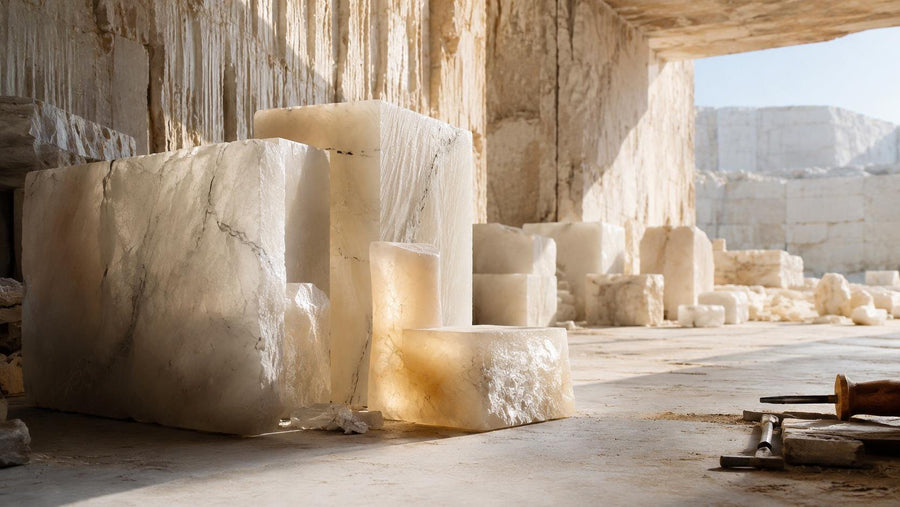
Teeshaa makes sculptural lighting in Spanish alabaster, designed in Bangalore and made in its own facilities in India. Because the variation between blocks is part of the stone, Teeshaa selects and matches it rather than correcting it. Read the material page for how stone is chosen and cut, or the guide on why alabaster glows.
To see the stone in different forms, look at the Essenzo Pendant, the Alabaster Lana Style 1 or the Totem Table Lamp. The Pebble Lamp pairs Spanish alabaster with black Gorara stone, so its look includes that dark stone as well. Browse everything under alabaster lighting.
Alabaster is a soft, translucent stone that ranges from white through cream and honey to pale grey and amber. It usually carries cloudy patches, veins and small mineral inclusions, so it is rarely one flat colour. Unlit it looks pale and quiet, and when lit it appears to glow from within.
The purest alabaster is white. Impurities such as iron oxides add brown clouding and veining, so real blocks range across white, cream, honey, grey and amber. Teeshaa's Spanish alabaster varies block to block: some read soft and cloudy, some carry grey veins and some hold warm amber inclusions.
Only loosely. Alabaster as a colour name means a whitish off-white, taken from the mineral. The stone itself is rarely one flat colour, because clouding, veins and inclusions vary within a single block. Paint makers use the name for slightly different off-whites, so judge a paint shade from a physical swatch.
Every block of alabaster is different. Clouding, veining and mineral inclusions change from block to block, and wall thickness and shape change how much light passes through. Teeshaa does not treat this variation as a defect. It reviews the stone unlit and lit and matches sections of multi-part pieces for colour, clouding and transmission.
Yes. Unlit, alabaster looks pale and calm, and its character sits mostly in the surface. When lit, light scatters through the stone, clouds soften into gradients, veins show as darker lines and amber areas glow warm. A warm 2700K source also makes cream stone look warmer, which is why Teeshaa reviews stone both unlit and lit.
Reviewed by the Teeshaa studio, 19 October 2026.
 What Is Alabaster, and Why Does It Glow?Alabaster is a translucent gypsum stone. Why it glows from within, why no two blocks match, how thickness changes the...Read the guide
 Alabaster vs Marble vs Onyx: Which Stone Is Best for Lighting?Which stone is best for lighting? Alabaster glows evenly, onyx shows bold bands, marble belongs in bases. Translucenc...Read the guide
 Designed in Bangalore: How an Alabaster Light Is MadeFrom Aragon quarry block to lit piece: selection, matching, carving, thickness, LED and assembly, plus a checklist fo...Read the guide
Ask the studio about alabaster samples, or arrange a visit to see the stone unlit and lit.