Your cart
(0)
Made to order · dispatched by 24 December

By commission
TeeshaaChandelier
exposed bulbs, hidden LED or a glowing body: how the light source inside a chandelier changes the room.
Chandelier lights, or jhumar lights, come in three kinds: exposed bulbs, hidden integrated LED, and a glowing body. The source decides how much glare you see, how even the light is and how much upkeep it needs. Most Teeshaa alabaster lighting is the third kind: an integrated LED behind the stone, so the piece glows instead of showing a bulb.
They are lamps, the technical word for bulbs, or LED modules built into the fitting. What you see when the room is lit depends on whether that source is bare, hidden or diffused by the body.
Jhumar lights and chandelier lights are the same thing, so a search for either asks this question. The what is a jhumar page defines the word.
Historically, the source was fire. Wikipedia says chandeliers were originally designed to hold candles, that gas lighting followed, and that electric-only chandeliers became standard as supply grew dependable.
Exposed bulbs give sparkle and are easy to replace, but the bare source is bright to look at, which matters most for people sitting down.
Candle-shaped and filament bulbs read as points of light, which suits crystal and glass that catch them. In a living room or dining room on a 2.7 to 3.0 m ceiling, a bare bulb often sits within the line of sight from the sofa or table. Bulbs also need changing, and in a dusty Indian home the arms and bulbs collect dust that you see directly.
A hidden LED gives a more even light with no bulb to change, but the source is sealed and needs a driver.
An LED runs on controlled direct current, so a driver converts mains power. Wikipedia notes that LED lamps must be designed to be dimmable and compatible with the dimmer, or damage to the lamp or dimmer may result. So for any LED chandelier, ask which dimmer is suitable before wiring, and where the driver sits: in the canopy at the ceiling or in a remote box. Teeshaa lists dimming as on request. How dimming works is covered in dimming and drivers for alabaster lighting.
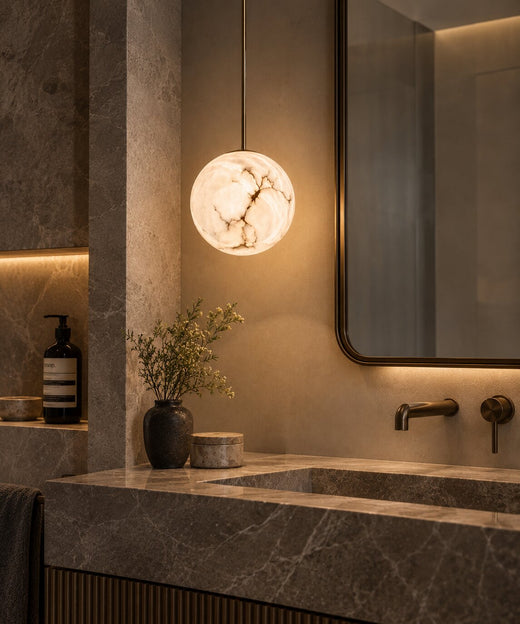
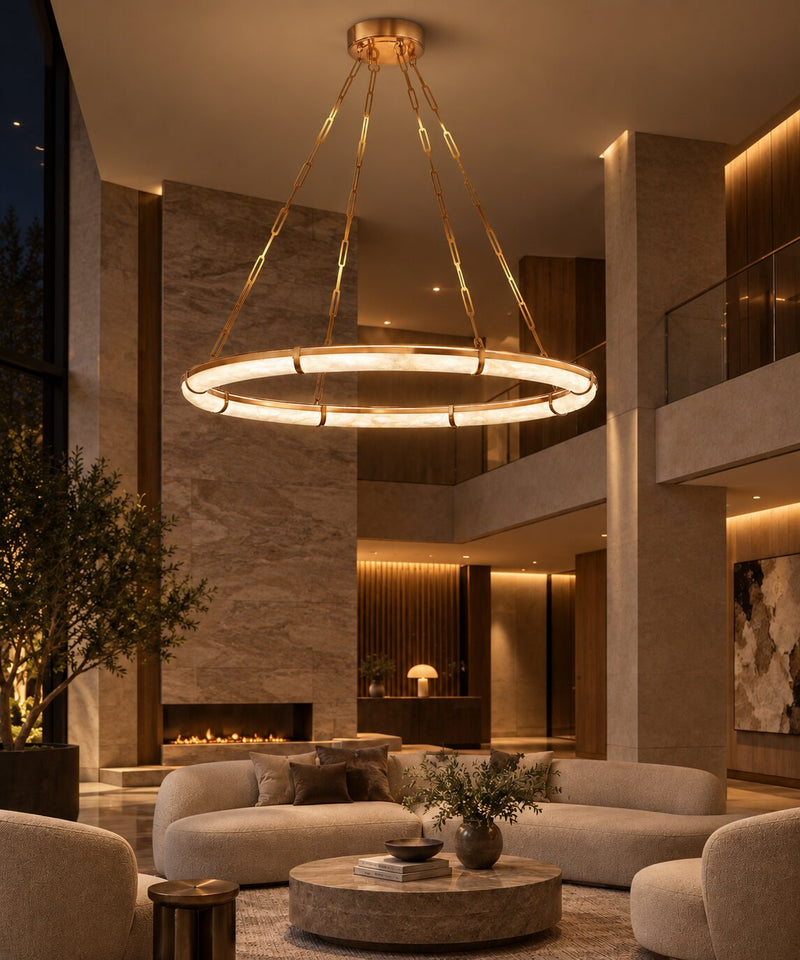
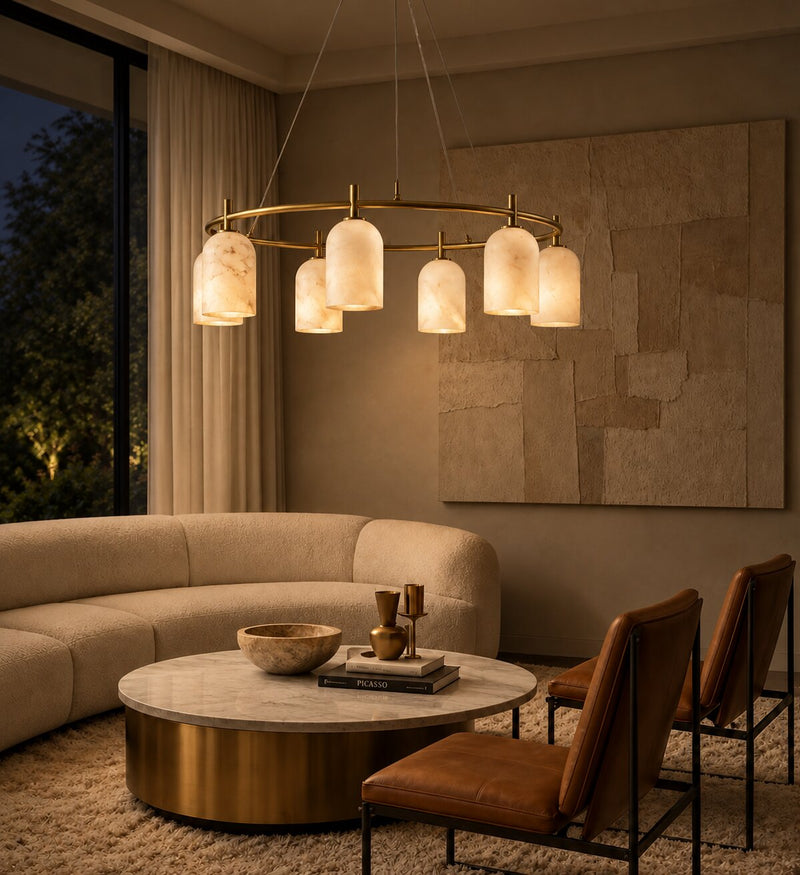
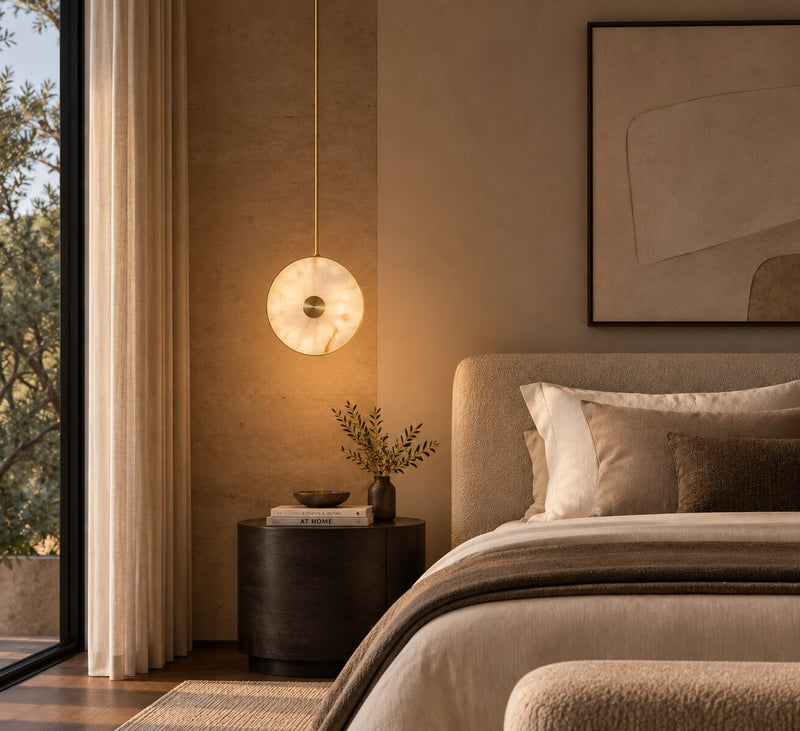
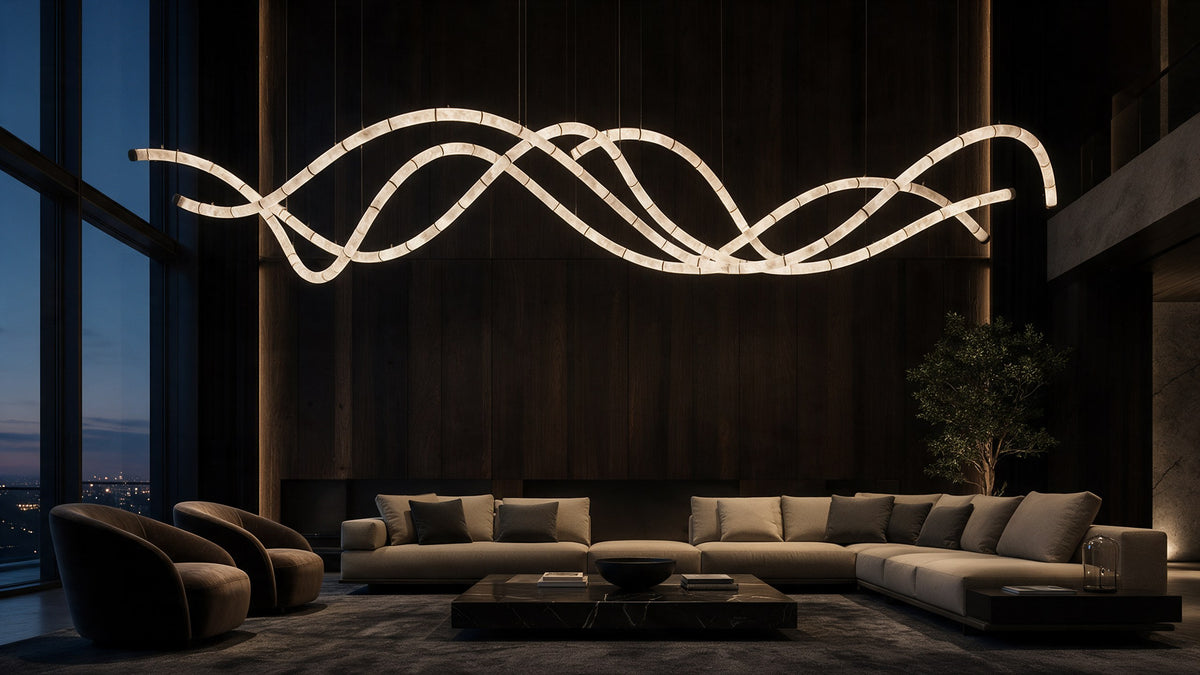
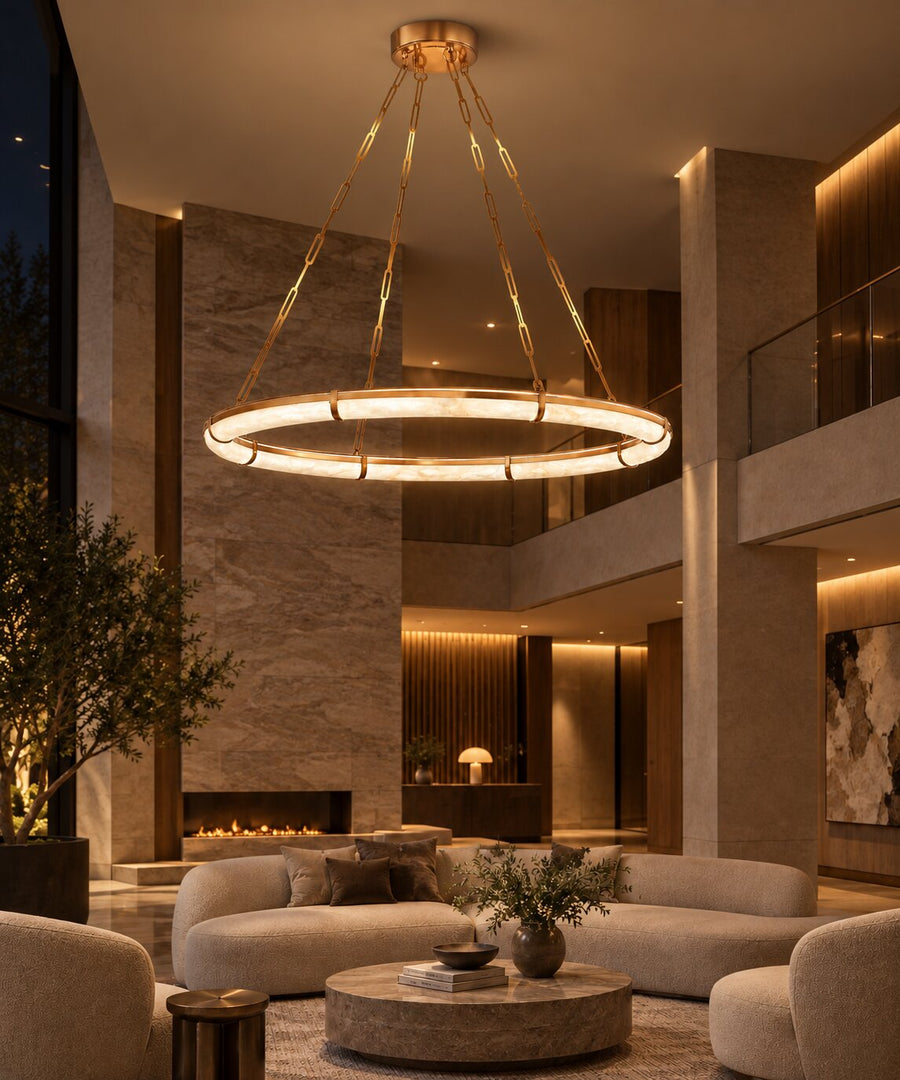
When the body is a translucent material, the source disappears and the stone, glass or shade becomes the light. You see a soft surface, not a point, so glare at eye level is much lower.
Alabaster does this naturally. Its clouding, veining and mineral inclusions change from block to block, so two pieces never glow identically. Teeshaa reviews the stone unlit and lit, and sections of multi-part pieces are matched for colour, clouding and transmission. The trade-off is that a glowing body is an ambient and accent source, not a task light: keep discreet downlights where you read or cook.
Often yes. Light thrown up washes the ceiling, light thrown down pools on a table, and an all-round glow fills the space between. Which one you need depends on the room.
Under a ceiling of 2.7 to 3.0 m with a 20 to 30 cm false-ceiling cove, the usable drop is short, so measure the finished ceiling, not the slab. Downward light suits a dining table, where the bottom of a pendant hangs 75 to 90 cm above the surface. An all-round glow suits a living room. Ask the studio which way a given Teeshaa piece sends its light.
The table compares what each kind is good at, not which is better.
| Light source | Look lit | Look unlit | Glare | Upkeep | Dimming |
|---|---|---|---|---|---|
| Exposed bulbs | Points of sparkle | Arms, bulbs and any crystal or glass visible | High at seated eye level | Bulbs to replace; dust on bare arms and bulbs | Depends on the bulb and dimmer |
| Hidden integrated LED behind a diffuser | Even wash of light | Plain fitting | Low to moderate | No bulb to change; driver needed | Needs a compatible driver and dimmer |
| Glowing body such as alabaster | Soft glow across the whole surface | Sculptural stone form | Low | Wipe with a soft, dry or lightly damp cloth; no bulb to change on integrated LED pieces | Needs a compatible driver and dimmer; on request at Teeshaa |
A diffused body usually suits both: it avoids a bright point at head height, and compact or horizontal forms can leave room around a fan.
Fans and chandeliers compete for the same ceiling point in many Indian rooms. A horizontal or ring form may sit offset from the fan. Your electrician should confirm blade clearance before anything is hung. The room-by-room options are in chandelier with a ceiling fan in an Indian living room.
Teeshaa Lighting makes its lights in Spanish alabaster, designed in Bangalore and made in its own facilities in India. Most pieces use an integrated LED at 2700K, with 2000K, 2300K or 3000K on some, and a few use E26 or E27 bulbs, so read each product page. Drivers sit in the canopy or remotely, and dimming is on request. Teeshaa does not sell bulbs, LED strips or drivers separately.
Teeshaa's own collection does not offer crystal or glass chandeliers. Teeshaa Design Labs develops lighting in wood, metal, stone, crystal and glass to a brief, including one-off pieces. Share a drawing or a reference through the Design Labs page and the team confirms what is possible.
Browse the chandelier collection, or see the Aura Chandelier, which is made to order on enquiry, and the Halo Crown Chandelier, where the 60 cm size is ready to order and the larger rings are on enquiry. More on the stone is on the alabaster lighting hub and the alabaster chandelier page.
Installation is by your own licensed electrician or, on request, Teeshaa's team: ask the studio. The one-year warranty does not cover damage caused by an installation done by anyone other than Teeshaa's team. You may use your own electrician, but then the installation cannot be guaranteed.
The light sources are lamps, the technical word for bulbs, or integrated LED modules that are part of the fitting. Older chandeliers held candles or gas burners. Today they use filament bulbs, replaceable LED lamps, or sealed LED sources hidden behind a diffuser or a glowing material such as alabaster.
Yes. Jhumar is the Hindi word for a chandelier or hanging light, so jhumar lights and chandelier lights are the same thing. The light source question is the same whichever word you use: exposed bulbs, hidden LED, or a body that glows. Check which of the three a fitting uses before you buy.
Not necessarily. A count of lights tells you how many sources a fitting holds, not how much light it gives. Output depends on each source and on what covers it. For a Teeshaa piece, ask the studio about output for your room.
A diffused body usually suits both. Exposed bulbs can sit in the line of sight on a low ceiling and cause glare, and long arms can crowd a fan. A glowing body spreads light softly, and compact or horizontal forms can leave room around a fan. Confirm fan clearance on site with your electrician.
Most Teeshaa pieces use an integrated LED, usually at 2700K, so there is no bulb to change. A few pieces use E26 or E27 bulbs, so check the product page. Several offer 2000K, 2300K or 3000K. Dimming is on request, and the driver sits in the canopy or remotely.
Last updated 6 November 2026.
 How to Choose an Alabaster Chandelier: Size, Drop and RoomA size table for Indian rooms and tables, drop heights for false ceilings and double heights, and how to choose betwe...Read the guide
 Chandelier Size Guide for Indian Living RoomsThe length-plus-width rule for Indian room sizes, how low a chandelier can hang under 2.7 m, sharing a ceiling with a...Read the guide
 Lighting a Double-Height Space: Stairwells, Voids and Tall Living RoomsDouble-height lighting is proportion, not brightness: a vertical composition read from two levels, 2.1 m clear over t...Read the guide
Share your room, ceiling height and preferred glow, and ask the studio which pieces to look at.