Your cart
(0)
Made to order · dispatched by 24 December

By commission
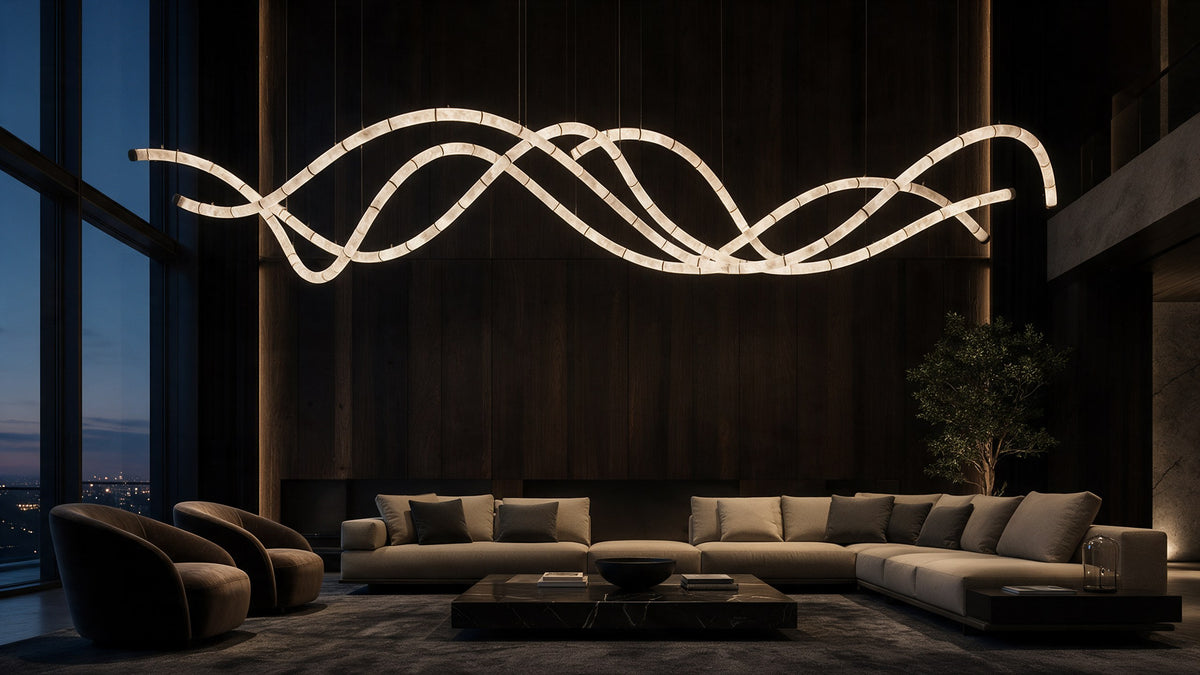
TeeshaaChandelier
a room-area method for total lumens, a worked table for three room sizes, and why a lamp count is not an output figure.
 Aura ChandelierAura · ChandelierPrice on request
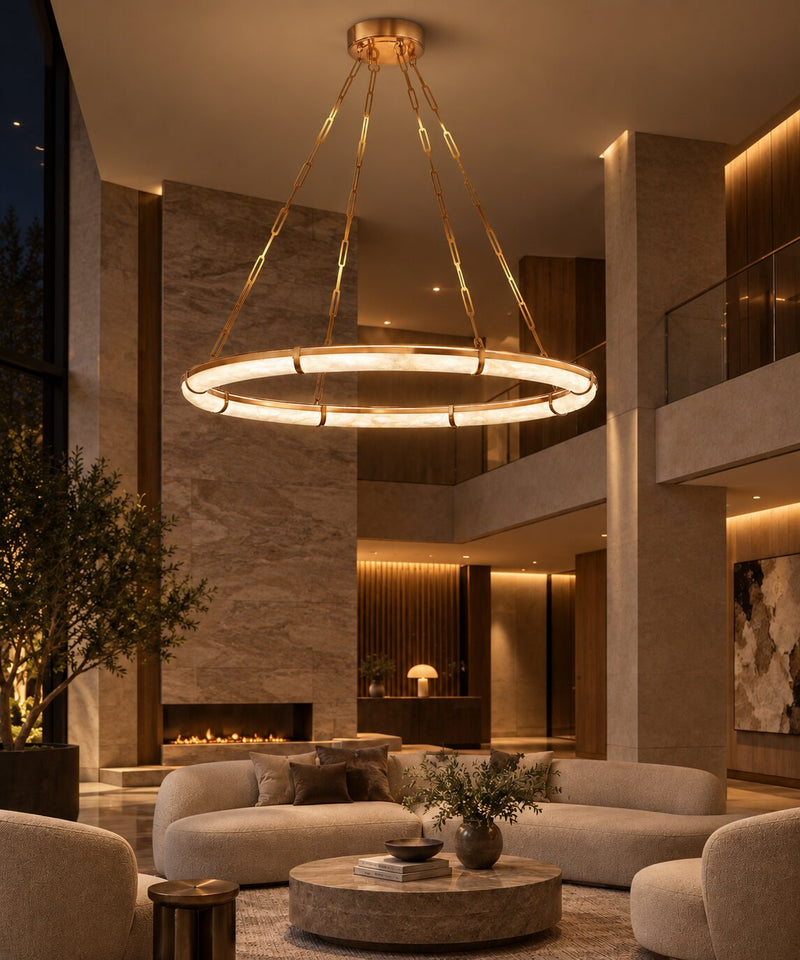 Halo Crown ChandelierHalo · ChandelierPrice on request
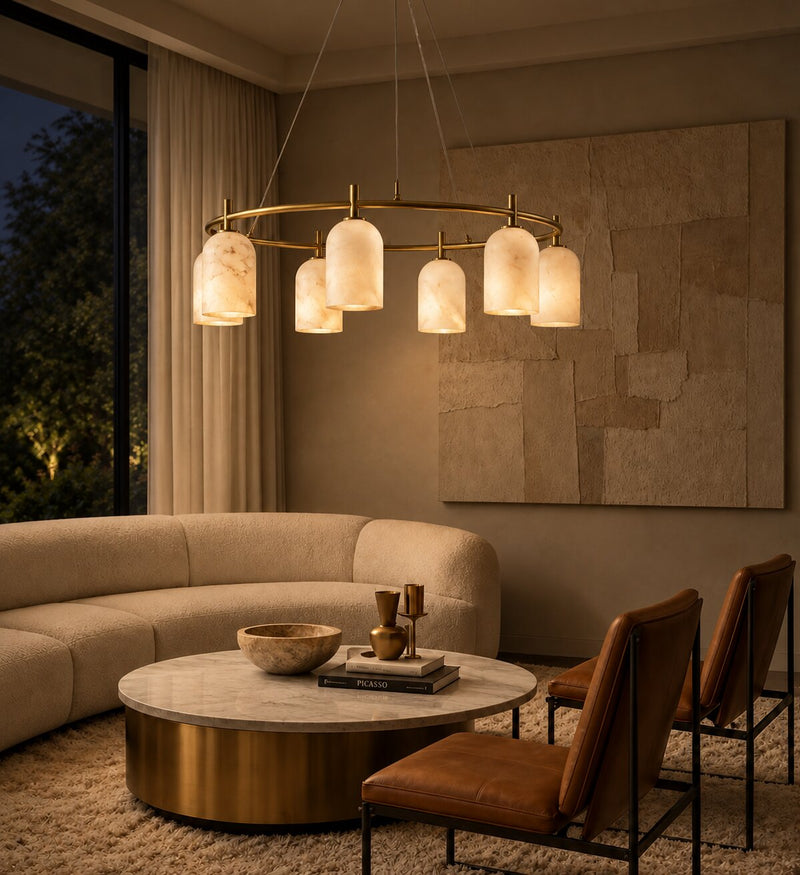 Essenzo Ring SuspensionEssenzo · ChandelierPrice on request
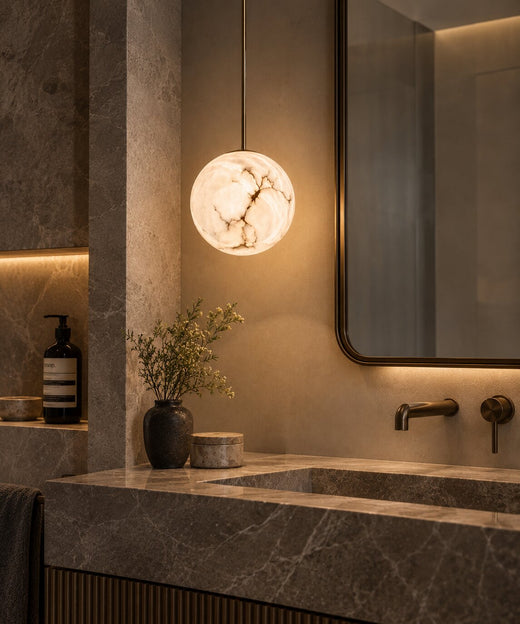
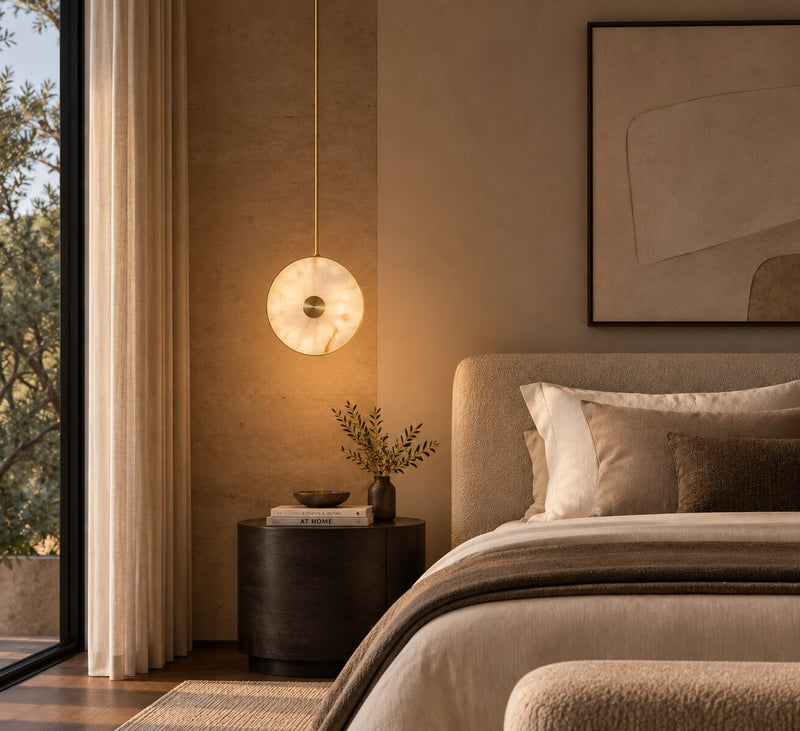 Alabaster Aura SuspensionAura · PendantFrom ₹ 55,000
 Alabaster Linea PendantLinea · PendantFrom ₹ 30,000
 Totem Table LampTotem · TableFrom ₹ 28,000
A chandelier needs no fixed number of lumens: it is one layer of a room's light, so the brightest fitting is not the answer. Multiply floor area in square metres by a target lux for the room's total lumens, then split that across chandelier, downlights and wall lights. A lamp count says little. Teeshaa alabaster sits in the ambient layer.
Lumens are the light; watts are the power. Two chandeliers of the same wattage can give very different amounts of light, so compare lumens when you compare output.
Watts worked as a proxy for filament bulbs: Wikipedia's lamp equivalents table puts a 40 W incandescent at a minimum of 450 lumens, a 60 W at 800 and a 100 W at 1,600. LEDs broke that link. Wikipedia's luminous efficacy table lists 230 V incandescent bulbs at about 8 to 14 lumens per watt and 230 V LED screw-base lamps from 75 to 217, so a 10 W LED can out-light a 60 W bulb or fall well short of another 10 W LED.
Start with the room, not the chandelier: floor area in square metres multiplied by a target lux gives a starting total, and the chandelier takes a share of it.
Engineering ToolBox gives 150 lux for homes, 250 lux for easy office work and 500 lux for normal office work and kitchens. These are general reference levels, not a rule for any one room. India's code of practice for interior illumination is IS 3646, which a lighting consultant can check a project against. A living room lit to office levels looks like an office.
The physical size of the piece is a separate question; use the chandelier size guide for Indian living rooms.
Starting totals for the whole room with every fitting on, using the Engineering ToolBox targets. The fittings need to emit more once walls and shades have taken their share.
| room | floor area | total at 150 lux (homes) | total at 250 lux (easy office work) |
|---|---|---|---|
| small bedroom or compact living room | 12 sq m (about 130 sq ft) | about 1,800 lm | about 3,000 lm |
| apartment living room | 16 sq m (about 170 sq ft) | about 2,400 lm | about 4,000 lm |
| larger living or living-dining room | 20 sq m (about 215 sq ft) | about 3,000 lm | about 5,000 lm |
A kitchen is different. At Engineering ToolBox's 500 lux a 10 sq m kitchen works out at about 5,000 lumens, so use downlights or under-cabinet fittings over the work surfaces. Teeshaa does not supply bulbs, recessed fittings or task lighting.
Not necessarily. A three light chandelier holds three lamps; its output is the sum of their lumen ratings, less what the shades absorb. A single pendant with one strong LED module can match or exceed it.
The same 3 lamp frame gives about 1,350 lumens bare with 450 lumen candle bulbs and about 2,400 with 800 lumen bulbs. An integrated LED ring has no sockets at all; its output is whatever the module and driver were specified to give. More lamps spread light more evenly across a wide fitting, but more exposed lamps also mean more glare, so a dimmer helps.
Give the chandelier the ambient share, let downlights or a reading lamp carry tasks, and let wall lights lift the edges of the room.
The split is a planning choice, not a standard, and the figures below are generic, not the output of any Teeshaa piece. One illustration for the 16 sq m living room above:
| layer | fitting | illustrative share |
|---|---|---|
| ambient | chandelier or ring over the seating | about 1,000 lm |
| task | two or three downlights or a reading lamp | about 1,000 lm |
| accent and balance | wall lights or a table lamp | about 400 lm |
Because the chandelier is not alone, it need not be oversized or run at full output. See how to layer lighting around an alabaster fixture.
Yes. Spanish alabaster is translucent, not transparent, so less light leaves the fitting than the same LED would give bare, and how much less differs from stone to stone. The detail is on how bright is alabaster lighting.
For a lumens plan, count the stone as a soft ambient source and let the other layers reach the room total. Alabaster is not a task light; where you read or cook, add discreet downlights. Teeshaa does not publish lumen figures, and a wattage does not convert reliably into lumens, so ask the studio about output for the exact piece.
Teeshaa makes sculptural lighting in Spanish alabaster, designed in Bangalore and made in its own facilities in India, and its pieces sit in the ambient layer of a lumens plan. Most use integrated LED, and dimming is available on request with the driver in the canopy or remote; see dimming and drivers for alabaster lighting. Light sources vary by piece, for example the 8 W LED strip of the Totem Table Lamp and the 12 W to 20 W of the Alabaster Aura Suspension. For a living room centre, look at the Aura Chandelier, the Halo Crown Chandelier or the Essenzo Ring Suspension, or start from the living room chandelier page. Before an order the team reviews scale, drop, sightlines, output, suspension and access; architects can request electrical information through the trade programme. The full range is on the alabaster lighting hub.
Work in square metres. 12 ft x 14 ft is 168 sq ft, about 15.6 sq m. Engineering ToolBox lists 150 lux for homes, so 15.6 x 150 gives a starting total of about 2,300 lumens from all layers together. Add more where someone reads, and split it between the chandelier, downlights and wall or table lamps.
It depends on the lamps, not the count. Three 800 lumen bulbs, the usual 60 W incandescent equivalent, give about 2,400 lumens bare, roughly a 16 sq m room at 150 lux before shading losses. Three 450 lumen bulbs give about 1,350. Read the lumen rating of the actual lamps, then plan downlights and wall lights for the rest.
Neither is brighter by type. An LED strip, an LED module and a screw-in bulb all produce lumens, so compare the lumen figure for each fitting. A strip spreads light evenly along its length, which suits rings and linear forms; bulbs are simpler to replace. Teeshaa uses integrated LED on most pieces and does not supply bulbs or strips separately.
Softer, and usually less bright. Clear glass is transparent, while translucent Spanish alabaster passes some light, scatters some and absorbs the rest, so the same LED reaches the room as an even glow rather than a bright point. Teeshaa does not publish lumen figures, so ask the studio about output for the exact piece. Alabaster is an ambient source, not a task light.
Yes, and this is the normal way to finish a scheme. Add downlights over the reading chair, wall lights at the room edges or a table lamp beside the sofa, each on its own switch. What is hard to add later is wiring and a dimmer, so plan the chandelier circuit with dimming before the false ceiling closes.
Last updated 6 November 2026.
 Chandelier Size Guide for Indian Living RoomsThe length-plus-width rule for Indian room sizes, how low a chandelier can hang under 2.7 m, sharing a ceiling with a...Read the guide
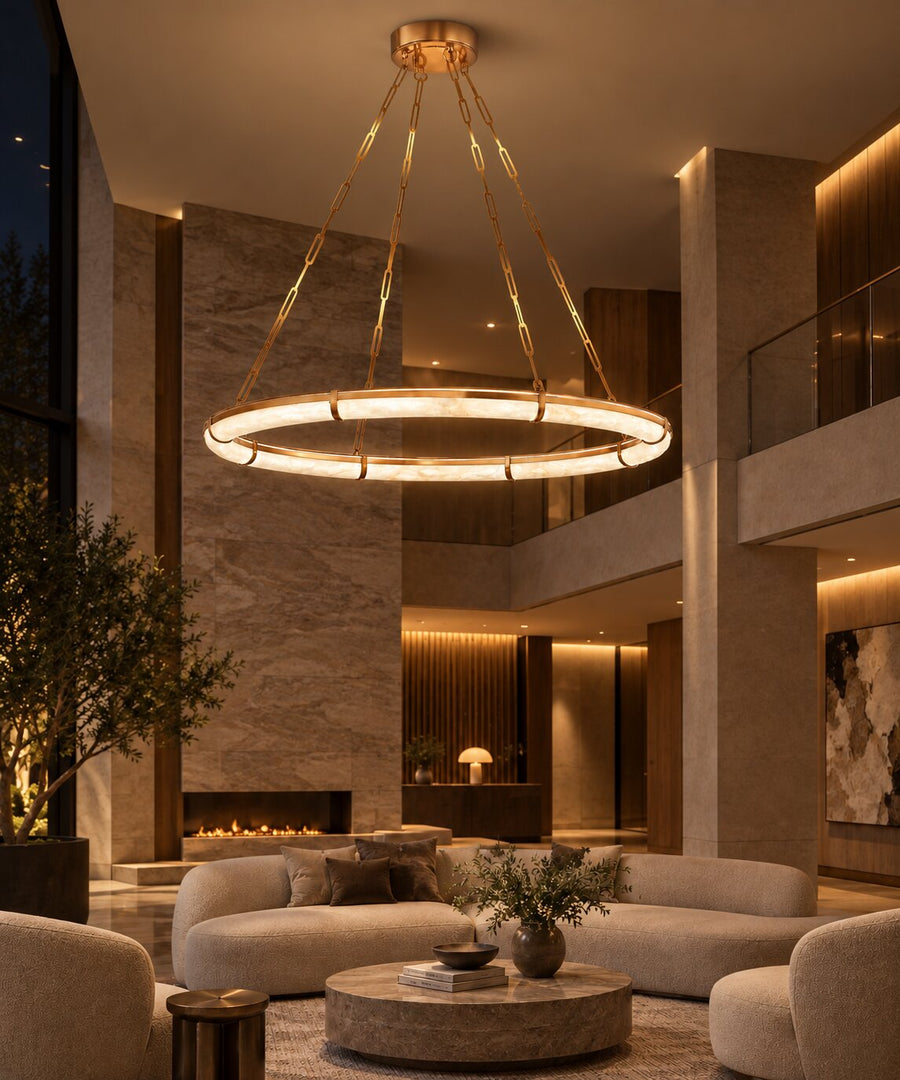 How to Choose an Alabaster Chandelier: Size, Drop and RoomA size table for Indian rooms and tables, drop heights for false ceilings and double heights, and how to choose betwe...Read the guide
 A Lighting Plan for a Villa, Room by RoomVilla lighting room by room: double-height volumes, stairwells, dining, bedrooms, corridors and verandas, with height...Read the guide
Share the floor area, ceiling height and how you use the room in the evening, and ask the studio about output and dimming for the piece you have in mind.