Your cart
(0)
Made to order · dispatched by 24 December

By commission
TeeshaaPendant
an honest comparison of fabric shades and alabaster for pendants and wall lamps: glow, dust, humidity, discolouration and weight.
Fabric pendant lights suit dry bedrooms, rented homes and quick style changes, because cloth is light and easy to swap, but it collects dust, smoke and oil and can absorb monsoon humidity. Alabaster lighting from Teeshaa suits rooms you plan to keep: light travels through the stone itself, though it is heavier and needs dry, ventilated placement.
A fabric shade diffuses the light of a bulb that sits inside it. Alabaster is the light-bearing surface: light enters the stone and scatters, so the whole piece glows.
Fabric shades use cloth such as silk, linen or cotton, and shades often reduce the intensity of the bulb they cover (Wikipedia: Lampshade). The result is even and gentle, but the colour of the cloth tints the light, and a reflective lining can send light up and down rather than outward. A silk pendant lamp feels warm and textile; a stone pendant feels sculptural and carries visible clouding and veining. Our guide to why alabaster glows explains the mechanism.
Fabric collects more visible dust and holds on to it. The weave catches fine particles, and in busy Indian cities a shade in a room with open windows can turn grey over time.
Cloth shades are cleaned with a soft brush attachment or a lint roller; check the maker's advice before using liquid. Alabaster is cleaned with a soft, dry or lightly damp cloth, with harsh chemicals and abrasive cleaners avoided, following the care guide supplied with the piece. A smooth stone surface gives dust less to catch on than a weave, but the stone is soft, about 2 on the Mohs scale for gypsum (Wikipedia: Gypsum), and can mark if rubbed hard. See the care page for Teeshaa's care advice.
Humidity can make cloth feel damp and, in poorly ventilated rooms, encourage mildew spots. Alabaster has its own limit: it is slightly soluble in water, so it needs a dry, ventilated place.
Neither material likes a shut-up, damp room in the monsoon. Fabric shows trouble as spotting and smell; stone should be kept away from bath and shower splash zones and open balconies. The Teeshaa warranty does not cover water or humidity damage. Read our page on alabaster in humid and coastal homes before choosing stone for a damp room.
Fabric discolours from smoke, cooking oil, sun and handling, and these marks can be hard or impossible to remove. Alabaster has colour questions of its own, but many are natural, not damage.
Many alabaster blocks start cream, honey or amber, and warm light makes the same stone look warmer, so that is not discolouration. Real changes come from handling, oils, cooking residue, harsh cleaning and moisture. Natural variation between blocks is not treated as a defect under the returns policy. For the full diagnosis, see does alabaster turn yellow.
Under cloth the concern is the bulb, because incandescent heat can scorch a fabric shade. With stone it is the fixing, because the piece is heavier.
LEDs emit very little heat (Wikipedia: Lampshade), so an LED bulb suits cloth better, within what the shade maker allows. Each Teeshaa product page lists the light source of that piece.
A cloth pendant is usually light, but its ceiling point still needs to be sound. A stone pendant or wall light should be hung from a fixing that suits it: ask the studio for the weight of the piece, and take advice from a licensed electrician or structural professional, particularly for a false ceiling. You may use your own electrician, but then the installation cannot be guaranteed, and the warranty does not cover damage caused by an installation done by anyone other than Teeshaa's team. Ask the studio about installation by Teeshaa's team. Our guide on false-ceiling installation sets out the principles.
Choose by the room, how long you will stay and how often you want to change the look. The table sets out the main trade-offs for pendants and wall lamps with shades.
| Question | Fabric shade | Alabaster |
|---|---|---|
| Quality of glow | Soft, tinted by the cloth, bulb hidden | Light through the stone, with clouding and veining |
| Dust | Collects in the weave; brush or lint roller | Less for dust to catch on than a weave; soft cloth |
| Humidity | Mildew risk in damp, closed rooms | Dry, ventilated placement; away from splash zones |
| Smoke and oil | Marks and holds odour | Avoid cooking residue; clean gently |
| Heat | Incandescent bulbs can scorch cloth; use an LED | Most pieces use integrated LED |
| Weight | Light | Heavier; needs a sound fixing |
| Changing the look | Swap the shade | A permanent piece |
| Suits | Dry bedrooms, rented homes, changing styles | Dry, ventilated rooms you plan to keep, bedrooms included |
Fabric still wins in dry bedrooms, rented homes and rooms where you want to refresh the style cheaply. A new shade changes a room in minutes; a stone piece does not.
As a pendant, fabric is a poor fit over a kitchen island, where it sits in cooking oil and steam. An alabaster pendant can hang over an island, but keep it clear of the hob, because cooking residue can mark the stone. It is also not a task light: pair it with discreet downlights where you read or cook.
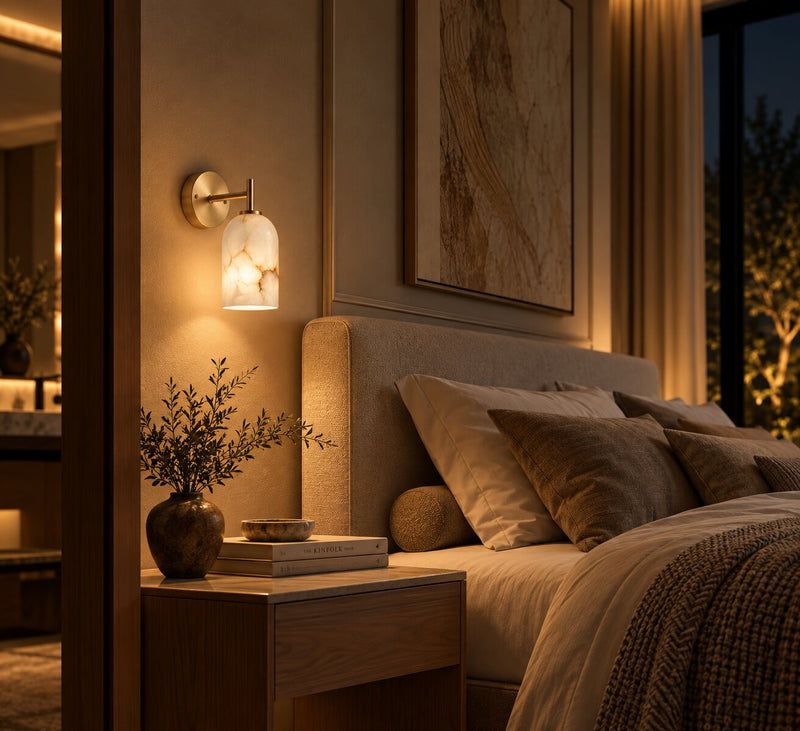
Wall lamps with shades suit a bedside, where the light is close and low and the room is dry. A wall lamp sits within reach, so a shade gets brushed and handled, and soft alabaster can be scratched or knocked. Our guide to wall sconce height and placement covers where to mount one.
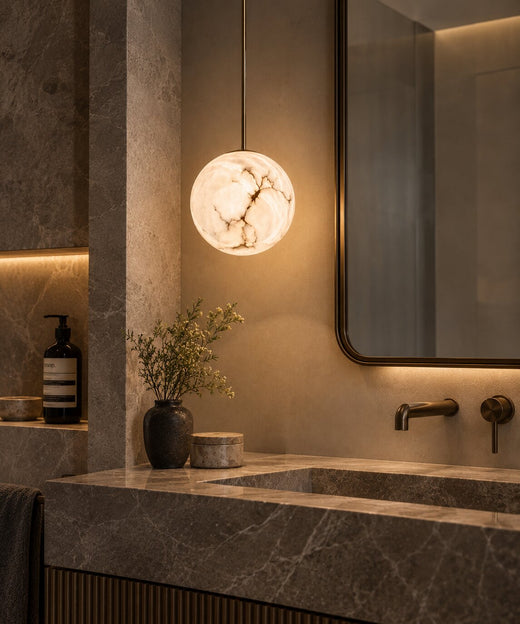
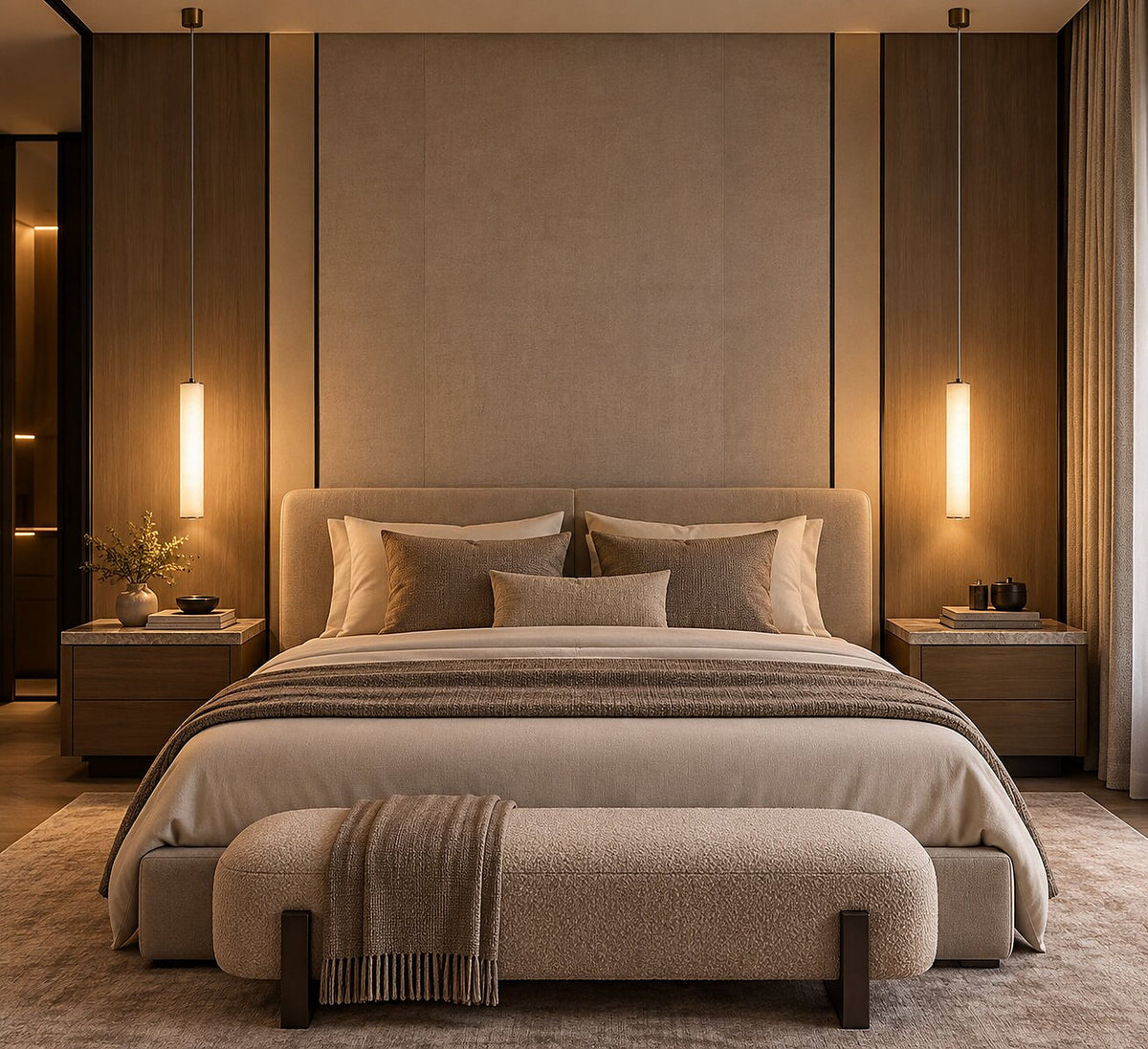
Teeshaa does not sell fabric shades; its collection is made in Spanish alabaster. For hanging light, look at the alabaster pendant lights, such as the Alabaster Linea Pendant or the Essenzo Pendant. For the wall, see the alabaster wall lights, including the Aura Wall Mount and the Essenzo Dome Wall Sconce, whose shade is itself alabaster. Stone can also work in a dry, ventilated bedroom: the Essenzo Pendant is designed for bedrooms, and the Alabaster Linea Wall Mount can sit beside a bed. The alabaster lighting hub gathers every form.
Teeshaa Design Labs develops lighting in wood, metal, stone, crystal and glass to a brief, including one-off pieces. Share a drawing or a reference through the Design Labs page and the team confirms what is possible. Fabric is not on that list, so ask before assuming a cloth shade can be made.
No. Fabric pendant lights suit dry, well-aired rooms such as bedrooms and are light to hang. The trouble starts in kitchens, near open windows and in damp coastal rooms, where dust, cooking oil and humidity mark or spoil the cloth faster. Place them with the room's conditions in mind.
No. Teeshaa's own collection is made in Spanish alabaster. Teeshaa Design Labs develops lighting in wood, metal, stone, crystal and glass to a brief, including one-off pieces. Cloth is not on that list, so ask first. Share a drawing or a reference through the Design Labs page and the team confirms what is possible.
Dust it often with a soft brush attachment on a vacuum or a lint roller, and check the maker's advice before using any liquid, since some cloth marks easily. Cooking oil and smoke are harder to remove than dust, so keep fabric away from the kitchen if you can.
Different, not necessarily harder. For Teeshaa's alabaster, use a soft, dry or lightly damp cloth, avoid harsh chemicals and abrasive cleaners, and follow the care guide supplied with the piece. The stone also needs a dry, ventilated spot away from splash zones and open balconies.
Fabric is usually easier in a rented flat. A cloth shade is light, cheap to swap and simple to take with you. A stone pendant is a more permanent piece that needs a sound fixing point and careful packing, so it suits a home you plan to stay in.
Last updated 6 November 2026.
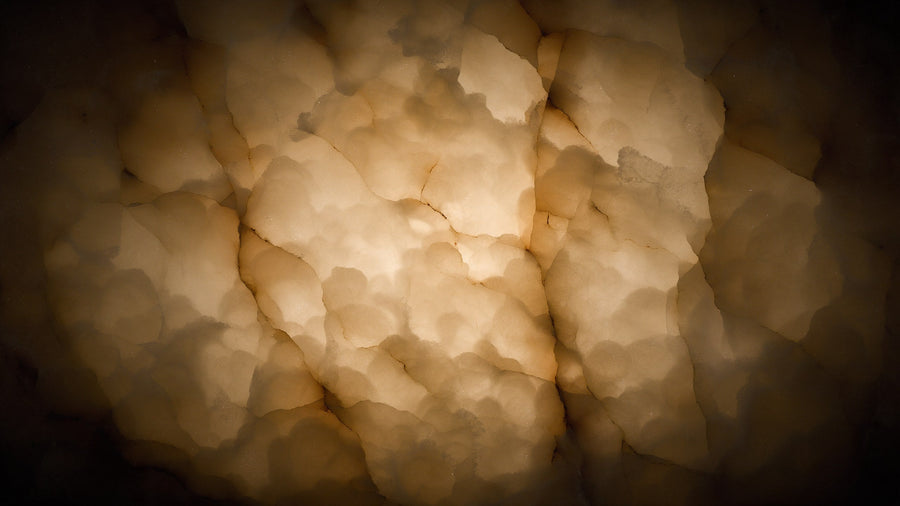 What Is Alabaster, and Why Does It Glow?Alabaster is a translucent gypsum stone. Why it glows from within, why no two blocks match, how thickness changes the...Read the guide
 Alabaster Pendant Lights: Single, Cluster or Linear?Which pendant format suits which spot, with drop heights by location, a spacing table for islands and tables, and the...Read the guide
 Wall Sconce Height and Placement: Bedside, Corridor, MirrorMounting heights for wall sconces by location, with a table, corridor spacing, when to use pairs, how to switch and d...Read the guide
Tell the studio the room, the ceiling height and the finish you have in mind, and ask which pieces suit the space.