Your cart
(0)
Made to order · dispatched by 24 December

By commission
TeeshaaPendant
how many heads, how much stagger and how wide a spread: the numbers for hanging a cluster of alabaster pendants over a table, in a foyer or down a stair void.
 Essenzo Pendant Cluster P3Essenzo · Pendant₹ 150,000
 Alabaster Linea Pendant ClusterLinea · PendantFrom ₹ 110,000
 Essenzo PendantEssenzo · PendantFrom ₹ 25,000
 Lunar PendantLunar · PendantFrom ₹ 40,000
 Alabaster Linea PendantLinea · PendantFrom ₹ 30,000
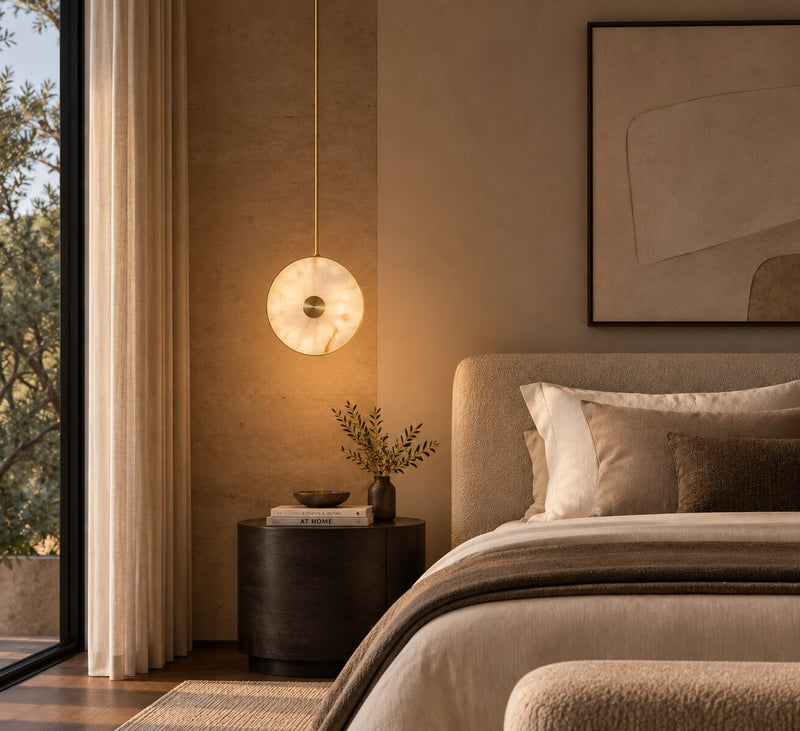 Alabaster Aura SuspensionAura · PendantFrom ₹ 55,000
For cluster hanging lights, use an odd number of heads, usually three or five, hung from one canopy at staggered heights. Keep the lowest head about 2.1 m above the floor where people walk and 75 to 90 cm above a table. As a guide, a cluster of alabaster lighting needs a finished ceiling above about 2.7 m.
Three, five or seven, rising with net ceiling height. Net height is the finished ceiling after any cove, not the slab: apartment ceilings are commonly 2.7 to 3.0 m, and a false-ceiling cove often takes 20 to 30 cm.
Odd numbers are a styling convention, not an engineering rule: an odd count gives a middle head and a rhythm that looks arranged, not paired.
At a net height of about 2.7 m or lower, skip the cluster: a lowest head at 2.1 m leaves little room above for canopy, drop and higher heads, and a net 2.45 m leaves none. Use one short pendant, a ring or lamps instead; see chandeliers for low ceiling rooms.
As a starting guide, step each head 15 to 30 cm from its neighbour in a room up to about 3 m, and 30 to 60 cm in a tall void.
Set the lowest head first, over the middle of the table or seating group, and let the others rise away from it. Stagger also keeps the heads distinct when seen from across the room, so they do not merge into one shape.
Over a table, measure the whole cluster edge to edge and keep it within one half to two thirds of the table width, the same rule used for a chandelier.
In a stair void, keep the spread to a third to a half of the void's narrowest width. On plan, leave half to one shade width between neighbouring heads.
Hang three in a line along a long table or island, or as a triangle over a round or square table.
In a line, the usual rule of thumb is 60 to 75 cm apart, centre to centre, with the outer two at least 15 cm in from the table or island ends. For islands see how many pendants over a kitchen island. As a triangle, space the heads evenly and drop one 15 to 25 cm lower so the group does not read flat. For table sizes see pendant size for 4, 6 and 8 seater tables.
One canopy is simpler; several points allow a freer spread. A canopy means one ceiling point, one support and one feed, with the spread limited by the size of the canopy: rods hang straight, so a wider spread means a larger canopy or separate points.
Separate points mean a fixing, support and wiring for every head, laid out before the false ceiling is closed. A moved point is the costly mistake, so decide before the electrician's first fix, and make each fixing reach the slab. Drivers can sit in the canopy or remotely; ask the studio which suits.
Look from directly below, from the far end of the room, and from the stairs or landing. A standing adult's eye is roughly 1.5 m above the floor, and a lit head at that height is the brightest thing in view, even in diffusing alabaster.
Aim the visual centre of the group near the landing's eye line, but shift any single head that sits directly in the view from the top of the stairs. Hang strings at the planned lengths and look from each spot before the lengths are final. For voids see lighting a double-height space.
Treat these as starting numbers, and confirm heights on site and with the studio.
| Location | Net ceiling | Heads | Lowest head | Step | Spread |
|---|---|---|---|---|---|
| Round dining table, 4 to 6 seats | 2.8 to 3.0 m | 3 | 75 to 90 cm above the table | 15 to 20 cm | Half to two thirds of table width |
| Larger round or square table | 2.9 m or more | 5 | 75 to 90 cm above the table | 15 to 25 cm | As above |
| Foyer or entrance | 3.0 to 3.6 m | 3 or 5 | About 2.1 m above the floor | 20 to 30 cm | A third to a half of the floor width |
| Living room, fan elsewhere | 2.8 m or more | 3 | About 2.1 m above the floor | 15 to 25 cm | No wider than the seating group |
| Stair void or double height | 4.5 m or more | 5 or 7 | At least 2.1 m above the floor or treads beneath it | 30 to 60 cm | A third to a half of the void's narrowest width |
| Under a ceiling fan | Any | None: offset the cluster or use lamps | Not applicable | Not applicable | Not applicable |
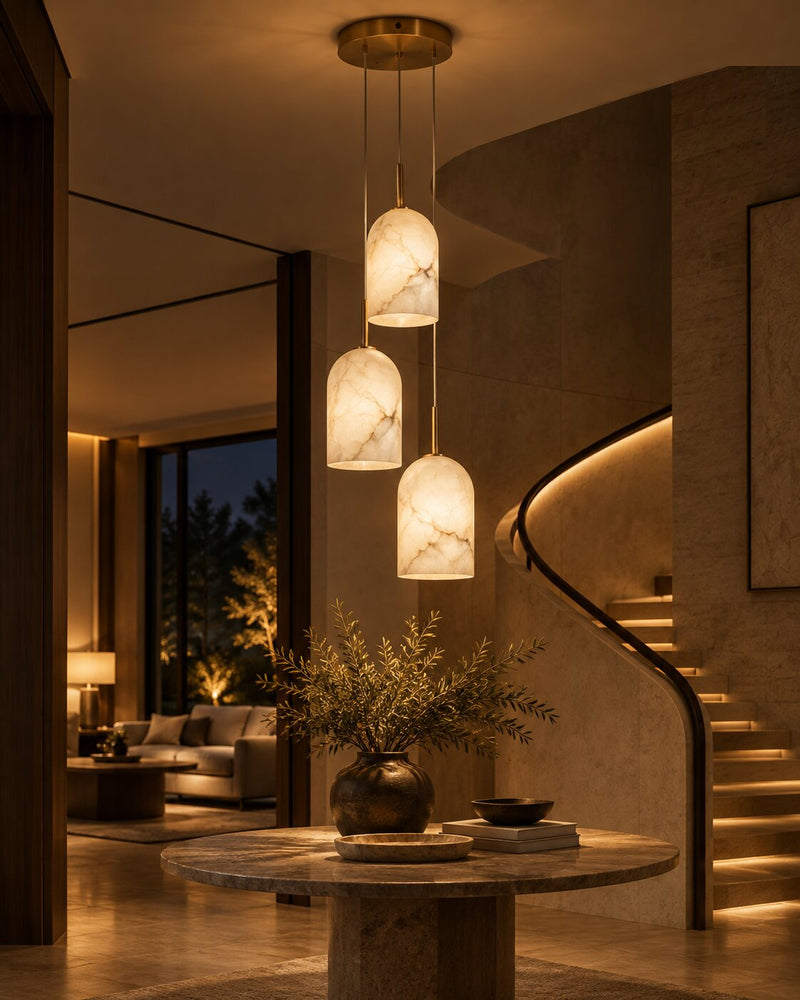
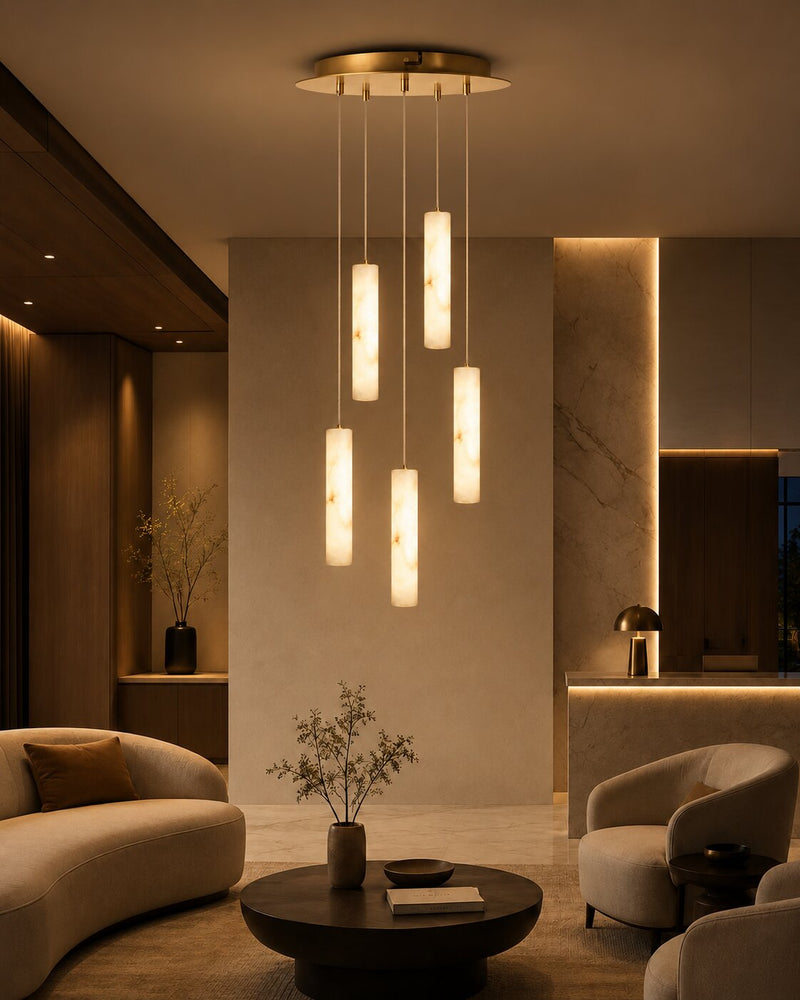
Teeshaa makes sculptural lighting in Spanish alabaster. Ready-made clusters include the Essenzo Pendant Cluster P3, three Essenzo pendants at varying heights, about 190 cm in total height and 25 cm in total width, and the Alabaster Linea Pendant P5, slim pendants in staggered lengths for entryways and tall interiors, about 185 cm by 38 cm. Both can be ordered online in Champagne Gold, Brass Gold, Black or Stainless Steel, and the product pages state lead times.
Both are narrow groups, so a wider spread across a table calls for separate points. For a void taller than their total height, ask the studio about longer drops. Ask too how each is fixed and fed before the ceiling is closed.
For separate points, single pieces such as the Essenzo Pendant and the Lunar Pendant, with spheres of 20, 25, 30 and 40 cm, can be planned as a group; ask the studio to confirm lengths and heights for each drop. Suspension is typically stainless-steel rod cut to size or stainless wire with transparent cable, and dimming is available on request. Alabaster is not a task light, so add discreet downlights, which Teeshaa does not supply, where you read or cook.
To choose the form first, read single, cluster or linear pendants, then see alabaster pendant lights, the alabaster lighting hub and the contact page.
Three is the smallest set that reads as a cluster, and three, five or seven are the usual counts. Match the count to the net ceiling height: three suits about 2.8 to 3.0 m, five needs more height and a wider zone, and seven belongs in a tall void. Even counts work on a clear grid.
Not under the blades. A fan holds the centre of many Indian rooms, and the clearance between blades and any hung head is a question for your electrician and the fan maker. Move the cluster to another zone, such as the dining table, or choose a wall or table lamp instead.
On plan, leave a gap of about half to one shade width between neighbouring heads, and step their heights by about 15 to 30 cm in a room up to 3 m. Tighter reads as one object, wider as separate pendants. Mock it up on strings first.
Not if it is one cluster fixture: every head hangs from one canopy, so it needs one point and one support. Separate pendants each need their own point, wiring and fixing, planned before the false ceiling is closed. Either way the support should reach the slab, and a licensed electrician should do the wiring.
A licensed electrician, with the support fixed to the structural slab. Ask the studio whether Teeshaa's team can install. You may use your own electrician, but then the installation cannot be guaranteed, and the warranty does not cover damage caused by an installation done by anyone other than Teeshaa's team.
Last updated 6 November 2026.
 Alabaster Pendant Lights: Single, Cluster or Linear?Which pendant format suits which spot, with drop heights by location, a spacing table for islands and tables, and the...Read the guide
 Lighting a Double-Height Space: Stairwells, Voids and Tall Living RoomsDouble-height lighting is proportion, not brightness: a vertical composition read from two levels, 2.1 m clear over t...Read the guide
 How High to Hang a Pendant Light Over a Dining TableThe 75 to 90 cm rule, a drop table by ceiling height, what a false ceiling changes, one piece or a row by table shape...Read the guide
Share your finished ceiling height, the table or void below and the fan position, and ask the Teeshaa studio which cluster and drop lengths could suit.