Your cart
(0)
Made to order · dispatched by 24 December

By commission
TeeshaaAll Lighting
why the same light looks different in each room, and how to choose output, position and warmth once the finishes are known.
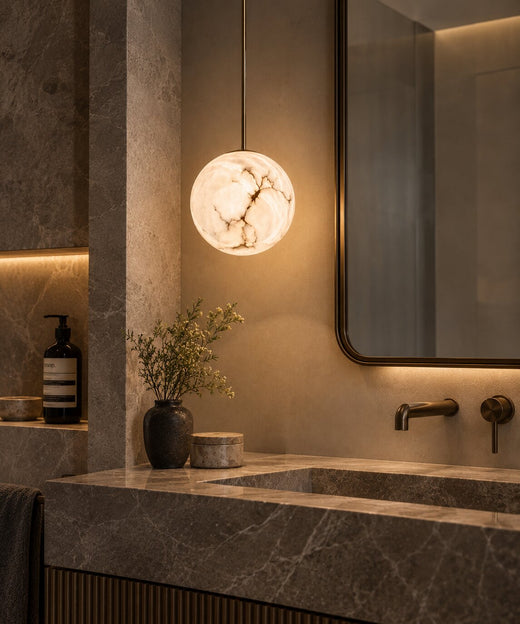
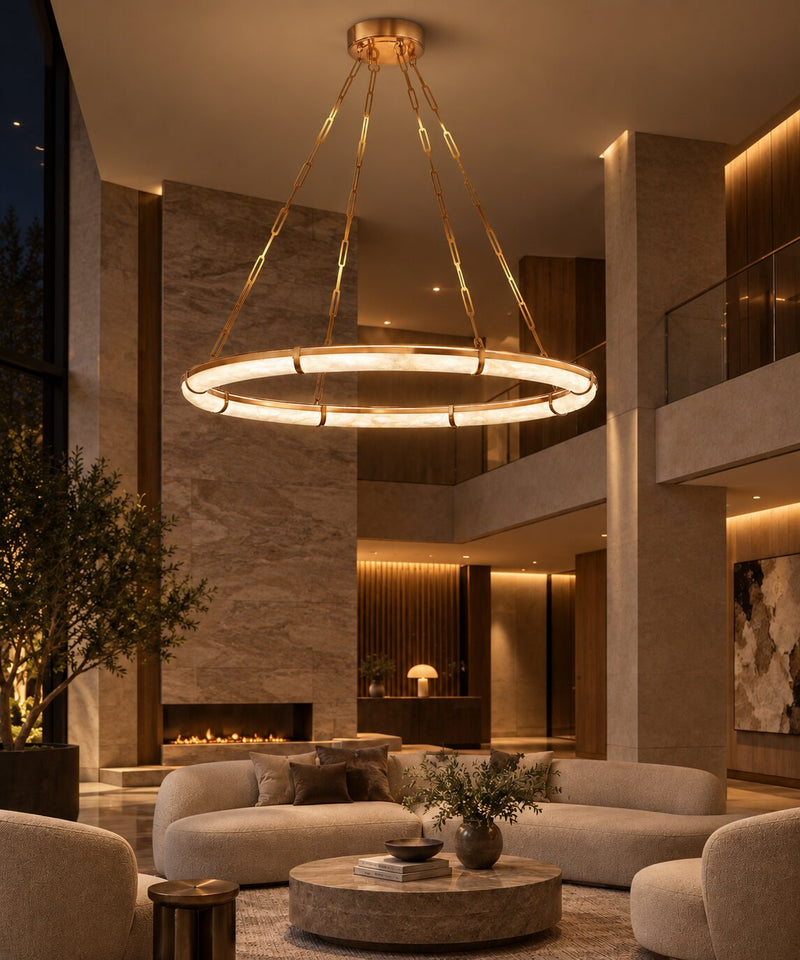
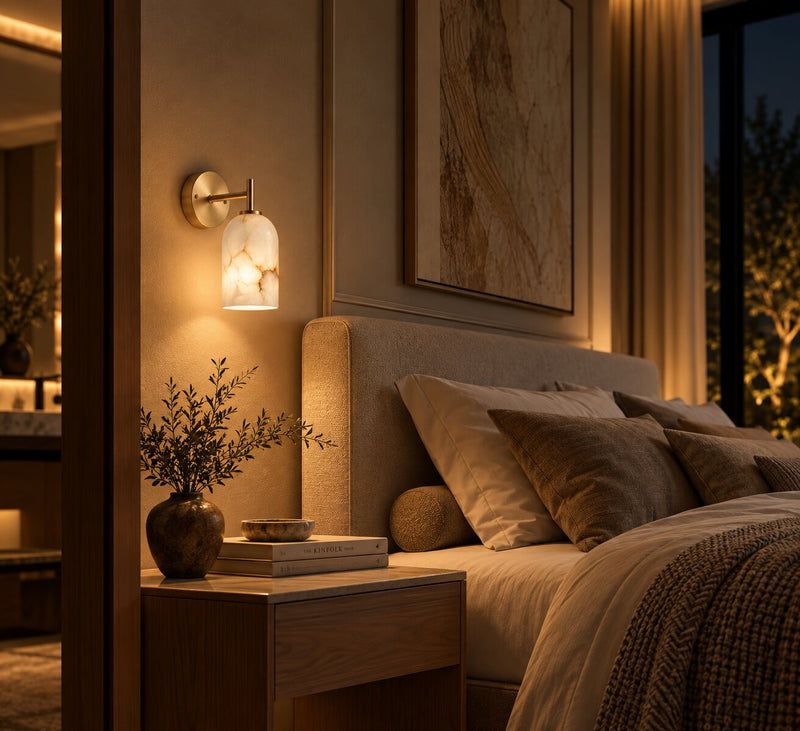
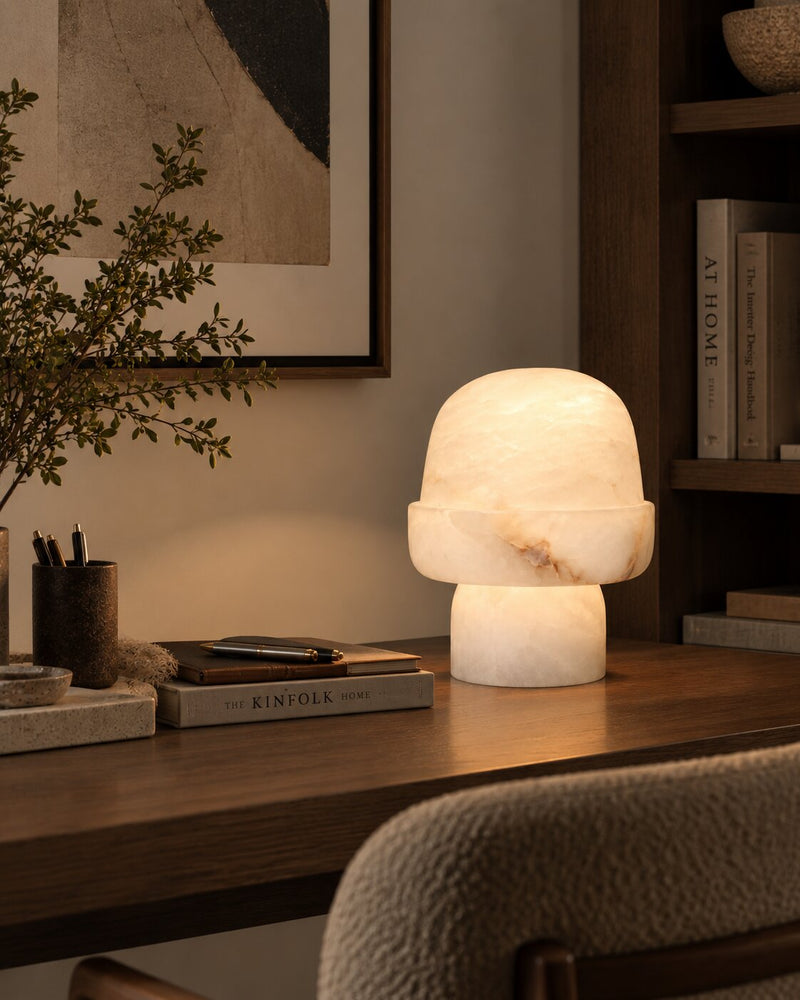
Interior lights for the home do not work alone: the same fixture looks brighter against pale matte walls and dimmer against dark wood or deep paint. Glossy floors add reflections, and afternoon sun can make a lamp look weak. Teeshaa alabaster lighting gives a diffused glow that softens reflections. Decide finishes and lights together, before the false ceiling closes.
Apart from the fixture itself, what you see in a room is the light its walls, ceiling, floor and furniture send back.
Pale, matte surfaces scatter light in all directions and keep the room even. Dark surfaces absorb it, so the same output feels dimmer. Glossy surfaces do not scatter much. They mirror, which is why a bare bulb can appear twice. These are principles, not a lighting calculation, and a large project still benefits from a lighting consultant. For the basic roles of ambient, accent and task light, see how to layer lighting around an alabaster fixture.
This table rates common Indian finishes in words, not measured figures.
| finish | light returned | glare or reflection risk | what to do |
|---|---|---|---|
| White or off-white matte wall | High | Low | One central piece goes further; add lamps for depth |
| Dark accent wall (green, navy, charcoal) | Low | Low | Add a wall light or table lamp near it; keep the ceiling pale |
| Glossy vitrified tile or polished marble floor | High if pale, low if dark | High from bare sources | Prefer a diffused piece; check the floor reflection from seat height |
| Wood or matte stone floor | Low if dark, medium to high if pale | Low | If dark, allow more sources at lower height |
| Mirror or glass partition | Mirror: high, as an image. Clear glass: low, but shows an image after dark | High if a bare source is visible | Place so the reflection adds depth and no bare bulb shows in the glass |
| Dark wood or dark painted ceiling or cove | Low | Low | Do not rely on cove uplight; let a hung piece and lamps do more |
Light-coloured matte walls and ceilings bounce light and make a glowing piece feel brighter. Dark walls swallow it, so they need more sources or closer ones.
In a room with white or off-white walls, a single chandelier or pendant goes further, because the ceiling and walls pass the glow around, though other layers are still needed. In a room with a deep green, navy or charcoal accent wall, that wall will look dark whatever hangs in the centre. Add a wall light or a table lamp near it, and keep the ceiling pale if you can.
A dark wood or dark painted ceiling absorbs the uplight from a cove, so a hung piece and lamps have to do more.
They reflect it. A glossy vitrified tile or polished marble floor can show a bare source as a second, sharp image, while a diffused piece reads as a soft pool of light instead.
Mirrors and glass partitions double a fixture visually. That can help: a pendant reflected in a hall mirror makes the space feel deeper. Place the lamp so the reflection helps, and so no bare bulb or bright spot shows in the glass from a normal seated or standing position. Matte floors give no sharp mirror image. How much light a floor returns depends mainly on how pale it is, not how polished, so dark wood returns little and pale matte stone returns more.
Daylight decides when the lamps start to matter. West-facing rooms are often harsh in the late afternoon, and warm light looks weak against that sun. East and north rooms get softer daylight in the afternoon and need the lamps sooner.
Do not judge a lamp in a west-facing room at that hour. Look at it at dusk, when the room depends on it. Plan dimming for both kinds of room, so the output follows the day. Teeshaa offers dimming on request, so confirm it for the piece you choose. For colour temperature itself, read colour temperature for alabaster lighting.
2700K reads as a soft warm white on white walls and deepens on teak and terracotta. On grey stone it softens the cool tone.
A very warm-toned interior, with teak, rosewood or terracotta, can feel heavy under 2700K. There, 3000K may suit where the piece offers it. Test a sample of your own wood, tile or paint under the colour temperature you plan to use. The warm lighting by room guide covers keeping one warmth from room to room.
Decide them together, before the false ceiling is closed. A cove often takes 20 to 30 cm of height, which shortens the drop available to a hung piece.
For a whole house, see the villa room-by-room lighting plan. A licensed electrician should carry out any wiring. You may use your own electrician to install a Teeshaa piece, but then the installation cannot be guaranteed: the one-year warranty does not cover damage caused by an installation done by anyone other than Teeshaa's team.
Teeshaa makes sculptural lighting in Spanish alabaster. The stone is naturally translucent, so it glows rather than showing a bare point of light, and in a glossy floor or a mirror that glow reads as a softer reflection.
For a pale room with a glossy floor, the Halo Crown Chandelier gives a central glow (the 60 cm size is ready to order and larger rings are on enquiry), and the Alabaster Linea Pendant, a narrow alabaster column, gives a smaller one. On or beside a dark wall, or in a corner, the Essenzo Dome Wall Sconce and the Essenzo Porcini Table Lamp add light close to the dark surface.
Alabaster is not a task light, so pair it with discreet downlights where you read or cook. Teeshaa does not supply downlights, cove lights or loose LED strips, and it does not make flush ceiling fittings. If the room needs a flush fitting or a piece in another material, Teeshaa Design Labs develops lighting in wood, metal, stone, crystal and glass to a brief, including one-off pieces. Share a drawing or a reference through the Design Labs page and the team confirms what is possible.
See the alabaster lighting hub for the range. Teeshaa's design studio and workshop is in Bangalore, open by appointment through the contact page. It is not a showroom, and there is no showroom in any other city.
Because most of what you see is light the room sends back to your eyes. Pale matte walls return most of it, dark walls and dark wood absorb it, and glossy floors add reflections. Daylight and the warmth of the lamp change the picture again.
Decide them together, before the false ceiling is closed. Finishes decide how much light comes back and where reflections fall, while the lighting plan decides where the sources and wiring points go. A cove often takes 20 to 30 cm of ceiling height, so plan it early.
Usually they need more sources or closer ones, not simply a stronger single light. A dark wall absorbs much of what lands on it, so the room feels dimmer than the fixture suggests. Add wall lights or table lamps near the dark surface.
A bare, bright point source can show up as a sharp second image in polished tile or marble. A diffused piece, where the whole surface glows, reads as a softer pool instead. Teeshaa's alabaster pieces glow through the stone, so the reflection reads softer than that of a bare source.
2700K is a sound starting point and is what most Teeshaa pieces use. In a very warm-toned interior, with teak, terracotta and cream walls, the room can feel heavy under 2700K in the evening. Some pieces offer 3000K, so ask the studio whether the piece you like does, and test a sample of your own wood or paint under both.
Last updated 6 November 2026.
 A Lighting Plan for a Villa, Room by RoomVilla lighting room by room: double-height volumes, stairwells, dining, bedrooms, corridors and verandas, with height...Read the guide
 Wall Sconce Height and Placement: Bedside, Corridor, MirrorMounting heights for wall sconces by location, with a table, corridor spacing, when to use pairs, how to switch and d...Read the guide
 Chandelier Size Guide for Indian Living RoomsThe length-plus-width rule for Indian room sizes, how low a chandelier can hang under 2.7 m, sharing a ceiling with a...Read the guide
Send the studio the room size, ceiling height and finishes when you enquire about a piece.