Your cart
(0)
Made to order · dispatched by 24 December

By commission
TeeshaaAll Lighting
who plans, who specifies and who installs your lighting, and when a home actually needs a lighting consultant.
A lighting consultant plans how light behaves across a whole space: the layers, positions, output and controls. An interior designer fits that into the room's look, a maker such as Teeshaa supplies the decorative fixtures, and a licensed electrician installs it. Teeshaa is a fixture studio, not a lighting consultancy.
Lighting design can mean the profession, the layer built into the ceiling and walls, or the fixtures you see. If you are asking who to hire, you need the first meaning. If you are asking what to buy, you need the third.
Each role answers a different question and hands over a different deliverable. The table maps the question you have to the person who answers it.
| Your question | Who answers it | What they typically deliver |
|---|---|---|
| How high is the ceiling, and where can things hang? | Architect or structural advisor | Plans, sections, ceiling heights and slab details |
| What should the room look and feel like? | Interior designer | Layout, finishes, furniture, fixture choices and a coordinated scheme |
| How should light be layered, switched and dimmed? | Lighting consultant (or the interior designer on smaller jobs) | A lighting layout, fixture schedule and control scheme |
| Which decorative piece, in what size and finish? | Fixture maker, with the designer | The piece, dimensions, finishes and lead time; some makers, including Teeshaa for trade members on an active project, also provide samples on request |
| Where do the wires, circuits and drivers go? | Licensed electrician | Wiring, installation and testing on site |
These roles overlap, so make sure someone owns each decision.
Often not. A standard flat is well served by a clear scheme and a good interior designer. A lighting consultant earns the fee on double-height voids, large villas and hospitality spaces.
| Project | Who to involve | Why |
|---|---|---|
| A 2BHK or 3BHK flat with standard ceilings | Interior designer and electrician; a consultant is optional | A simple scheme of focal pieces and downlights covers most needs |
| A flat with a double-height living room | Interior designer, plus a consultant if the void is large | Scale, access to the fixture and sightlines from the upper floor all matter. See lighting a double-height space |
| A large villa or multi-storey home | Lighting consultant, interior designer and electrician | Many zones, circuits and control scenes are easier to coordinate with a specialist. See villa lighting |
You can plan a sound home lighting scheme yourself with three layers: ambient, accent and task. Choose one warm colour temperature for the whole home, and decide the focal pieces before the ceiling is closed.
Our guide to planning lighting for a new apartment in India walks through this room by room.
Before the false ceiling is built and before the electrical first fix. After that, moving a point means opening finished work.
Height is the other reason. A false-ceiling cove often takes 20 to 30 cm, and apartment ceilings are commonly 2.7 to 3.0 m. Measure the finished ceiling, not the slab, because the net height decides how far a fixture can drop. A hung chandelier also needs support that reaches the structural slab, not the false-ceiling board. A licensed electrician or structural advisor should confirm the fixing. See installing an alabaster chandelier on a false ceiling.
A typical sequence when working with an interior designer:
Bring the finished ceiling heights, floor plans, furniture layout, fan positions and finish palette.
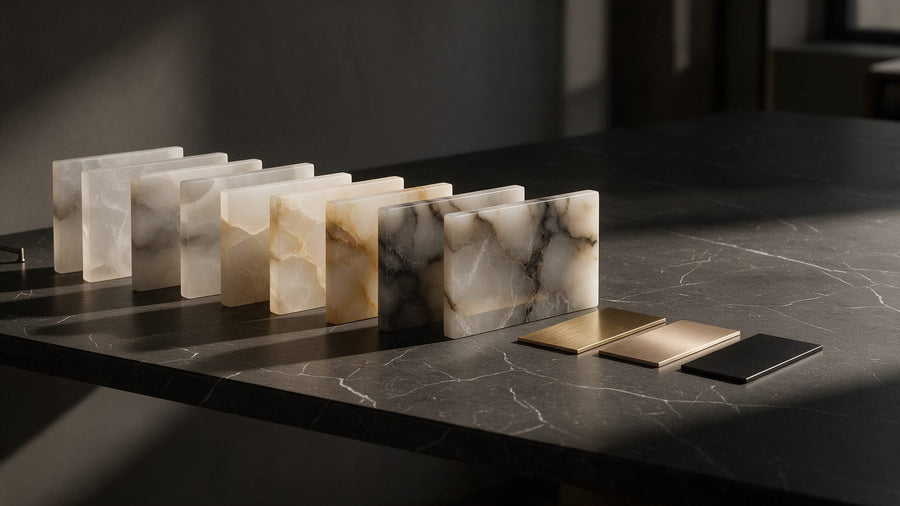
A maker fits in as the source of the decorative layer in the designer's drawings. Before an order, a maker should help resolve scale, drop, sightlines, output, suspension and access. Through the Teeshaa trade programme, approved professionals can request technical drawings, dimensions, weights, finishes, lead times, electrical information and alabaster or finish samples against an active project. With those details, a consultant can draw the architectural layer around the piece, keeping downlights and coves clear of its drop and suspension point.
| What Teeshaa does | What Teeshaa does not do |
|---|---|
| Designs and makes decorative alabaster fixtures | Act as a lighting consultancy |
| Advises on its own pieces for your space; ask the studio what review it offers | Provide room lighting-design services or lighting calculations |
| Supports professionals through the trade programme | Replace structural advice on your ceiling |
| Develops original commissions through bespoke | Supply the downlights and strips around the piece |
Teeshaa is the decorative layer. The studio and workshop are in Bangalore, visits are by appointment, and there is no showroom. Teeshaa's lights are made in Spanish alabaster and built in its own facilities in India.
Ready-to-order pieces such as the Alabaster Linea Pendant or the Totem Table Lamp suit a scheme you plan yourself. The Halo Crown Chandelier mixes ready-to-order and enquiry sizes, and the Aura Wall Mount is an option where a hung piece will not fit. Your consultant or designer can specify any of them, and you can ask the studio about fit. Start from the alabaster lighting hub, or see specifying decorative lighting for residential projects if you are a professional. Installation is by your own licensed electrician or, on request, Teeshaa's team: ask the studio. Teeshaa's one-year warranty against manufacturing defects does not cover damage caused by an installation done by anyone other than Teeshaa's team. You may use your own electrician, but then the installation cannot be guaranteed.
Usually not. A 2BHK or similar flat is generally well served by a clear scheme: a few well-placed focal fixtures, discreet downlights for tasks, and one warm colour temperature throughout. A lighting consultant earns the fee when ceilings are tall, plans are complex or the space is large. Decide before the false ceiling is built.
An interior designer shapes the whole room: layout, furniture, finishes and the choice of fixtures. A lighting consultant specialises in light itself: layers, positions, output, control and a fixture schedule. On some homes the interior designer covers both. On larger or more complex jobs a consultant works alongside them.
Not usually, and Teeshaa does not. Teeshaa is a fixture design studio and maker, not a lighting consultancy. It does not offer room lighting-design services or lighting calculations. For its own pieces in your space, ask the studio what review of scale, drop, sightlines, suspension and access it can offer.
A lighting design studio is a practice that plans light for buildings: where light falls, how bright it is, what controls it and which fixtures deliver it. Some work on architecture and hospitality, some on homes. It is separate from a fixture maker, which designs and builds the pieces that hang or stand in the room.
Models vary, and fees are agreed with each practice, so ask for the structure in writing. Common approaches include a fixed fee for a defined scope, a fee tied to the size or value of the project, an hourly or daily rate for reviews, or a stage-by-stage fee. Ask what drawings and schedules each stage includes.
Last updated 6 November 2026.
 Lighting a Double-Height Space: Stairwells, Voids and Tall Living RoomsDouble-height lighting is proportion, not brightness: a vertical composition read from two levels, 2.1 m clear over t...Read the guide
 A Lighting Plan for a Villa, Room by RoomVilla lighting room by room: double-height volumes, stairwells, dining, bedrooms, corridors and verandas, with height...Read the guide
 Specifying Alabaster Lighting for Hotels: Lobbies, Corridors and Guest RoomsA specifier's guide to alabaster in hotels: zone by zone, how variation is matched across many rooms, the spec checkl...Read the guide
Share your plans and ceiling heights with the studio, or apply to the trade programme for technical information.